
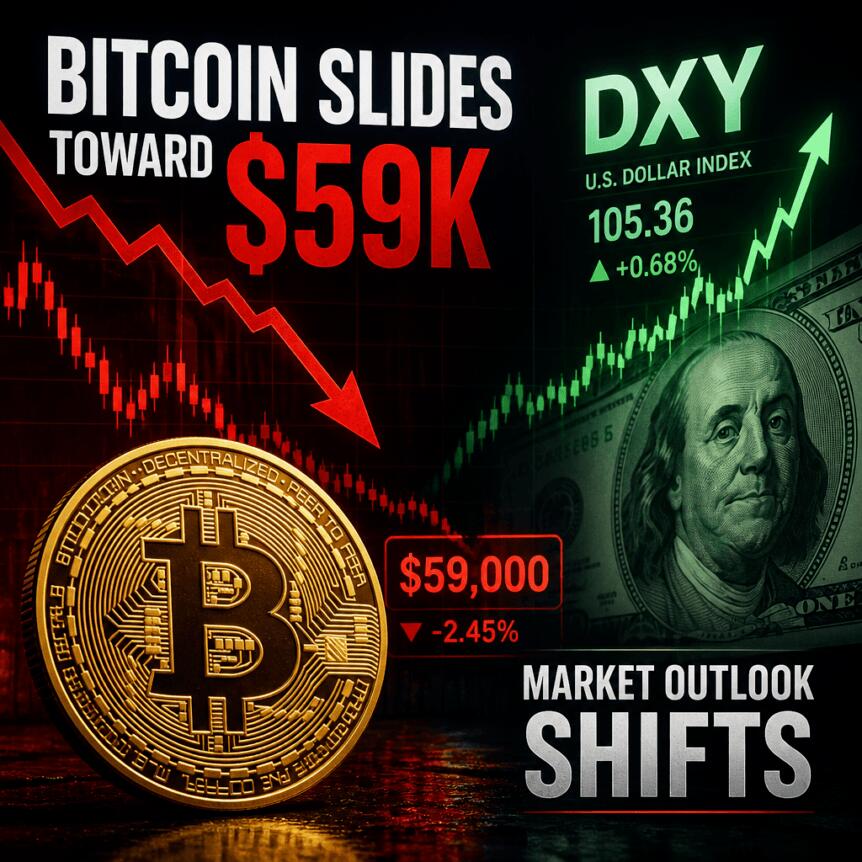
Bitcoin slipped to around $59,060 on Wednesday as investors rotated away from assets that typically thrive when inflation fears and weaker dollar momentum are in play. The move came alongside a sharp cooldown in oil prices and a multi-month high for the US dollar, both of which tend to tighten financial conditions for non-yielding investments like BTC.
Macro read-throughs were reinforced by updated market data: the dollar strengthened to its highest level against a basket of foreign currencies in 13 months, while gold prices fell below $4,000 for the first time in seven months as Brent crude slid below $74. For traders, the combination raised concerns that any quick bounce back toward the $60,000 area may face renewed pressure.
Key takeaways
- A stronger US dollar and lower oil prices increased headwinds for Bitcoin, which often trades like a non-yielding asset during risk and rate repricing cycles.
- Spot Bitcoin ETF flows remained a drag, with outflows continuing to weigh on near-term sentiment.
- Strategy’s latest purchasing pace slowed to its lowest weekly intake in 18 months, suggesting weaker institutional accumulation signals.
- US data and monetary expansion underline why investors may still expect higher-for-longer interest rates, which generally favors fixed income over scarce, non-yielding assets.
Dollar strength and easing inflation expectations
Bitcoin’s decline on Wednesday was attributed to shifting macro dynamics rather than idiosyncratic crypto news. A memorandum of understanding between the US and Iran, reported as temporarily reopening the Strait of Hormuz, helped oil prices retreat quickly. With crude moving lower, traders appeared to scale back near-term inflation anxiety—an environment in which Bitcoin has often struggled when rate expectations firm up.
At the same time, the US dollar’s rebound was notable. According to TradingView’s BTCUSD chart alongside the US dollar strength index, the currency moved to a 13-month high versus a basket of foreign currencies. Historically, that kind of move can be a tailwind for the dollar and a headwind for Bitcoin, particularly when investors treat BTC as an inflation-sensitive alternative rather than a pure risk-on asset.
Gold’s performance mirrored the broader commodities and inflation narrative. The article notes that gold dropped under $4,000 for the first time in seven months as Brent crude approached pre-conflict levels near $74. The implication for BTC traders is straightforward: if investors believe scarcity-linked “inflation hedges” are losing urgency, demand for Bitcoin can soften as well.
Rates stay “higher for longer” as US data counters slowdown
Beyond commodities, the piece points to a US economic backdrop that still does not look like a decisive cooling trend. It cites Labor Department data indicating unemployment benefit claims fell by 4,000 from the prior week, supporting the view that the economy is not yet slowing sharply.
In this framework, easing inflation will take time to reach the Federal Reserve’s 2% target. As a result, traders may keep pricing interest rates higher for longer—conditions that typically raise the opportunity cost of holding non-yielding assets. The article also references an increase in the US monetary base (M2), which rose to $23.05 trillion in May from $22.8 trillion the month before, per Fed St. Louis data.
That monetary expansion matters for the broader liquidity picture, but the article highlights a key nuance: even if there is no immediate one-to-one relationship between liquidity measures and Bitcoin price, the shift toward higher fixed-income demand can eventually dampen flows into alternatives. For now, the tech sector remains the dominant place for investors’ capital, which can further weaken the “scarce alternative” narrative that often supports Bitcoin during periods of uncertainty.
Strategy’s slower buying and ETF outflows weigh on sentiment
While macro forces set the backdrop, the article also points to crypto-native flow dynamics. It notes that spot Bitcoin ETF outflows have persisted, adding incremental selling pressure and limiting the market’s ability to sustain rallies.
In addition, Strategy’s acquisition pace appears to have slowed. The article states that the company added 520 BTC during the week ending June 21—its lowest weekly intake in 18 months. That matters because Strategy (led by Michael Saylor) has frequently been treated as a bellwether for corporate Bitcoin demand. A reduction in pace can be read as either a pause to manage treasury considerations or a shift in how capital is deployed.
The piece further adds that $300 million of net proceeds from MSTR’s stock issuance during the period were used to replenish its cash position, citing earlier coverage on Cointelegraph about dividend coverage falling and cryptoquant’s analysis. Taken together, the slower BTC purchases and cash management choice likely contributed to weaker market sentiment around near-term demand.
At the same time, the article notes that Strategy’s stock trades below its Bitcoin reserve acquisition cost, pointing to a mismatch that may affect how investors interpret the efficiency of the company’s Bitcoin exposure. If equity remains under pressure relative to reserve economics, it can reduce the confidence of traders watching Strategy as a proxy for institutional accumulation.
What to watch next for BTC around $59,000–$60,000
The article concludes that Bitcoin’s negative performance on Wednesday reflects a combination of macro pressures—stronger dollar, softer oil and gold—and crypto market positioning, including spot ETF outflows and the more cautious tone implied by Strategy’s reduced weekly buying. With BTC sitting near the $59,000 level, it argues that additional downside should not be dismissed.
For investors and traders, the next signals likely include whether the dollar continues to strengthen or reverses, as well as whether ETF flow data stabilizes. Corporate accumulation pace will also remain a key variable: any re-acceleration from Strategy, or continued moderation, could materially change how the market prices near-term demand for spot Bitcoin.
https://www.cryptobreaking.com/bitcoin-slides-toward-59k-as/?utm_source=blogger%20&utm_medium=social_auto&utm_campaign=Bitcoin%20Slides%20Toward%20$59K%20as%20DXY%20Strengthens—Market%20Outlook%20Shifts%20
Comments
Post a Comment