
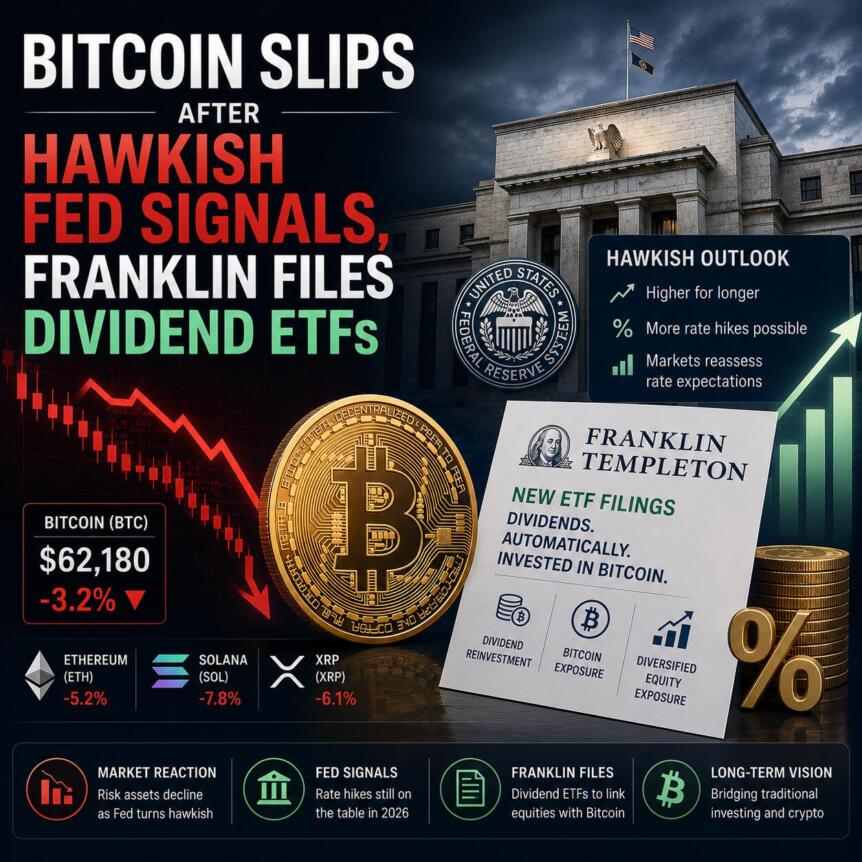
Bitcoin retreated last week after the US Federal Reserve delivered a message market participants interpreted as more hawkish than expected. The move came alongside a fresh exchange-traded fund filing from Franklin Templeton that, if approved, would create a new mechanism for converting certain equity dividends into bitcoin-linked exposure on an automated, rules-based basis.
While price action remained volatile, the juxtaposition of tighter financial expectations and incremental progress in mainstream-style bitcoin access highlighted the market’s current fault line: macroeconomic expectations are driving near-term risk appetite, even as financial products continue to evolve.
Fed outlook shifts, bitcoin slides
According to eToro analysis cited in the latest market note, bitcoin fell to $62,180 after the most recent Federal Open Market Committee meeting and a press conference by the newly installed Fed chair, Kevin Warsh. The update described pressure across major crypto markets, with ether, Solana and XRP down between roughly 5% and 10% over the week.
The Federal Reserve kept interest rates unchanged, but investors focused on updated dot-plot projections that suggested higher chances of rate hikes than markets had priced. In the framing provided by eToro’s crypto analyst Simon Peters, nine policymakers projected at least one rate increase during the year, while six indicated that multiple hikes were still possible.
That combination, even without an immediate rate move, is often enough to change how investors discount future growth and risk. In crypto, where liquidity conditions and leverage can matter quickly, repricing of rates expectations typically translates into short-term downside momentum.
What markets are watching next
Attention is now shifting to upcoming US inflation data, specifically Personal Consumption Expenditures, or PCE. eToro’s note highlighted that the market outlook may hinge on whether inflation remains above target or cools further. If inflation stays elevated, investors may take the Fed’s more hawkish projections more seriously. If inflation continues to cool, markets may interpret the dot-plot as overly pessimistic and scale back expectations for rate hikes.
The same update also pointed to other elements that can influence the macro-to-crypto transmission, including recent oil price declines and easing geopolitical tensions in parts of the Middle East. Those factors can affect broader risk sentiment and US dollar dynamics, both of which are commonly referenced by market participants when explaining crypto volatility.
Franklin Templeton files “Bitcoin DRIP” ETF proposals
Alongside the macro-driven price pullback, a separate development in financial product design moved attention back to institutional pathways for bitcoin exposure. Franklin Templeton filed with the US Securities and Exchange Commission for two new ETFs described as “Bitcoin DRIP” products. The concept is straightforward in structure, but notable in how it ties bitcoin accumulation to an equity income stream.
As outlined in the eToro briefing, the proposal would reinvest stock dividends automatically into bitcoin-linked exposure rather than sending dividends back to investors as cash. In effect, the mechanism is intended to convert a traditionally equity-based benefit, dividends, into a systematic way to add bitcoin exposure over time.
How the proposed ETFs would work
The filing covers two separate index-based funds:
- Franklin US Equity Bitcoin DRIP Index ETF, which would track the 500 largest US-listed companies by market capitalization.
- Franklin US Innovation Bitcoin DRIP Index ETF, which would focus on 100 major non-financial companies listed on the Nasdaq.
The briefing indicated an expected initial allocation of about 95% to equities and 5% to bitcoin-linked investments, including exposure to spot bitcoin ETFs. The bitcoin component would be increased gradually through the automated reinvestment of dividends.
It is important to note that an SEC filing does not guarantee approval, and proposed structures can change during the review process. Still, the direction of travel is clear: issuers are experimenting with ways to broaden access and systematize bitcoin buying beyond direct spot purchases.
Why this matters for market access
Institutional adoption of bitcoin exposure in US markets has largely progressed through established ETF frameworks. The dividend reinvestment concept adds a different behavioral lever, potentially appealing to investors who already allocate capital to equity indices and dividends. Instead of requiring additional decisions about when to buy bitcoin, the process would be embedded in the fund’s mechanics.
In the eToro note, Peters described the potential value of this approach as creating a “bridge” between traditional equity investing and systematic bitcoin accumulation through automation. For crypto markets, product innovation of this type can influence expectations around demand stability, even if it does not immediately change spot price levels.
Weekly movers highlight pockets of crypto-specific catalysts
While macro headlines dominated attention, the update also pointed to crypto-native drivers in select assets. Aerodrome Finance’s native token, AERO, was identified as one of the week’s strongest performers, rising about 35% and returning toward levels last seen in mid-May.
The rally was attributed to a major protocol upgrade that replaces a weekly gauge-voting mechanism with real-time liquidity incentive allocation. The note also referenced additional support from token buybacks by the Aerodrome Foundation and increased accumulation by larger holders.
These details underscore a consistent pattern in crypto markets: even when rates expectations steer broad sentiment, individual protocols can generate idiosyncratic catalysts that move prices independently of bitcoin’s direction.
Bottom line
Bitcoin’s pullback reflects a common cycle where changes in interest-rate expectations can quickly tighten risk conditions for high-volatility assets. At the same time, Franklin Templeton’s proposed dividend-to-bitcoin ETF structure signals continued efforts to integrate bitcoin exposure into mainstream investment habits, potentially widening the pool of participants over time.
For now, traders appear to be balancing near-term macro sensitivity with longer-term product developments, with upcoming inflation data expected to play a central role in determining whether the market’s hawkish interpretation of the Fed gains further traction.
Note: This report is based on information provided in an eToro market update and is for informational purposes only, not investment advice.
https://www.cryptobreaking.com/bitcoin-pulls-back-hawkish-fed/?utm_source=blogger%20&utm_medium=social_auto&utm_campaign=Bitcoin%20slips%20after%20hawkish%20Fed%20signals,%20Franklin%20files%20dividend%20ETFs%20
Comments
Post a Comment