
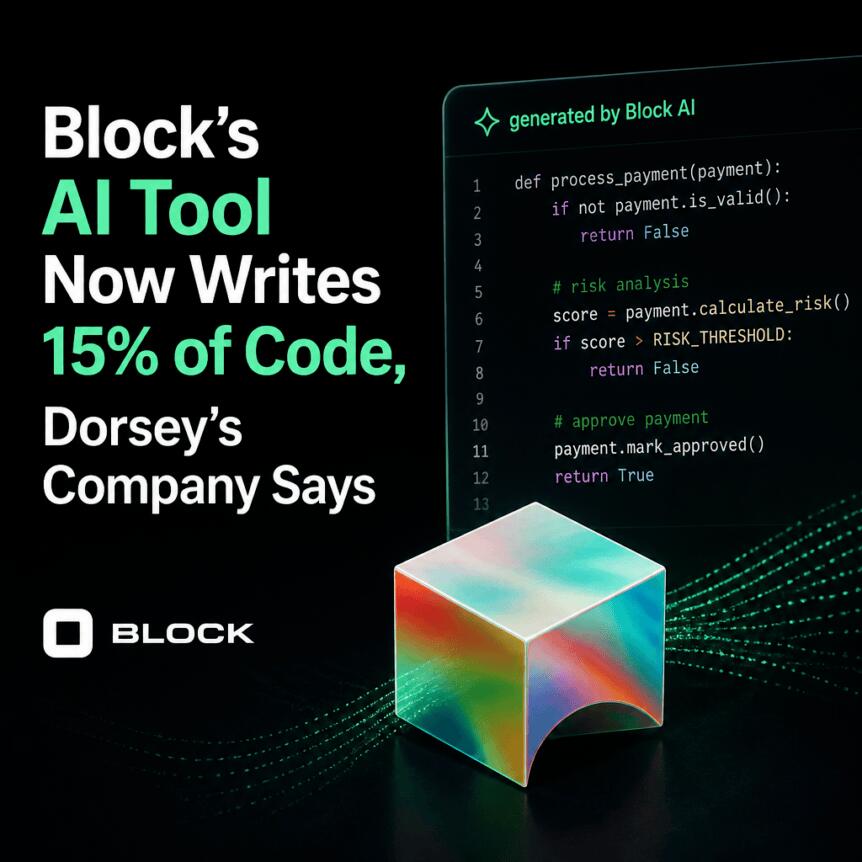
Block, the financial services company led by Jack Dorsey, says it has launched “Builderbot,” an AI-native set of engineering tools designed to handle a meaningful portion of production software changes. The company claims the system can carry out roughly 15% of all production code changes at Block, positioning the rollout as a step beyond traditional AI coding assistants.
In describing Builderbot, Block frames the development as a practical shift: AI systems are moving from suggesting code to coordinating work that can be merged and shipped, while engineers retain responsibility for higher-level judgment and product decisions. Block also linked the announcement to its broader AI push that coincided with a major workforce reduction earlier this year.
Key takeaways
- Block says Builderbot can execute around 15% of its production code changes, turning AI from “assistive” into “operational” in day-to-day engineering.
- The company estimates Builderbot performs over 200,000 operations per day and merges about 1,500 pull requests per week.
- Builderbot is presented as an orchestration layer that coordinates multiple AI agents across Block’s full codebase rather than a single repository.
- Block attributes faster delivery—moving items from backlog to live—on the order of days rather than months, with humans still focused on key decisions.
- The rollout adds new context to Block’s February decision to cut about 40% of staff, which Dorsey said was driven by accelerating AI adoption.
Builderbot aims to bridge AI coding and real engineering
Block introduced Builderbot as a “missing layer” between AI coding tools and how software teams actually operate at scale, according to Brad Axen, head of AI capabilities at the company. Block’s internal metrics, as presented in its announcement, suggest the system is not limited to drafting snippets or generating isolated changes.
Axen said that tasks that previously took months could be completed in days with Builderbot, reflecting an emphasis on throughput and execution speed rather than experimentation alone. The company also claims Builderbot can perform more than 200,000 operations per day and merges approximately 1,500 pull requests per week, figures intended to show tangible productivity impact.
For investors and builders watching AI deployment, the key question is whether these systems can reliably translate intent into production-ready code—without overwhelming reviewers or compromising quality. Block’s decision to describe measurable operational metrics suggests it is aiming to make the case that AI-generated work can fit existing engineering workflows, including review and merging processes.
An orchestration approach across Block’s entire codebase
A central feature of the system, Block says, is that Builderbot understands the broader environment in which software runs. The company describes Builderbot as an orchestration layer that coordinates multiple AI agents across its full codebase—covering services, APIs, and internal conventions—rather than restricting agents to a single repository.
Block contrasts this with the typical approach of coding assistants that operate within one codebase boundary. In its example, an engineer working on Cash App could use Builderbot to make changes in a Square service they have never worked on, because the system allegedly already knows how that service is built and how it fits into Block’s overall architecture.
This matters because production scaling isn’t only about generating more code; it is about making changes that are consistent with system rules, dependencies, and deployment practices. If Builderbot genuinely has awareness of cross-service relationships, it could reduce the “handoff friction” that often slows teams down when changes span multiple systems.
Block adds that the practical outcome is faster iteration: an idea can move from backlog to being available to “millions of customers” in days instead of months, while engineers focus on judgment and product taste rather than repetitive scaffolding.
AI acceleration and workforce restructuring context
Block’s announcement does not arrive in isolation. The company also connected Builderbot to its earlier restructuring, noting that its February layoffs—40% of staff—were attributed by Jack Dorsey to the rapid acceleration of AI at Block.
That linkage highlights a tension that many companies in this space are grappling with: faster engineering cycles can reduce certain forms of manual work, even as firms argue that human roles shift toward oversight, product direction, and quality decisions. Block’s description of engineers remaining responsible for judgment and taste suggests it is positioning Builderbot as augmentation rather than a complete replacement.
Still, the practical question for employees and outside observers remains how responsibilities are redistributed. Metrics like merged pull requests and daily operations can indicate scale, but they don’t alone reveal how the human workload changes—whether review becomes faster, whether engineers spend more time on higher-level design, or whether roles are reduced in practice.
The broader shift toward AI-written code at major tech firms
Block is not the only company exploring AI agents for software development. Other large organizations have publicly discussed how automation is affecting coding and engineering output.
Earlier reporting highlighted that Spotify engineers have used a background coding agent called Honk, which runs a version of a Claude model through Anthropic’s Agent SDK. Separately, Spotify Co-CEO Gustav Söderström said on a February earnings call that the best developers “have not written a single line of code since December,” underscoring how far the conversation has shifted from assistance to execution.
At Google, CEO Sundar Pichai said in April that three-quarters of new code is AI-generated, pointing to a scale where AI output is shaping day-to-day development. Microsoft’s Satya Nadella also described, in 2025, that the company uses AI to write between 20% and 30% of code powering its software, again positioning AI as a meaningful part of the production process rather than a side tool.
Taken together, these examples place Block’s Builderbot announcement in a larger trend: CEOs and engineering leaders are increasingly measuring AI productivity in terms of code volume and delivery timelines. For the crypto industry, this matters indirectly—many crypto projects rely on fast-moving engineering teams, and the same automation patterns could influence how quickly core infrastructure is iterated, audited, and updated.
For readers tracking this space, the next signals to watch are whether systems like Builderbot can maintain reliability as they scale, how quality controls evolve with higher AI throughput, and whether other companies follow Block’s lead in publishing comparable operational metrics rather than only high-level claims.
https://www.cryptobreaking.com/blocks-ai-tool-now-writes/?utm_source=blogger%20&utm_medium=social_auto&utm_campaign=Block’s%20AI%20Tool%20Now%20Writes%2015%%20of%20Code,%20Dorsey’s%20Company%20Says%20
Comments
Post a Comment