
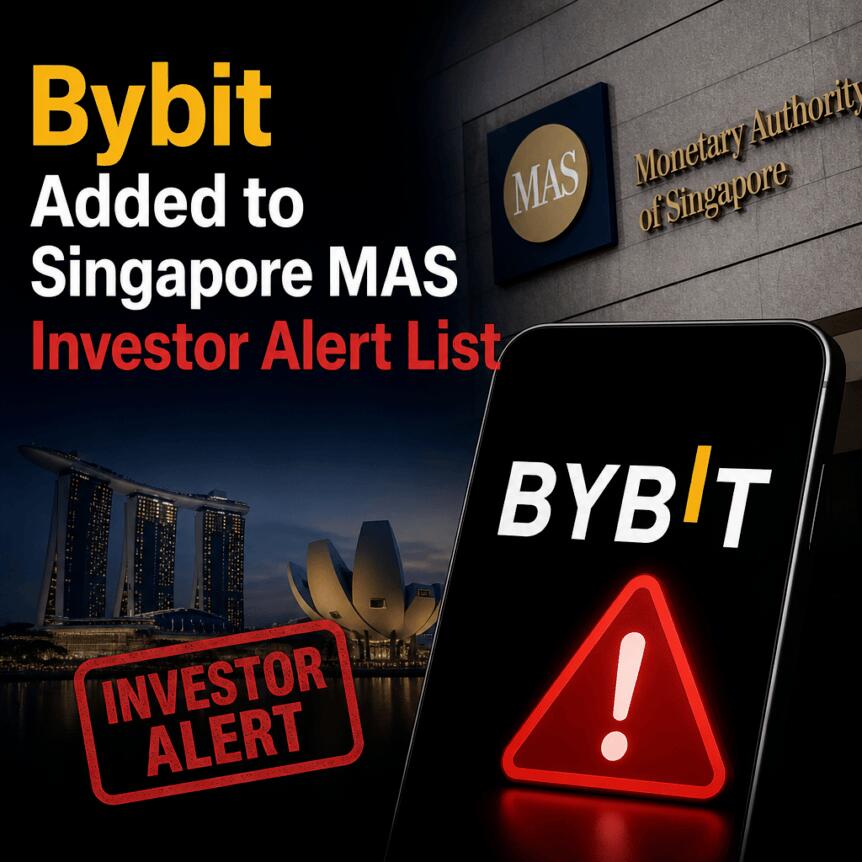
Singapore’s financial regulator has added Bybit to the Monetary Authority of Singapore’s (MAS) Investor Alert List, a move that highlights how strictly the city-state polices the boundary between legitimate oversight and consumer misunderstandings about crypto firms’ regulatory status.
MAS listed Bybit Fintech Limited and “Bybit” on the Investor Alert List on Wednesday. The regulator did not publicly state a specific reason for the entries, but it said the list is intended to warn consumers about entities and investment offers that could be wrongly perceived as licensed, authorised, regulated, or registered by MAS—or as having received MAS approval when they have not.
Key takeaways
- Bybit Fintech Limited and Bybit were added to MAS’s Investor Alert List on Wednesday.
- MAS did not provide a specific explanation for why the exchange appears on the list.
- MAS describes the alert list as a consumer-protection tool aimed at preventing misconceptions of regulatory approval.
- Cointelegraph reports that Bybit is not licensed or regulated by MAS, based on publicly available information.
- Singapore continues to tighten enforcement against crypto-related compliance failures, including licensing actions and fraud-related charges.
What the MAS Investor Alert List signals
MAS’s Investor Alert List focuses on preventing consumer confusion. According to the regulator, the list identifies entities and investment offers that may create a false impression that MAS has licensed, authorised, regulated, or registered them, or that their investment offerings were approved by MAS.
In the case of Bybit, MAS did not specify the grounds for inclusion. For users, the practical takeaway is straightforward: appearing on the alert list is a public caution that does not equal MAS oversight, and it may reflect concerns about how consumers could interpret the firm’s status.
Cointelegraph attempted to seek clarification from Bybit, but a spokesperson did not respond by the time the article was published. MAS likewise did not disclose a particular justification for the additions.
Bybit’s Singapore access restrictions
While Bybit’s corporate founder Ben Zhou is Singaporean, the exchange does not operate in Singapore. The company’s own materials indicate that Singapore is included among the “Service Restricted Countries” on its website, meaning users in the jurisdiction are not permitted to access its services.
The MAS listing therefore aligns with what the exchange’s public terms imply: Singapore residents should not treat Bybit as a locally operating, MAS-authorised platform.
Cointelegraph also notes that, based on publicly available information, Bybit is not licensed or regulated by MAS.
Singapore’s broader approach to crypto oversight
MAS’s action against Bybit comes amid a sustained pattern of scrutiny in Singapore’s crypto sector. The country has positioned itself as a major blockchain hub, and Chainalysis’ 2025 Global Crypto Adoption Index ranked Singapore among the top jurisdictions for both decentralised finance and institutional digital asset services. However, the same index showed retail crypto adoption ranking lower than those institutional and DeFi-related categories.
That contrast helps explain why Singapore has continued to apply enforcement that can be especially consequential for consumer-facing businesses. In May, MAS revoked the Major Payment Institution license of crypto liquidity provider Bsquared Technology, citing serious regulatory breaches. MAS said the firm’s issues included weaknesses in risk management and conflict-of-interest policies, and it also accused the company of providing false or misleading information during both its initial license application and a later inspection.
Singapore law enforcement has also pursued alleged misconduct in the crypto lending space. Separately in May, the police charged former Hodlnaut CEO Zhu Juntao with six counts of fraud for allegedly misleading customers about the company’s exposure to the 2022 Terra ecosystem collapse. Hodlnaut, which at one point served tens of thousands of users, suspended withdrawals in August 2022 after Terra’s collapse and was later ordered to liquidate.
Investor alerts as a recurring tool
MAS has used the Investor Alert List more than once in the past. The regulator placed Binance.com on the list in 2021, according to reporting by The Straits Times. However, Cointelegraph reports that a search of the list on Wednesday did not show Binance among 910 records in the query it used.
The Bybit entry therefore reinforces the idea that MAS’s consumer-warning mechanism remains active, even as the list’s contents can change over time. For investors, the most useful habit is to verify both the platform’s access status and its regulatory position, rather than relying on marketing claims or assumptions that a well-known brand operating in the broader region automatically carries Singapore authorisation.
With Bybit now on MAS’s Investor Alert List, users and counterparties should watch for any further regulatory updates or clarifications from MAS—particularly whether the regulator expands on the specific compliance concerns behind the listing and how Bybit responds publicly.
https://www.cryptobreaking.com/bybit-added-to-singapore-mas/?utm_source=blogger%20&utm_medium=social_auto&utm_campaign=Bybit%20Added%20to%20Singapore%20MAS%20Investor%20Alert%20List%20
Comments
Post a Comment