
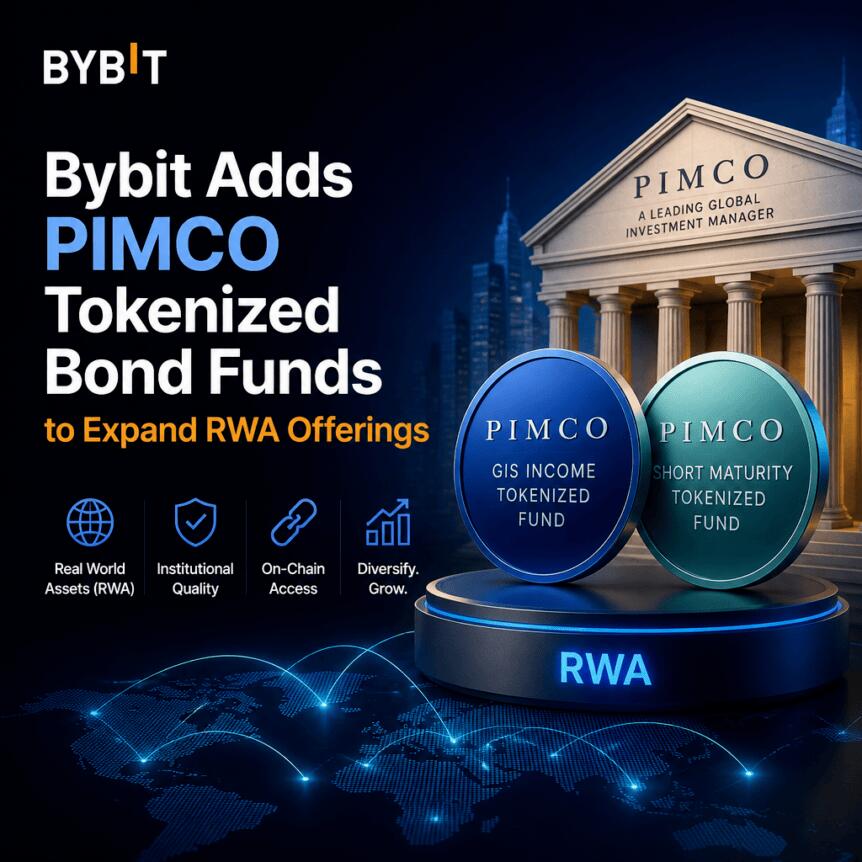
Bybit is rolling out a new real-world assets (RWA) offering that extends its push beyond tokenized Treasuries into tokenized bond funds from major traditional asset managers. The exchange says its new RWA Earn platform will give eligible customers access to two PIMCO- and China Merchants Bank International (CMBI)–managed funds, with tokenization carried out through DigiFT and onchain subscription and allocation supported by Plume.
The launch highlights how tokenized credit products are becoming more than a niche “yield” wrapper for crypto investors—moving toward mainstream distribution models while integrating established finance partners and regulated tokenization infrastructure.
Key takeaways
- Bybit’s RWA Earn platform launches with two tokenized bond funds managed by PIMCO and CMBI Investment Management.
- The funds are tokenized through DigiFT, with Plume providing onchain infrastructure for subscriptions and fund allocation.
- Users can subscribe using USDC, and Bybit states there are no subscription, redemption, or onchain transaction fees—but returns are not guaranteed.
- RWA.xyz data shows the Plume network has processed more than $512 million in RWA transfer volume over the past 30 days and supports 210+ tokenized assets.
- Tokenized assets overall are valued at $31.8 billion (as of June 12), with US Treasury products still the largest segment.
Bybit’s RWA Earn adds tokenized bond funds
According to Bybit’s announcement, the RWA Earn program begins with two specific tokenized funds:
- PIMCO Dynamic Income Opportunities Fund (PDO), which invests across fixed-income sectors including corporate debt, mortgage-backed securities, and government bonds.
- CMBI Investment Grade Bond Fund, focused on investment-grade credit across Asian and global markets.
Bybit said the tokenization process is handled by DigiFT, which it describes as a digital asset exchange regulated in Singapore and Hong Kong. Plume, meanwhile, is positioned as the provider of the onchain infrastructure used for subscriptions and fund allocation.
For investors, this matters because the structure signals a typical split of responsibilities in today’s tokenized securities stack: one party manages the fund/token wrapper and distribution interface, while separate rails help deliver the onchain lifecycle (subscriptions, allocations, and transfers) that can reduce operational friction versus purely off-chain processes.
How subscriptions work and what users should know
Bybit stated that eligible users can subscribe to the products using USDC. It also said customers will not pay subscription fees, redemption fees, or onchain transaction fees. However, Bybit emphasized that the funds are not principal protected, and returns are not guaranteed.
That combination—fee-free participation alongside non-guaranteed investment terms—may appeal to active crypto users, but it also underscores that these products remain investment vehicles linked to underlying credit and fixed-income performance rather than capital-preservation instruments. Traders and allocators typically should treat tokenized bond funds as they would any other credit exposure: risks can still exist, even if tokenization changes custody, settlement, and transfer mechanics.
Plume network traction behind the scenes
Bybit’s partnership stack also points to the growing importance of infrastructure networks for tokenized RWA distribution. RWA.xyz data cited in the announcement says Plume has:
- more than 250,000 RWA holders, and
- support for over 210 tokenized assets.
- processed $512 million+ in RWA transfer volume over the last 30 days.
Those metrics matter because subscription growth is only one side of the story; onchain transfer volume and holder counts reflect whether tokenized assets are seeing real circulation rather than remaining locked in a buy-and-hold pattern. In other words, infrastructure adoption can be a leading indicator of liquidity development—at least at the token/settlement layer, even if underlying market liquidity still depends on the fund structure and investor behavior.
Tokenized assets broaden beyond Treasuries
The Bybit launch arrives as tokenized real-world assets continue to expand in scope across both traditional finance and crypto-native distribution.
RWA.xyz data referenced in the article places the tokenized asset market at $31.8 billion as of June 12. That total remains led by tokenized US Treasury products, which account for roughly $14.9 billion in assets. Outside of Treasuries, the same dataset shows:
- Commodities: about $4.7 billion
- Asset-backed credit: around $2.2 billion
- Tokenized stocks: approximately $1.5 billion
While Treasuries are still the dominant bucket, the direction is clear: exchanges and platforms are increasingly attaching tokenization rails to a wider set of fund types and cash-flow mechanics. In April, for example, OKX integrated BlackRock’s BUIDL tokenized Treasury fund into its collateral framework, enabling eligible institutional clients to use the yield-bearing asset as trading margin. Separately, Archax introduced a system on Hedera for real-time interest payments for tokenized securities, aiming to let cash flows track asset transfers onchain.
Institutional interest is also building. In May, JPMorgan filed to launch a tokenized money market fund on Ethereum.
Taken together, these developments suggest tokenization is evolving from simple “digital wrapper” products into systems that can support settlement, collateral usage, and potentially automated income flows—capabilities that may ultimately make tokenized RWA exposure easier to manage for both investors and market operators.
Bybit’s next test will be adoption: whether the exchange’s eligible user base converts interest into sustained subscriptions and whether the tokenized bond funds gain measurable circulation on the underlying token infrastructure. Investors should also watch how fee structures, eligibility rules, and performance disclosure evolve once more products beyond initial bond funds are added to the RWA Earn lineup.
https://www.cryptobreaking.com/bybit-adds-pimco-tokenized-bond/?utm_source=blogger%20&utm_medium=social_auto&utm_campaign=Bybit%20Adds%20PIMCO%20Tokenized%20Bond%20Funds%20to%20Expand%20RWA%20Offerings%20
Comments
Post a Comment