
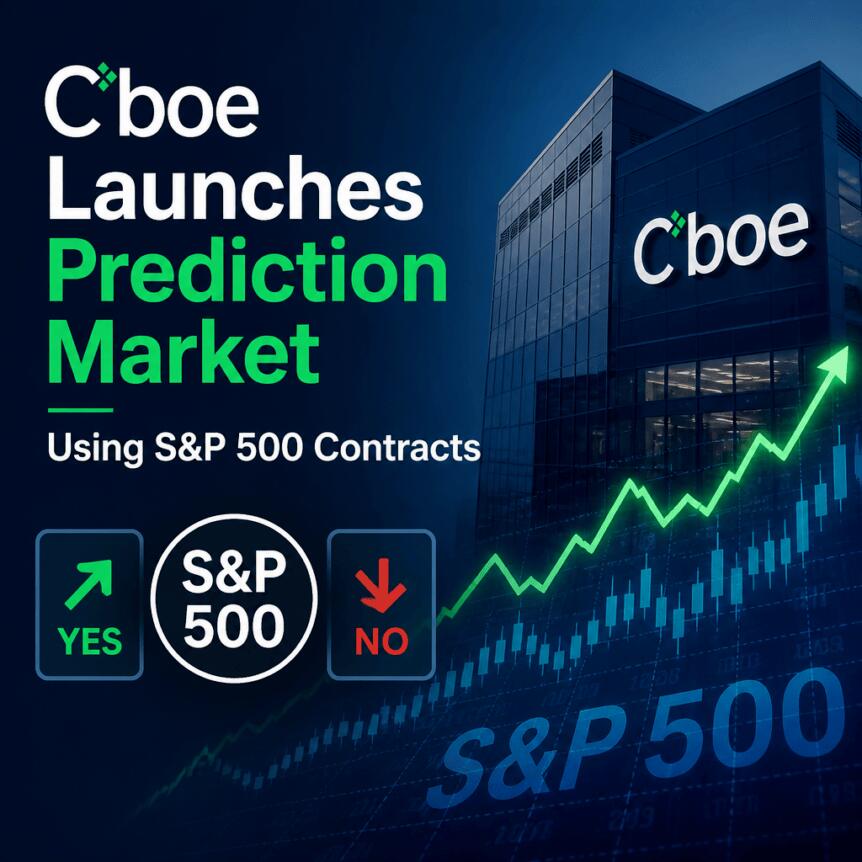
Cboe Global Markets is stepping further into prediction markets with the launch of a new platform, Cboe Predicts, offering binary options linked to the S&P 500. The product debuts with contracts based on whether the index will finish its trading day above or below predefined price levels.
According to a Tuesday press release, the contracts are now available via Interactive Brokers. Cboe expects additional retail distribution through Charles Schwab and other brokerage platforms in the coming months. The move underscores how quickly outcome-based trading has become a competitive battleground between traditional exchanges and crypto-native prediction venues.
Key takeaways
- Cboe Predicts launches with binary “yes” or “no” contracts tied to the S&P 500’s daily closing level.
- The contracts are initially available through Interactive Brokers, with plans to expand to Charles Schwab and other retail brokers later.
- Cboe says the offerings are built to trade under the existing US options regulatory framework, aiming for “institutional-grade liquidity.”
- The launch comes amid heightened US legal and regulatory attention on prediction markets, particularly around sports and political contracts.
- Competition already exists: S&P 500-related contracts are reportedly available on platforms such as Polymarket and Kalshi.
A traditional exchange enters outcome-based trading
Binary contracts are simple in concept: traders place a position on the likelihood of a specific outcome. In this case, Cboe Predicts centers on whether the S&P 500 will close above or below a predetermined price threshold. These “yes” or “no” structures are designed to let participants express a view on short-term market direction without trading the index itself.
What makes the release notable isn’t just that Cboe is launching a new product—it’s that it’s entering a segment that has increasingly drawn retail attention. By packaging the contracts as security options within the established US options framework, Cboe is attempting to offer a pathway that traders already recognize from conventional derivatives markets.
In remarks tied to the launch, Cboe pointed to growing customer demand for shorter-dated, outcome-based trading opportunities. The implication for traders is straightforward: more vehicles are emerging that may allow faster turnover and more frequent “event-style” positioning based on market closes and other measurable triggers.
How Cboe’s structure differs from crypto-native venues
Cboe said its new contracts will trade within the same regulatory framework as other US-listed options, characterizing the platform as providing “institutional-grade liquidity” and transparency. While the underlying mechanics—binary outcomes and time-bounded events—will feel familiar to users of prediction markets, Cboe’s approach attempts to reduce friction for participants accustomed to conventional brokerage and exchange operations.
This matters because distribution and compliance are often decisive factors in whether prediction market activity scales beyond niche audiences. By integrating with mainstream brokerage channels—starting with Interactive Brokers and expanding to Charles Schwab—Cboe is aiming at a broader retail base that may prefer regulated access over more experimental venues.
At the same time, the product faces a wider industry backdrop: earlier reports indicated Charles Schwab was seeking to enter prediction markets through a partnership with Cboe, with similar S&P 500-linked contracts. The current launch suggests that those discussions are translating into real customer access rather than remaining a concept.
Regulatory pressure continues to shape what prediction markets can offer
Cboe’s entry comes as prediction markets face mounting scrutiny in the United States, particularly around contracts that resemble political betting or event wagering tied to sports. In recent coverage, multiple developments have highlighted how uneven the regulatory landscape can be.
For instance, Kentucky was reported as the latest state to sue five prediction market platforms, including Kalshi and Polymarket, alleging they were operating “unlicensed and illegal sports betting and gambling platforms.” The dispute reflects a broader pattern: regulators and states have pursued cases that treat certain outcome contracts as gambling rather than market infrastructure.
There has also been pressure at the federal level. Earlier, US lawmakers proposed legislation aimed at restricting political prediction market trading by government officials following a widely cited example involving a Polymarket user who reportedly profited over $400,000 on a contract related to the removal of former Venezuelan President Nicolás Maduro—an episode that fueled insider-trading concerns.
For investors and builders watching this space, the key takeaway is that prediction markets are not operating under a uniform set of rules. Even as platforms compete on product design—shorter deadlines, clearer settlement, and more popular event categories—the permissible boundaries continue to shift based on jurisdiction, contract type, and perceived intent.
Why S&P 500 binary contracts may be the “safe” wedge
One reason S&P 500-linked markets are strategically attractive is that they can be framed as finance-based forecasting rather than pure wagering on entertainment or political outcomes. The contracts reference a widely followed benchmark and settle based on a transparent, widely observed data point: the index’s daily close.
The source also notes that S&P 500 contracts are already available on prediction market platforms such as Polymarket and Kalshi. Cboe’s launch, then, looks less like a brand-new category and more like a push to capture a segment of demand that already exists—while doing so through distribution that may feel more familiar to mainstream market participants.
Investors should also watch how Cboe positions liquidity, settlement clarity, and accessibility as the product rolls out to additional brokers. While the binary concept is straightforward, user retention often hinges on execution quality: spreads, depth, the frequency of contract opportunities, and how smoothly users can move between traditional brokerage accounts and these “event-style” derivatives.
Next, market participants will likely focus on how quickly Cboe expands Cboe Predicts beyond Interactive Brokers to Charles Schwab and whether the platform can maintain strong trading depth as competition from existing prediction venues continues. At the same time, the broader regulatory question—how US authorities draw the line between finance-linked forecasting and prohibited gambling—will remain a central factor shaping what other “event” contracts may follow.
https://www.cryptobreaking.com/cboe-launches-prediction-market-using/?utm_source=blogger%20&utm_medium=social_auto&utm_campaign=Cboe%20Launches%20Prediction%20Market%20Using%20S&P%20500%20Contracts%20
Comments
Post a Comment