
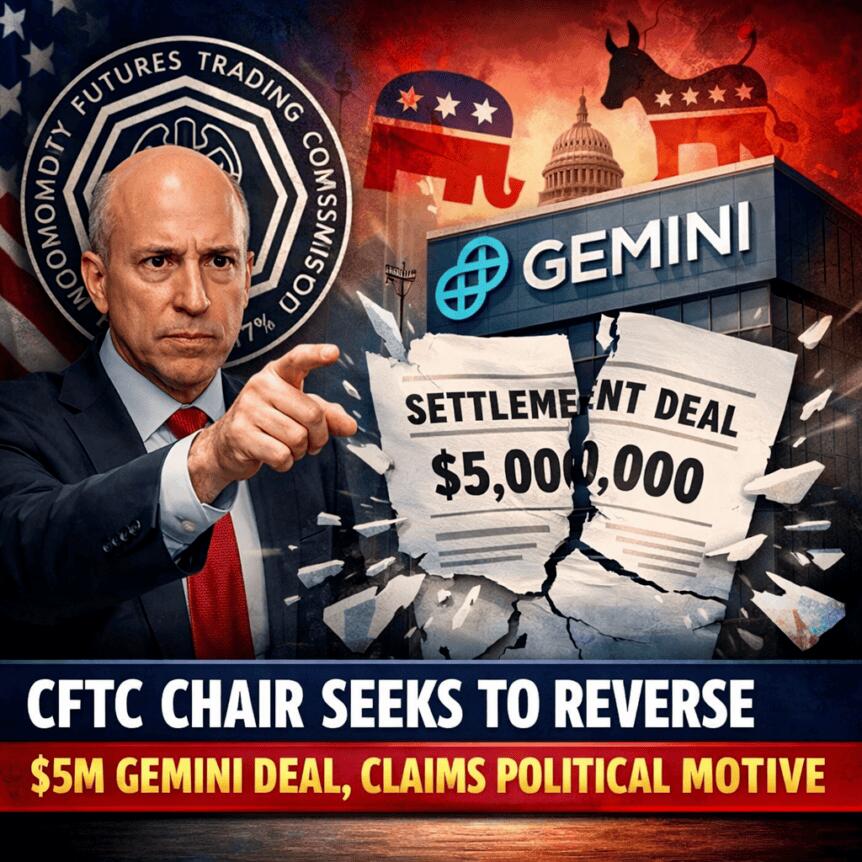
US Commodity Futures Trading Commission (CFTC) Chair Michael Selig has framed enforcement actions taken against Gemini as politically targeted by the Biden administration, arguing that the agency should reset its posture to a nonpartisan baseline. In remarks sent to mainstream media and reproduced in part in a CNBC interview, Selig contended that enforcement has been weaponized and pledged a fresh start focused on rule of law rather than politics. He also signaled that recent staff reductions in the agency may reflect an emphasis on addressing what he characterized as “lawfare” against the crypto industry.
“The Biden administration weaponized the federal agencies against the crypto industry and many other industries,” Selig stated. “They politically targeted people like the Winklevoss twins, and that’s not acceptable. We’re righting those wrongs. We’re gonna start fresh. The agency should not be used to engage in lawfare.”
According to the context provided by Cointelegraph, Selig’s remarks come as the CFTC pursued a nuanced realignment of its enforcement approach after a period of controversy surrounding Gemini. The agency, under his leadership, has also moved to reverse a prior settlement against Gemini—an action the commission described as part of its ongoing effort to revisit and, where appropriate, correct past positions.
In the same timeframe, the CFTC sought a federal court’s intervention to vacate a $5 million settlement with Gemini that had been reached in January 2025, prior to Selig’s accession as chair. Gemini’s co-founders, Tyler and Cameron Winklevoss, have longstanding political ties, including donations to Donald Trump’s 2024 campaign and attendance at White House events related to administration initiatives, including the GENIUS Act’s signature ceremony. Selig declined to discuss the specifics of the Gemini matter, noting that the investigation and litigation remain active, but underscored the broader aim of ensuring enforcement actions reflect neutral, nonpolitical application of the law.
“I’m not going to get into the facts, because this is an active investigation, litigation, but what is important here is that to the extent the agency was used to politically target folks, we’re reversing that, and we’re starting fresh,” Selig told CNBC in the interview. Cointelegraph notes that this framing fits into a broader narrative about regulatory reorientation under the current leadership.
Key takeaways
- The CFTC chair alleges political targeting of Gemini’s founders by the Biden administration, framing enforcement as partisan prior to his tenure.
- The agency moved to vacate a previously agreed $5 million settlement with Gemini, signaling a broader reexamination of past actions.
- Selig positions federal commodities law as superseding state prerogatives in certain market structures, reinforcing a centralized enforcement stance.
Gemini settlement, litigation, and enforcement posture
Under Michael Selig, the CFTC has actively pursued steps aimed at recalibrating prior enforcement outcomes. In a development cited by outlets familiar with the matter, the commission asked a federal court to vacate the January 2025 Gemini settlement, a move that would undo the framework of the previously agreed resolution. The timing and rationale for the move appear to align with Selig’s stated objective of “starting fresh” and ensuring enforcement actions are grounded in robust legal merit rather than political considerations. While the agency has not disclosed detailed grounds for seeking to unwind the settlement, the action underscores a willingness to revisit high-profile cases that occurred before his tenure.
Gemini’s founders, Tyler and Cameron Winklevoss, have publicly engaged in U.S. political fundraising and policy events in recent years, including help for President Trump’s campaign and participation in administration-led initiatives such as GENIUS Act signings. While Selig declined to discuss the factual matrix of the Gemini case during interview remarks, he reiterated that the ongoing investigation and litigation will dictate the procedural trajectory, even as he asserts a broader corrective aim at the agency’s enforcement posture.
Analysts note that this move—if sustained—could carry significant implications for normalization and predictability of CFTC enforcement, particularly for crypto platforms that navigated earlier settlements. It also frames the Gemini matter within a broader discourse about the independence of investigative actions from political influence, a concern repeatedly raised by lawmakers and industry observers.
Federal law, state authority, and the regulatory landscape
In his public statements and policy orientation, Selig has reaffirmed the CFTC’s stance that federal commodities law can supersede state regulations in certain domains—most notably in the governance of prediction markets. The agency has pursued litigation against state authorities, including Minnesota, challenging restive measures to curtail or ban such platforms. This posture signals a continued push to centralize regulatory authority over core crypto-futures and related markets, reinforcing a federal framework for compliance and enforcement that may limit state-level maneuvering by policymakers and market participants alike.
These dynamics come at a moment when U.S. policymakers, regulators, and industry participants are wrestling with a complex patchwork of jurisdictional authority, licensing regimes, and cross-border compliance considerations. The enforcement approach described by Selig—emphasizing the primacy of federal standards—could influence how crypto exchanges and prediction-market operators structure products, manage risk, and coordinate with supervising authorities across states and, where relevant, international jurisdictions.
Conversations around leadership and governance within the CFTC have intensified in 2025 and 2026, as resignations and departures contributed to Selig’s status as the agency’s sole commissioner. The absence of a complete bipartisan panel raises questions about policy continuity and the breadth of perspectives shaping rulemaking and enforcement priorities. In public statements, lawmakers have urged President Trump to nominate a bipartisan slate of commissioners to restore a full five-member leadership body, though no new appointments had been announced as of the latest briefings. The evolving leadership dynamic adds a layer of regulatory risk for firms seeking stable, long-term compliance expectations from the agency.
Legal and policy implications for the industry
The described reset carries practical implications for crypto firms, including exchanges, lenders, and market participants engaged in derivative-like products and paid-of-interest structures. A renewed emphasis on nonpartisan enforcement could affect risk management, internal investigations, and the cadence of regulatory disclosures. For entities operating in the United States, the shift may influence how material enforcement actions are communicated to investors, and how compliance frameworks are structured to withstand potential policy pivots at the federal level.
The policy trajectory also intersects with broader regulatory initiatives, including ongoing discussions around stablecoins, banking access, licensing regimes, and cross-border regulatory alignment. While specific rulemakings are not detailed in Selig’s public remarks, the broader context points to heightened scrutiny of crypto-native products under a centralized enforcement paradigm, with potential ripple effects on ancillary services such as custody, settlement, and risk management infrastructures.
Closing perspective
As the CFTC continues its review of past actions and charts a path toward what Selig describes as a “fresh start,” industry observers will monitor how the agency balances enforcement rigor with procedural fairness and transparency. The Gemini matter, the leadership question at the agency, and the broader federal-state dynamic together illustrate a regulatory landscape in flux—one that could shape compliance expectations, product design, and cross-border operations for years to come.
https://www.cryptobreaking.com/cftc-chair-seeks-to-reverse/?utm_source=blogger%20&utm_medium=social_auto&utm_campaign=CFTC%20Chair%20Seeks%20to%20Reverse%20$5M%20Gemini%20Deal,%20Claims%20Political%20Motive%20
Comments
Post a Comment