
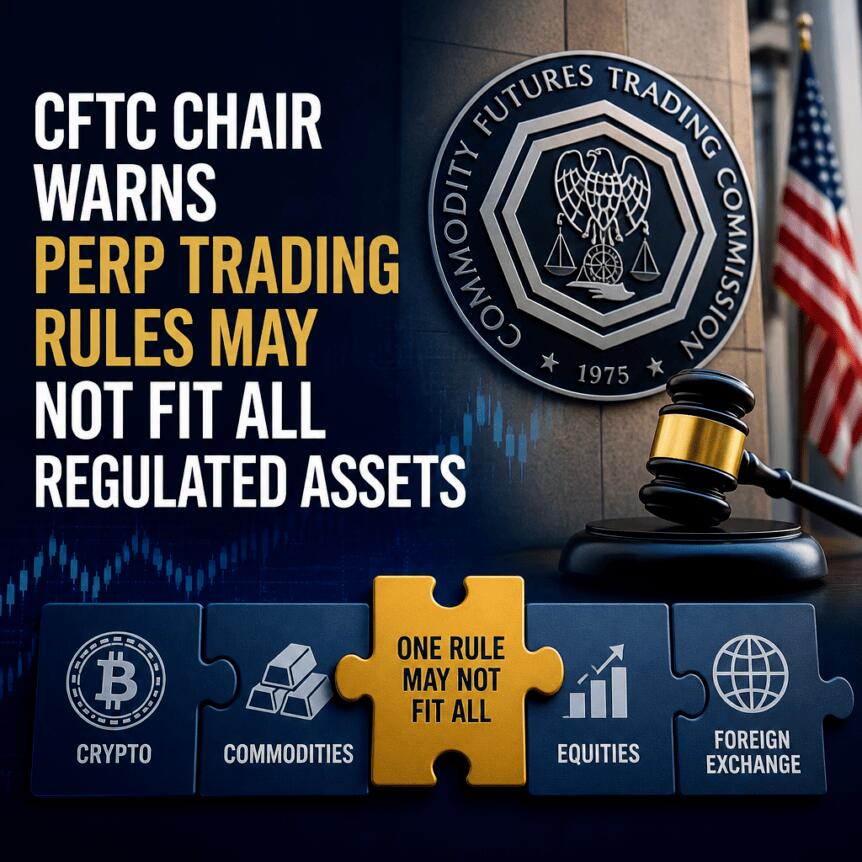
Commodity Futures Trading Commission (CFTC) Chair Michael Selig used a recent address to underscore a recurring tension in U.S. digital-asset regulation: the CFTC’s traditional commodity-market framework versus the mechanics of crypto-linked derivatives. Speaking to the American Cotton Shippers Association Annual Convention, Selig said perpetual contracts—particularly those tied to digital-asset pricing—do not readily map onto agricultural commodity markets that historically rely on limited trading hours and physical delivery.
His comments arrive as the CFTC continues to approve or facilitate certain crypto-perpetual products and as legal challenges to the agency’s expanding oversight role intensify. For compliance teams and institutional participants, the exchange of public rationale, enforcement posture, and ongoing litigation highlights how interpretive boundaries in the Commodity Exchange Act may shape market access, licensing decisions, and risk governance for crypto firms.
Key takeaways
- CFTC Chair Michael Selig said the agency’s traditional commodity-market models are not a “natural fit” for perpetual, 24/7 trading structures used in crypto derivatives.
- The remarks follow CFTC actions related to crypto perpetual futures, including approvals for prediction-market operator Kalshi and a no-action position involving Coinbase (as reported previously).
- Legal disputes continue around the CFTC’s asserted authority over prediction markets and crypto perpetual products, with major industry venues pursuing court challenges.
- U.S. CFTC leadership vacancies remain unresolved, and the pending Digital Asset Market Clarity (CLARITY) Act could alter how digital-asset oversight is divided between the CFTC and SEC.
Why Selig’s comments matter for derivatives compliance
Selig’s address framed the CFTC’s historical remit around commodities such as agricultural goods, which often feature scheduled market sessions and settlement practices tied to physical delivery. He characterized the perpetual model and continuous trading cadence as fundamentally different from those traditional commodity market characteristics.
In practical terms, that distinction matters because regulatory analysis for derivatives frequently depends on how closely a product resembles established commodity-market structures. When a product operates in a 24/7 environment and uses perpetual mechanisms rather than typical futures delivery or expiration schedules, firms must reassess how their offerings align with existing legal categories, risk controls, and market integrity expectations.
Selig explicitly acknowledged that the perpetual, continuously traded structure is not well suited to agriculture’s market conventions, emphasizing a structural mismatch rather than a purely technical one. While this is not itself a change in enforcement policy, it signals the CFTC’s internal awareness—at the leadership level—of how crypto derivatives may challenge older analogies used to fit new products into regulatory frameworks.
CFTC crypto-perpetual approvals draw scrutiny and litigation
The remarks were made in the wake of CFTC actions affecting crypto-linked perpetual derivatives. Prior reporting indicated that the CFTC approved perpetual futures contracts tied to the spot price of Bitcoin for Kalshi and issued a no-action position for similar products on Coinbase. Subsequent market developments also followed, including the launch of perpetual futures trading for U.S. users via Kraken’s CFTC-regulated route through Bitnomial.
These developments have not occurred in isolation. The CFTC’s expanding involvement has been met with opposition on legal grounds, especially where firms and some state-level authorities contend that the agency’s approach exceeds what the Commodity Exchange Act permits. The core dispute centers on whether the CFTC has “exclusive jurisdiction” in overseeing certain prediction-market and crypto-perpetual products, and how those products should be classified under U.S. commodity law.
That dispute escalated when CME Group sued the CFTC in the District of Columbia. According to prior reporting by Cointelegraph, CME alleged that the CFTC’s approvals for perpetual contract structures violated the Commodity Exchange Act. For institutional stakeholders, such litigation is not merely theoretical: it affects regulatory certainty, the willingness of regulated venues to list or clear similar products, and the compliance posture of market participants seeking to rely on CFTC determinations.
Meanwhile, unresolved questions remain about the outcome of court proceedings and whether the CFTC’s interpretation will be affirmed, narrowed, or reshaped. Until that process concludes, firms face uncertainty in product design, jurisdictional mapping (particularly when other regulators’ interests may overlap), and the defensibility of compliance assumptions.
Leadership gaps at the CFTC and the CLARITY Act outlook
Separate from product-specific approvals, the CFTC’s governance context continues to evolve. Selig has served as the only Republican commissioner and as chair after the departure of Caroline Pham in December 2025. Despite calls from U.S. lawmakers to fill the CFTC’s five-person leadership panel, the Trump administration has not moved to appoint additional commissioners.
Leadership composition can influence how aggressively an agency prioritizes contested legal interpretations, how decisional consistency is maintained across contested areas, and how public-facing explanations are calibrated. For regulated entities, commissioner availability can also affect the timing of formal rulemaking, responses to petitions, and the decisional pipeline for applications and no-action processes.
In parallel, the U.S. Senate is expected to take up a vote on the Digital Asset Market Clarity (CLARITY) Act in the coming weeks. If enacted or advanced, the legislation could change how responsibilities are allocated between the CFTC and the Securities and Exchange Commission for digital-asset oversight. For compliance programs, such statutory movement is material: it may require firms to update risk assessments, adjust internal control frameworks, and re-evaluate the regulator-of-record assumptions that drive licensing, reporting, and marketing review processes.
Regulatory uncertainty and cross-market risk
Beyond the CFTC’s internal rationale, the broader policy landscape for crypto derivatives remains fragmented. Crypto firms operating in the U.S. must navigate a jurisdictional patchwork where product classification can determine whether a given offering is treated as a commodity-based derivatives product, a security, or something else entirely. That classification then informs licensing requirements, supervisory expectations, and the extent to which AML/KYC controls, market surveillance, and other obligations apply.
The current environment—characterized by court challenges, agency leadership vacancies, and pending legislation—raises compliance management questions that extend beyond product legality. Institutions need to consider how counterparties evaluate regulatory risk, how exchanges and trading venues manage listing standards in disputed jurisdictions, and how legal uncertainty impacts contractual documentation and governance frameworks.
In addition, stablecoin and banking integration issues continue to influence compliance in related ways, particularly where settlement, custody, and fiat on-ramps intersect with derivative trading operations. While Selig’s remarks focused on perpetual trading mechanics and commodity-market analogies, institutional monitoring typically ties these operational details back to the regulatory obligations triggered by the overall digital asset ecosystem.
Closing perspective
With litigation underway around the CFTC’s crypto-perpetual approvals and with the CLARITY Act potentially shifting the SEC/CFTC boundary, the next phase will likely focus on legal outcomes and legislative movement. Market participants and compliance teams should monitor court developments, any changes to CFTC leadership, and signals on how the agency intends to reconcile perpetual 24/7 trading structures with long-standing commodity-market regulatory concepts.
https://www.cryptobreaking.com/cftc-chair-warns-perp-trading/?utm_source=blogger%20&utm_medium=social_auto&utm_campaign=CFTC%20Chair%20Warns%20Perp%20Trading%20Rules%20May%20Not%20Fit%20All%20Regulated%20Assets%20
Comments
Post a Comment