
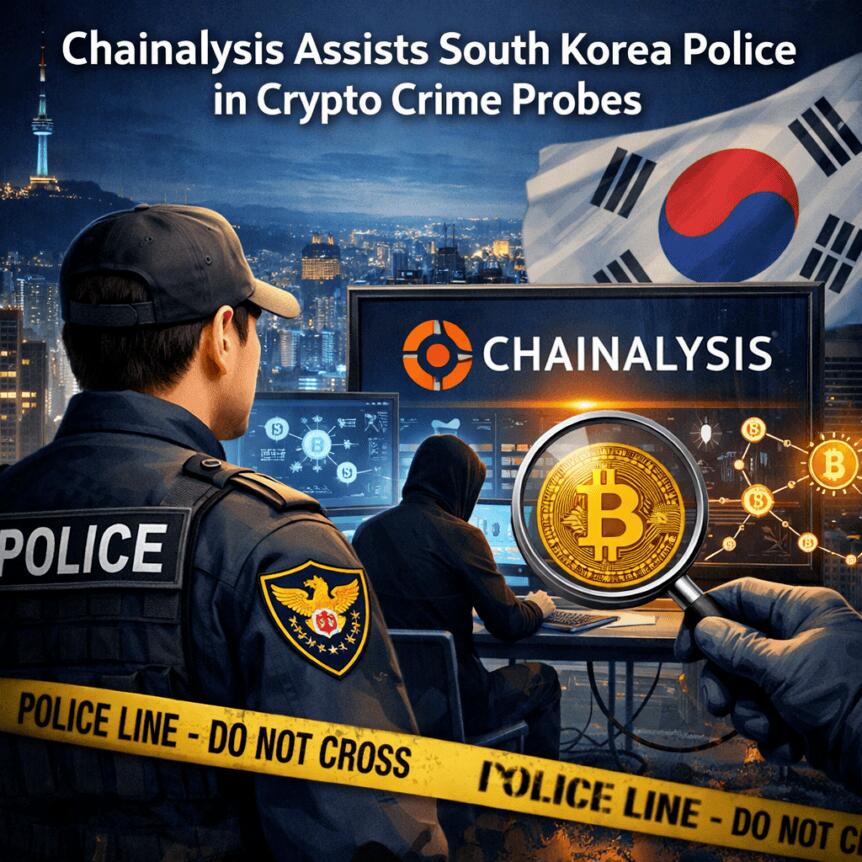
Chainalysis is expanding its collaboration with South Korea’s National Police Agency to bolster crypto-crime investigations, including cases tied to North Korea. The security firm announced on Wednesday that it signed a memorandum of understanding to help build investigative capability within South Korea’s law enforcement apparatus.
The agreement is framed as a broader move to strengthen institutional capability, not solely to confront North Korea–linked attacks, though those threats remain a major focus given recent activity in the region. Chainalysis’ Korea country director, Ryan Kwon, stressed that the collaboration is designed to tackle a wide spectrum of illicit activity, with North Korea as a principal concern but not the only one.
“While North Korean-driven attacks are understandably a national security focus, this partnership isn’t designed around a single threat. It’s fundamentally about building institutional capability,”
Kwon told Cointelegraph.
The memorandum of understanding will equip the KNPA with personalized training content from Chainalysis, along with professional certification programs and practical training to sharpen capabilities in tracing illicit crypto flows and conducting digital-forensics examinations. Chainalysis said the objective is to give Korean investigators a holistic view of global illicit fund movements that can improve investigative outcomes.
In explaining the rationale behind the move, Chainalysis emphasized the need for investigators to have global visibility into illicit fund flows to effectively pursue cases that cross borders and jurisdictions. The company noted that its support extends beyond a single threat landscape, aligning with a broader mission to strengthen law-enforcement infrastructure for a rapidly evolving crypto environment.
The agreement arrives amid heightened attention to North Korea–linked crypto activity. In April, authorities reported that North Korea–linked crypto thefts topped $578 million, with many of the attacks attributed to high-profile incidents involving platforms and protocols such as Kelp DAO and the Drift Protocol. Separately, research from CrowdStrike found that North Korea–affiliated hackers were responsible for about $2 billion in crypto losses in 2025, marking a 51% year-on-year increase in the threat landscape.
The MoU comes at a time when South Korea’s police are intensifying their focus on crypto-enabled crime. Earlier this year, Seoul’s authorities announced the launch of a dedicated multi-agency task force—the Money Laundering Eradication Task Force—led by the Economic Crime Investigation Division. The initiative signals a broader, cross-cutting approach to combating crypto-based money laundering and related illicit finance activities.
Chainalysis has a history of cooperation with Korean investigators. The company has provided support for years and played a role in recent high-profile investigations—most notably in September when Seoul authorities dismantled an international hacking ring that had stolen roughly $30 million. The operation began in South Korea and eventually traced the criminals to Thailand, illustrating the kind of cross-border collaboration that the new MoU seeks to institutionalize rather than merely supplement.
For South Korea, the partnership fits into a longer-term effort to align public enforcement with private-sector intelligence and analytics capabilities. By granting KNPA access to Chainalysis’ training curricula and certification paths, the collaboration aims to raise the baseline of investigative skills across the force and accelerate technical proficiency in tracing complex crypto transactions and money flows.
As policymakers and enforcement agencies weigh the next steps in crypto regulation and oversight, the Chainalysis–KNPA agreement highlights a growing willingness to formalize public-private partnerships as a core part of national security and financial-crime strategy. The effectiveness of such collaborations will hinge on program implementation, the speed with which investigators can translate training into actionable cases, and the capacity to sustain cross-border intelligence-sharing in an increasingly borderless fraud and theft landscape.
Key takeaways
- Chainalysis signs a memorandum of understanding with the Korean National Police Agency to strengthen investigative capability, including training, certification, and practical instruction for KNPA personnel.
- The partnership emphasizes a comprehensive approach to crypto crime, with North Korea–linked attacks cited as a major driver but not the sole focus of the collaboration.
- April saw North Korea–linked crypto thefts top $578 million, while CrowdStrike reports North Korea–affiliated hackers were responsible for about $2 billion in crypto losses in 2025, up 51% year over year.
- The MoU follows South Korea’s launch of the Money Laundering Eradication Task Force, signaling a broad, multi-agency push against crypto-based money laundering.
- Chainalysis has a history of aiding Korean investigators and positions this agreement as a move to formalize and scale institutional capabilities rather than provide ad hoc support.
Institutional capability building in a borderless crime landscape
The new MoU represents more than a single training program. By providing KNPA investigators with tailored content, professional certifications, and hands-on training, Chainalysis seeks to embed analytic methods and evidence-driven practices into everyday investigative workflows. The emphasis on global visibility into illicit fund flows underscores a shift toward more proactive and globally coordinated enforcement, where on-chain analytics play a central role in identifying patterns, tracing funds, and attributing wrongdoing across jurisdictions.
From an investor and user perspective, the move reflects a tightening of, or at least a clearer path toward, accountability in the crypto ecosystem. As exchanges, custody providers, and other actors increasingly rely on on-chain intelligence to assess risk, partnerships that elevate investigative capacity can influence how compliance programs are designed and how quickly investigations can be pursued when anomalies surface. In regulatory terms, the collaboration aligns with a trend toward more formalized cooperation between private analytics firms and public law enforcement to address cross-border crypto crime in a rapidly evolving policy environment.
Context and momentum in South Korea’s crypto-crime crackdown
The Chainalysis–KNPA MoU sits within a broader ripple of enforcement activity in South Korea. The government and law-enforcement agencies have signaled a sustained focus on illicit finance in the crypto space, including the creation of specialized task forces meant to coordinate across agencies and jurisdictions. The Money Laundering Eradication Task Force, led by the Economic Crime Investigation Division, is emblematic of this approach and may influence how cases are pursued, how assets are traced, and how cooperation with foreign partners is structured in the months ahead.
For now, the partnership with Chainalysis adds a practical capability boost—giving KNPA personnel access to advanced tooling, training, and a structured path to professional certification. It also highlights a growing recognition among authorities that blockchain analytics and institutional training are essential components of an effective response to crypto-enabled crime, including theft, fraud, and illicit financing tied to state-backed adversaries.
Readers should watch how the KNPA translates this training into on-the-ground results and whether the collaboration expands to additional agencies or regions. The next datapoints to monitor include any measurable improvements in case resolution times, cross-border investigations, and the integration of Chainalysis’ analytics into routine investigative workflows.
In the evolving landscape of crypto enforcement, the Chainalysis–KNPA MoU marks a notable shift toward structured, capability-building partnerships that could shape how crypto crime is investigated and deterred in the region and beyond.
https://www.cryptobreaking.com/chainalysis-assists-south-korea-police/?utm_source=blogger%20&utm_medium=social_auto&utm_campaign=Chainalysis%20Assists%20South%20Korea%20Police%20in%20Crypto%20Crime%20Probes%20
Comments
Post a Comment