
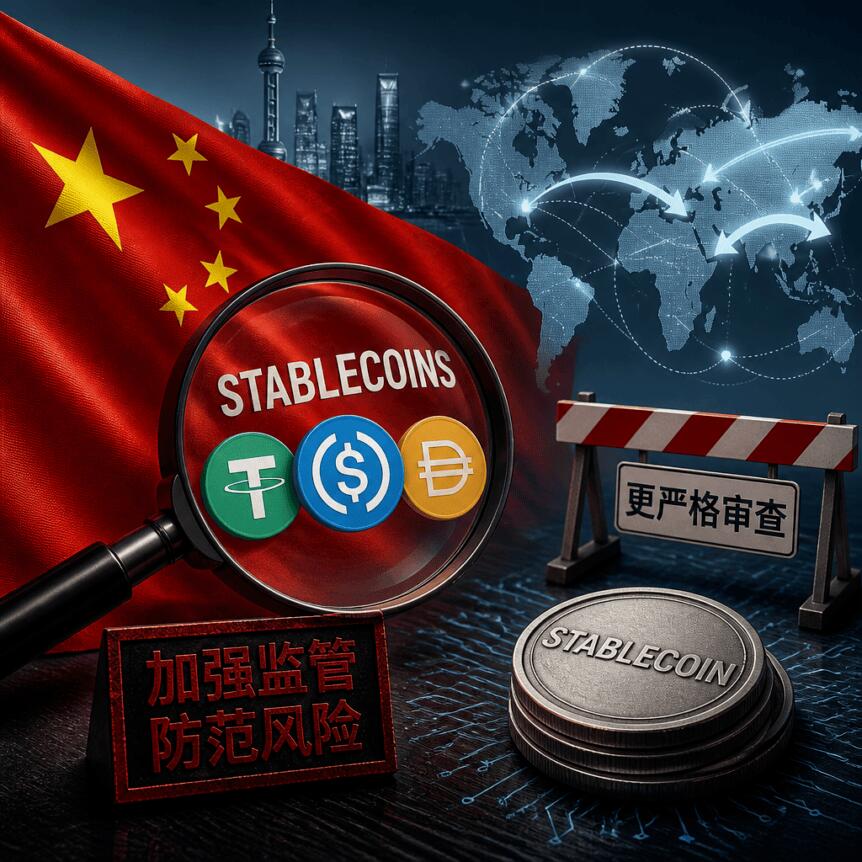
China’s central bank has signaled heightened attention to stablecoins, warning that privately issued tokens could play a larger role in cross-border payments and the broader international monetary system. In remarks reported by The Paper on Wednesday, Wang Xin, director general of the Research Bureau at the People’s Bank of China (PBOC), urged regulators to monitor how stablecoins develop abroad and refine oversight and international coordination accordingly.
Wang also cautioned that uncertainty around stablecoin usage—combined with the risk that payments could be “weaponized”—may disrupt routine cross-border transactions. While the comments emphasize vigilance rather than a policy shift, they underline how stablecoins remain firmly on the radar of Chinese financial authorities, particularly as global stablecoin activity continues to expand.
Key takeaways
- PBOC research chief Wang Xin said authorities should closely monitor stablecoins’ potential impact on cross-border payments and the international monetary system.
- Wang highlighted risks tied to growing uncertainty and the potential “weaponization” of payments that could disrupt cross-border commerce.
- His remarks also extended to central bank digital currencies (CBDCs), which he said warrant similar scrutiny for cross-border use.
- The statements arrive after China’s Feb. 6 ban on unauthorized issuance of renminbi-pegged stablecoins and tokenized real-world assets.
Why stablecoins remain a regulatory priority
According to The Paper, Wang Xin argued that regulators need to pay attention not only to stablecoins themselves, but to the specific question of whether they could take on a more meaningful role in cross-border payments. He also called for progress on regulation and international cooperation, framing stablecoins as a cross-border financial infrastructure issue rather than a purely domestic one.
Wang’s comments were described as emphasizing the practical consequences of stablecoin adoption—especially if stablecoins become more widely used for moving value between jurisdictions. That focus matters for investors and market participants because it suggests China’s approach is not limited to issuance controls inside its borders, but extends to how these assets could influence payment flows at scale.
While Wang did not signal endorsement of stablecoins or announce new rules, his warning about “weaponization of payments” points to a geopolitical lens that regulators across multiple jurisdictions have increasingly raised. For traders and institutions, the implication is that regulatory risk is not only about compliance with local laws, but also about broader concerns that may affect operational certainty for cross-border payment tools.
No policy reversal—China’s stance is already clear
Wang’s call for monitoring comes months after the PBOC and seven other Chinese agencies issued prohibitions targeting the unauthorized issuance of renminbi-pegged stablecoins and tokenized real-world assets. On Feb. 6, the rules banned such activity, covering both foreign and domestic entities and applying to onshore and offshore versions of yuan-pegged tokens. Authorities also required issuers to obtain government approval.
Cointelegraph previously reported that these restrictions were designed to reinforce China’s preference for state-controlled digital money over privately issued tokens. In that context, Wang’s remarks appear consistent with earlier enforcement posture: regulators can express openness to careful observation while continuing to resist broad permissionless development of stablecoin-like instruments that could compete with public policy objectives.
Importantly, Wang’s speech was framed around oversight and coordination rather than authorization or promotion. For market participants, that means the near-term direction remains cautious: even as global stablecoin usage grows, China’s central bank messaging continues to emphasize control, monitoring, and the management of international spillovers.
Stablecoin growth continues—behind the numbers
Regulatory concerns in China are unfolding as stablecoin activity has continued to scale elsewhere. Data referenced by CEX.io indicates that in the first quarter of 2026, overall stablecoin supply increased by roughly $8 billion to reach $315 billion—cited as the first time stablecoin supply reached that level. The figures were reported alongside commentary on transaction behavior and market structure.
In that same quarter, CEX.io said stablecoin transaction volume exceeded $28 trillion and that stablecoins accounted for 75% of total crypto trading volume. At the same time, CEX.io estimated that bots generated about 76% of the transaction volume. That combination—rising supply and high throughput alongside heavy bot activity—matters for readers because it suggests that stablecoin liquidity and market usage are expanding, but the composition of that activity may not be purely organic demand for payments.
For Chinese regulators, those distinctions could matter: if stablecoins are increasingly used for trading and settlement, cross-border payment risks may broaden beyond retail remittances into exchange-linked flows, liquidity provisioning, and other operational pathways. And if bot-driven volume dominates, regulators may still worry about system-level effects, even if immediate retail usage is less visible.
CBDCs also on the radar for cross-border payments
Wang’s comments were not limited to stablecoins. He also warned about the need to closely observe the role of central bank digital currencies in cross-border payments. The framing implies that, in China’s view, CBDCs and privately issued stablecoins can both influence international payment dynamics, but for different policy reasons—making international coordination a recurring theme.
For markets, this is a useful signal: China’s thinking appears to treat “digital money for payments” as a spectrum of technologies and governance models. That means future policy discussions about interoperability, regulatory alignment, and cross-border settlement may involve both public digital currency efforts and the constraints imposed on private tokens.
Readers should watch whether Chinese messaging evolves from general monitoring toward concrete enforcement guidance affecting cross-border token settlement channels, especially as stablecoin supply and activity continue to rise globally. The uncertainty Wang referenced—along with the possibility that governments treat payment tooling as a strategic asset—could remain a key driver of how stablecoin-related rules develop in the months ahead.
https://www.cryptobreaking.com/china-tightens-scrutiny-of-stablecoins/?utm_source=blogger%20&utm_medium=social_auto&utm_campaign=China%20Tightens%20Scrutiny%20of%20Stablecoins%20as%20Cross-Border%20Use%20Grows%20
Comments
Post a Comment