
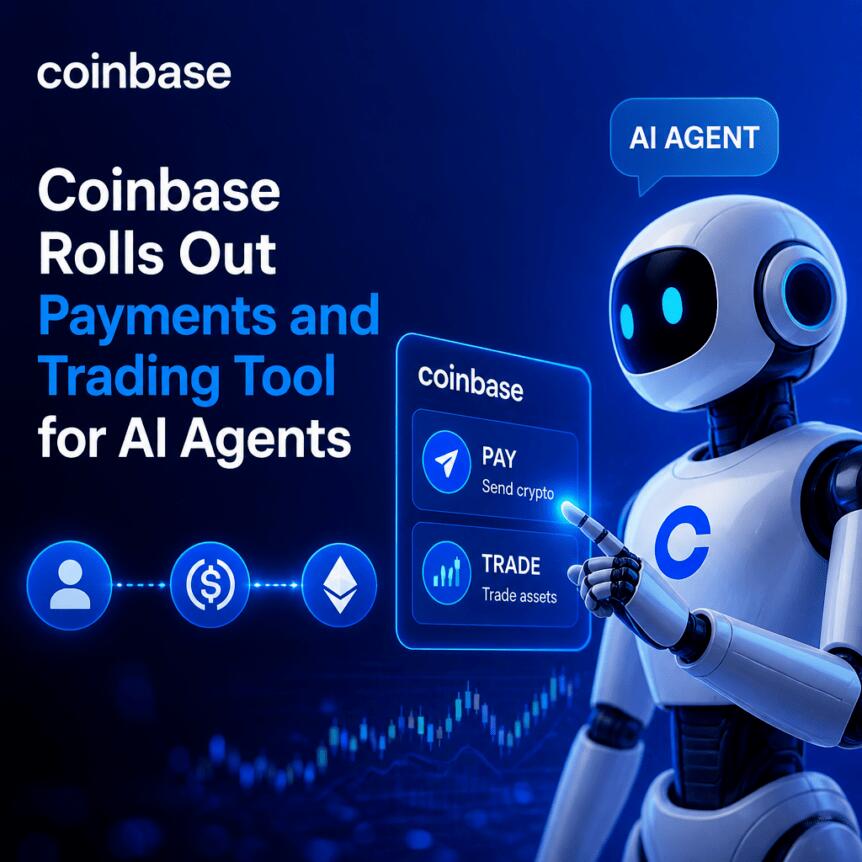
Coinbase has moved deeper into the AI-agent trend by launching “Coinbase for Agents,” a tool designed to let artificial intelligence models connect to a user’s Coinbase account to make payments and execute crypto trades on the user’s behalf.
Announced Thursday in a blog post, the offering targets a growing narrative across the sector: that increasingly capable AI systems will perform many small, repetitive transactions—such as automated trading routines and micro-payments—faster and more consistently than manual workflows.
Key takeaways
- Coinbase for Agents is intended to let AI models connect to a user’s exchange account and submit trades or strategies based on prompts.
- The company says agent payments can be enabled through Coinbase’s AI payments protocol x402, aimed at letting bots pay for data services involved in strategies.
- Access is offered via both a model context protocol (MCP) approach and a developer-friendly command-line interface.
- Coinbase also introduced “Coinbase Advisor,” an agent integrated into its app that the company describes as SEC- and CFTC-registered for advisory guidance.
- Recent academic research raises a caution: in studied cases, token holders reportedly lost more than agent treasuries gained on paper, and many projects showed limited proof of fully autonomous trading.
What Coinbase for Agents actually enables
Coinbase says Coinbase for Agents allows AI models such as ChatGPT and Claude to connect with a user’s exchange account. Once connected, the models can be prompted to place trades or carry out pre-defined trading strategies.
The tool is positioned for developers and integrations rather than as a standalone consumer feature. Coinbase said it will be available through two routes: via a model context protocol (MCP), which supports connecting AI models to external systems, and through a command-line interface for building and automating workflows.
The company’s framing emphasizes reduced oversight for users. In its description, the goal is to manage crypto activities “without the constant manual oversight,” including tasks like distributing funds to reward programs and scheduling recurring purchases.
Payments for agents via x402
Beyond trading, Coinbase says AI agents can also make payments using its AI payments protocol x402. The practical implication is that agents could pay for third-party services—such as data providers—needed to execute trading logic, without direct human involvement at every step.
This matters because many AI-agent use cases depend on pulling information from external systems in real time or near real time. If an agent cannot pay for those services, the workflow often breaks into manual steps. Coinbase’s approach suggests it is trying to reduce that friction by providing a payment channel built for automation.
Coinbase previously highlighted x402 in an AI-payments context, and the new announcement ties that capability directly to agent behavior—linking account connectivity, strategy execution, and agent-to-service payments within a single ecosystem.
Coinbase Advisor and the boundary between guidance and execution
Alongside Coinbase for Agents, Coinbase introduced “Coinbase Advisor,” an AI agent integrated into its app. Coinbase states that Coinbase Advisor is a US Securities and Exchange Commission and Commodity Futures Trading Commission-registered financial adviser and can offer guidance on trades.
The distinction between guidance and execution is likely to be important for users trying to understand risk and responsibility in automated systems. Coinbase’s broader agent tool is described as enabling AI models to connect to an exchange account and carry out prompts that can include trades. Coinbase Advisor, by contrast, is framed as advisory support inside the app.
Coinbase also offered an illustrative example of how agents could automate a routine: it described an ETH dollar-cost averaging scenario where an agent would pull 30 days of hourly price data, identify historically low times of day, then schedule a recurring $20 market buy at those times for a defined period.
Why the AI-agent pitch is gaining traction—and why it’s controversial
Coinbase’s launch lands during a period when many crypto infrastructure firms are betting that AI agents will become active participants across services, not just consumers. In the same general direction, Circle recently introduced tools intended to help AI agents use wallets, discover services, and make programmable payments with its token, with CEO Jeremy Allaire predicting that “billions of AI agents” will use stablecoins within five years. Earlier, Crossmint launched a service allowing AI agents to make payments using eligible Visa credit and debit cards.
There are also industry claims about real-world transaction volume involving autonomous agents. A report from crypto investment firm Keyrock in May said AI agents quickly created an “developed ecosystem,” citing $73 million settled across 176 million transactions between May 2025 and April 2026.
At the same time, a study published last month introduces a counterpoint that should temper expectations about fully autonomous performance. According to the research, conducted by teams including Pantera Capital, Stanford University, Ava Labs, and the Initiative for Cryptocurrencies and Contracts, investigators reviewed over 925,000 token holders. The paper reports that agent treasuries made gains of $30 million on paper, while token holders collectively lost $191.7 million.
The study also argues that many projects it examined did not provide clear evidence of autonomous trade execution, with a substantial share described as “basic API integrations.” In other words, the presence of an agent-like interface may not necessarily imply real autonomy in trading decisions or execution quality.
For investors and developers, that tension matters: if agent systems are not truly operating independently, or if incentives and outcomes are misaligned, the expected benefits—such as consistent execution or superior risk-adjusted returns—may not materialize for end users.
What to watch next
As Coinbase for Agents rolls out, users and builders should watch how Coinbase defines—and practically enforces—the line between AI planning, payment authorization, and actual trading execution, especially given recent research questioning the level of autonomy in some agent-driven token ecosystems. The next signals will likely be adoption details, integration documentation, and whether third-party evaluations confirm that these agents deliver value beyond the interfaces they provide.
https://www.cryptobreaking.com/coinbase-rolls-out-payments-and/?utm_source=blogger%20&utm_medium=social_auto&utm_campaign=Coinbase%20Rolls%20Out%20Payments%20and%20Trading%20Tool%20for%20AI%20Agents%20
Comments
Post a Comment