
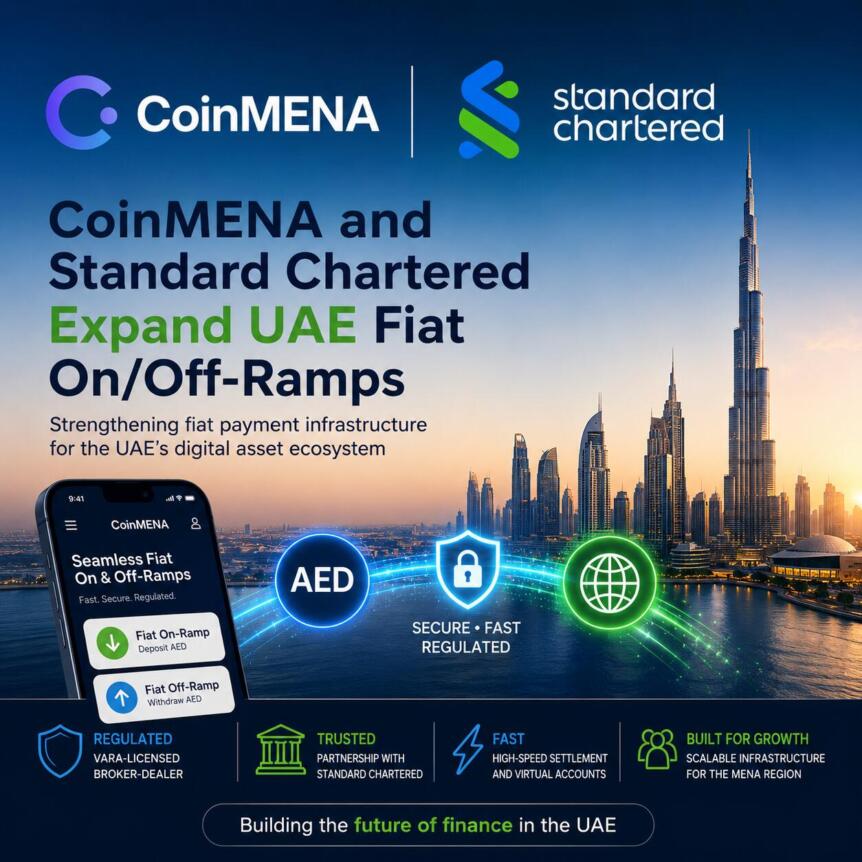
CoinMENA FZE, a regulated virtual asset service provider (VASP) in the United Arab Emirates, said it has entered a banking relationship with Standard Chartered intended to strengthen fiat “on” and “off” ramp operations. The announcement points to a broader trend in the UAE, where regulators have been shaping frameworks for digital assets and established banks are increasingly looking at how to serve compliant crypto businesses.
What the agreement covers
According to the company statement, CoinMENA’s partnership with Standard Chartered is designed to support customer money account services and fiat payment infrastructure. CoinMENA said it will use Standard Chartered’s banking capabilities to enable fiat on- and off-ramp flows for its customers.
The infrastructure described in the release includes safeguarded client money accounts and settlement rails, alongside what it calls virtual account-based transaction management. CoinMENA also said the goal is to improve the speed and efficiency of funding and settlements, while increasing transaction transparency.
Standard Chartered, for its part, did not provide granular technical details. The bank positioned the move as part of the UAE’s broader digital assets regulatory environment and said trusted banking infrastructure is likely to remain important as the sector matures.
Why fiat connectivity matters in regulated crypto
For regulated digital asset firms, fiat on- and off-ramps are often a key operational bottleneck. The ability to move money into exchanges or wallet services quickly, with clear settlement processes and appropriate controls, can determine the customer experience and also affect compliance workflows.
In practice, building fiat rails requires more than issuing payment instructions. It generally depends on the integration of payment processing, client funds safeguards, liquidity management, and reconciliation processes. A shift toward partnerships with major banks can reduce the need for firms to rely entirely on third-party payment providers, though it does not eliminate operational complexity.
CoinMENA’s emphasis on “safeguarded” client money accounts and “high-speed settlement rails” reflects the kinds of operational assurances that regulators and traditional counterparties typically look for when money movement is involved.
Scalability and liquidity settlement
The release also states that the integration is intended to strengthen CoinMENA FZE’s operational scalability and support liquidity settlement with approved global counterparties. It further frames the arrangement as a way to enhance the efficiency of fiat connectivity across its regulated ecosystem.
While these are common objectives in fintech infrastructure projects, they matter because they tie directly to volumes. As user onboarding grows, firms usually need more predictable settlement performance, faster funding cycles, and improved operational throughput for reconciliation and reporting.
UAE context: regulated digital asset frameworks and bank interest
The announcement comes from a market where digital asset regulation has been increasingly detailed. CoinMENA said it operates in the UAE under a license from Dubai’s Virtual Assets Regulatory Authority (VARA). It also operates in Bahrain under a separate Central Bank of Bahrain license for crypto asset services.
In this context, partnerships with large banks can be interpreted as a step toward mainstreaming crypto-related financial plumbing. Rather than operating payment flows purely through bespoke or indirect channels, firms seek to align fiat movement with bank-grade controls, settlement practices, and oversight.
Standard Chartered highlighted the UAE’s role as a leading regulatory environment for digital assets and said collaboration between regulated firms and established financial institutions creates opportunities as the market develops.
What we do not know yet
The press statement does not specify transaction fees, currency coverage beyond “fiat,” timelines for rollout, or whether the arrangement is limited to particular customer segments. It also does not disclose whether the integration changes CoinMENA’s underlying compliance structure, reporting approach, or risk controls, beyond the general mention of safeguarded client money accounts and improved transparency.
For market participants, those details typically influence practical outcomes. Even when partnerships are announced, customers may experience changes only after integration, testing, and operational readiness milestones are completed.
Implications for the digital asset sector in MENA
Banking partnerships of this kind can carry signal value for the region’s broader crypto infrastructure buildout. They suggest that regulated digital asset firms are increasingly able to engage with institutions that sit at the center of traditional financial systems.
If the operational improvements are delivered as described, the likely benefits would include smoother funding and settlement processes for customers, improved operational scalability for the platform, and clearer transaction tracking for compliance and audit purposes.
At the same time, the pace of integration, the effectiveness of risk controls, and the cost structure of fiat rails remain critical variables that are not covered in the release.
For now, CoinMENA and Standard Chartered have outlined an agreement focused on connecting fiat payment infrastructure into a regulated digital asset operating model in the UAE. The next test will be how quickly and effectively customers see the changes in real-world onboarding and settlement flows.
https://www.cryptobreaking.com/coinmena-standard-chartered-banking-agreement/?utm_source=blogger%20&utm_medium=social_auto&utm_campaign=CoinMENA%20and%20Standard%20Chartered%20Expand%20UAE%20Fiat%20On/Off-Ramps%20
Comments
Post a Comment