
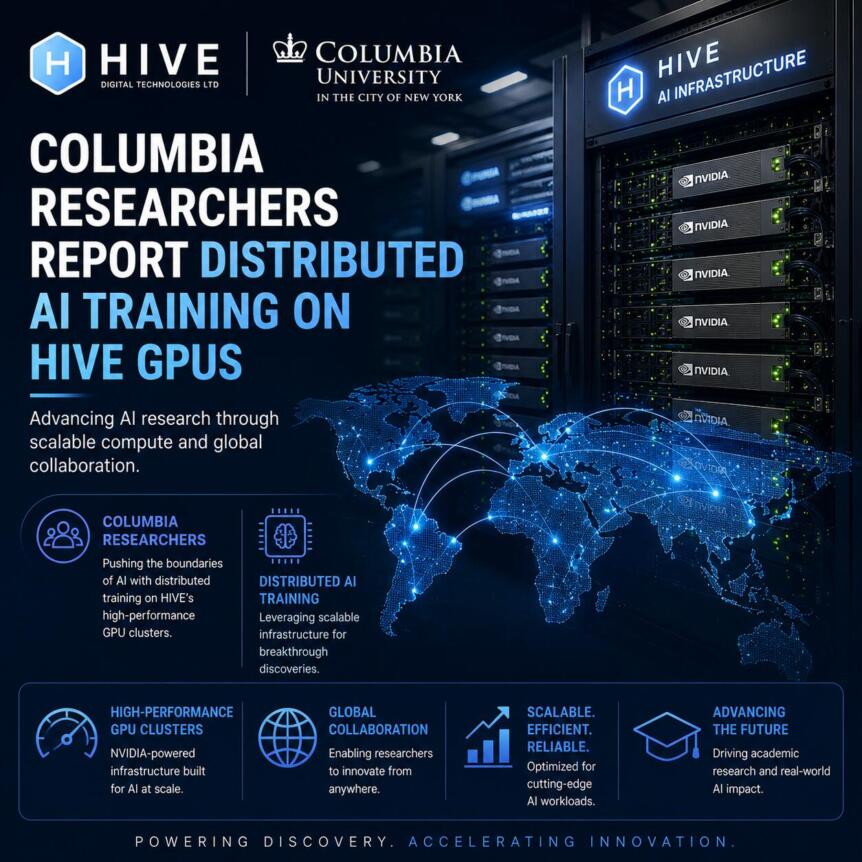
Distributed AI training, validated for intercontinental workloads
Columbia University’s Department of Industrial Engineering and Operations Research has been involved in a research effort that, according to its organizers, demonstrates remote AI model training using GPU infrastructure located in Paraguay. The work is described as a first AI research project completed on HIVE Digital Technologies’ (NASDAQ: HIVE) GPU cluster in Asunción, with results submitted for consideration at NeurIPS, one of the largest machine learning conferences.
What the study claims
In the reported setup, researchers based in New York trained AI models on HIVE’s GPU infrastructure in Paraguay, a distance of more than 5,000 miles. The key theme is the feasibility of distributed AI training across geographies, where latency, network reliability, and software performance can materially affect training efficiency.
The organizers also say the study found that software optimizations allowed HIVE’s A40 GPU infrastructure to deliver performance that was comparable to newer-generation H100 systems once normalized for hardware capabilities. Normalization matters in these comparisons because raw throughput often varies by model, batch size, and the software stack, making apples-to-apples benchmarking difficult without explicit methodology.
Why NeurIPS submission matters
For the AI infrastructure market, peer-reviewed or conference-submitted research serves as a signal that performance claims are at least reproducible within a defined experimental framework. NeurIPS is typically used as a venue where methods, measurements, and system constraints are scrutinized by other researchers.
That said, the announcement describes a project completion and submission, not the final peer-reviewed acceptance of results. For investors and operators, the practical value will hinge on what eventually appears in the NeurIPS program, including details such as the models used, the distributed training configuration, the networking assumptions, and the definition of performance equivalence.
Intercontinental training as an infrastructure test
Beyond the headline GPU comparison, the underlying test is whether an intercontinental arrangement can support meaningful training workflows. Distributed training is typically constrained by more than compute availability. Network throughput and jitter, data movement patterns, and synchronization overhead can reduce the efficiency of scaling, especially when compute nodes are remote from model development and experiment management.
If the reported outcomes are consistent with the conference submission, they suggest that organizations do not necessarily need to locate training infrastructure next to their primary research teams to run distributed workloads. That can broaden the feasible footprint for compute capacity, including in regions where power, land, and data center expansion may be favorable.
Paraguay’s expanding role in compute availability
The announcement ties the research project to HIVE’s longer-term strategy of building GPU capacity in Paraguay using renewable power. Paraguay has drawn attention in parts of the energy and data center ecosystem for its hydropower-based generation mix, which can be relevant for power-intensive compute operations.
HIVE also describes additional infrastructure development, including a planned 100 MW substation in Yguazú intended to support a Tier III AI data center and high-performance computing campus. If completed as outlined, that would be designed to increase both the reliability and scale of power delivery for HPC and AI training workloads, which are often bottlenecked by electrical capacity and cooling requirements as much as by GPU count.
What this could mean for “sovereign AI” positioning
In the broader industry conversation, the idea of “sovereign AI compute” typically refers to building and operating compute capacity within a country or region, rather than relying entirely on external hyperscale cloud providers. For researchers and enterprises, the motivations can include data governance requirements, supply chain considerations, and resilience in procurement.
Distributed training over long distances, as described in this collaboration, could support a model where research teams remain in one geography while compute is provisioned elsewhere. Whether that becomes a mainstream workflow depends on cost, performance, and operational tooling, including orchestration, scheduling, and monitoring across networks.
Key points to watch next
- Conference details: When the NeurIPS submission is finalized, reviewers will be looking for clear methodology, model specifications, and the metrics used to compare A40 to H100 performance.
- Software and benchmarking scope: Performance comparisons that rely on “normalization” and “optimizations” should clarify what was changed and how generalizable the results are across workloads.
- Operational reproducibility: Distributed training results are strongest when they can be reproduced under different conditions, including varied network performance and dataset sizes.
- Infrastructure scaling: The next phase will likely center on whether planned power delivery and data center capacity translate into repeatable, enterprise-grade training availability.
Bottom line
The Columbia University collaboration described in connection with HIVE’s Paraguay GPU cluster adds to an emerging body of work focused on making AI training more flexible by decoupling where compute is located from where research occurs. For market participants, the most concrete validation will come from what ultimately lands in NeurIPS, particularly the technical specifics behind distributed training performance and the conditions under which newer-generation GPUs can be closely matched through software and system design.
https://www.cryptobreaking.com/columbia-research-distributed-ai-training/?utm_source=blogger%20&utm_medium=social_auto&utm_campaign=Columbia%20Researchers%20Report%20Distributed%20AI%20Training%20on%20HIVE%20GPUs%20
Comments
Post a Comment