
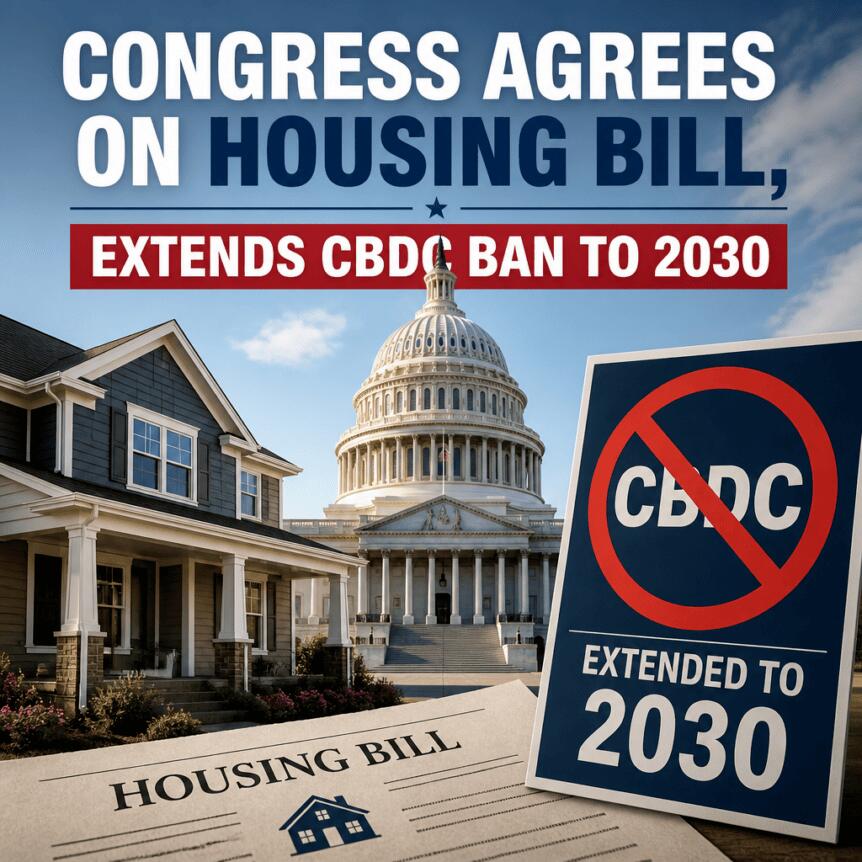
The US House and Senate have reached an agreement on a housing package that includes a ban on the Federal Reserve creating a central bank digital currency (CBDC) until the end of 2030, according to an updated bill text released by bipartisan lawmakers on Tuesday. The deal also addresses housing affordability and would block institutional investors from buying existing single-family homes to rent them out.
The updated version of the 21st Century Road to Housing Act will now move back to the House for consideration after the Senate added additional amendments. House Republican leaders are expected to put the measure to a vote after members return from recess on June 23, two people familiar with the plan told Politico.
Key takeaways
- The housing bill would restrict the Federal Reserve from issuing or creating a CBDC (or a substantially similar digital asset) until Dec. 31, 2030.
- The restriction includes a stated carveout for certain dollar-denominated stablecoins that are described as open, permissionless, and private.
- The Senate and House versions previously differed; the Senate’s added amendments must be approved by the House before final passage.
- Backers expect the agreement to advance quickly, potentially freeing Congress to focus on other crypto-related legislation, including the proposed CLARITY Act.
- The CBDC language revives concepts similar to an earlier House-passed “Anti-CBDC Surveillance State Act.”
How the CBDC ban ends up inside a housing bill
A bipartisan group of House and Senate leaders released updated bill text on Tuesday, launching the next stage of the 21st Century Road to Housing Act’s path to a final vote. As in earlier versions, the measure includes a CBDC prohibition aimed at limiting federal experiments with central-bank-issued digital money.
The CBDC ban was first added after the Senate passed the amendment in March, and the House supported its own version in May. But the two chambers could not immediately reconcile differences, leaving the bill in limbo. The new agreement reflects the latest round of negotiations, with Senate amendments now requiring House approval.
Crypto advocates have criticized CBDCs for what they view as the potential for government-controlled financial infrastructure and surveillance concerns—criticisms that have helped shape years of congressional pushback against standalone CBDC proposals.
What the law would actually restrict
The housing package’s CBDC language states that the Federal Reserve may not, directly or indirectly, “issue or create a central bank digital currency or any digital asset that is substantially similar to a central bank digital currency.” The provision is time-limited and would expire on Dec. 31, 2030.
Importantly for market participants, the clause includes a carveout for specific stablecoins—described as “dollar-denominated currency that is open, permissionless, and private.” That wording matters because it suggests the bill’s authors are drawing a boundary between central-bank-issued digital currency and privately issued stablecoins that meet the bill’s stated attributes.
In practical terms, the decision to embed this restriction in a housing bill may influence the bill’s momentum: housing legislation typically attracts broader coalitions than narrow crypto bills, potentially giving CBDC opponents a more workable legislative vehicle.
Connections to earlier CBDC proposals
The clause in the updated bill “revives much of the language” from Republican Rep. Tom Emmer’s Anti-CBDC Surveillance State Act, which was introduced in June 2025 and passed by the House the following month—but did not advance in the Senate.
That history highlights a key tension in Washington’s approach: even when House support for CBDC limits is strong, Senate action has been less predictable. By folding CBDC language into a broader measure, the current bill may sidestep some of that earlier gridlock.
The broader policy pressure also follows executive action. US President Donald Trump signed an executive order in January 2025 directing federal agencies to avoid work related to CBDCs, arguing the technology would threaten “the stability of the financial system, individual privacy, and the sovereignty of the United States,” as described in the order published by the White House.
What happens next for Congress and the crypto policy agenda
Lawmakers expect the housing bill to pass quickly once the House considers the Senate’s updated amendments. If House leadership proceeds on the June 23 timeline mentioned by Politico, the legislation could clear the final procedural hurdle before the August recess and the November midterm elections.
That timing may also shape what comes next on crypto regulation. The agreement is expected to allow Congress to devote attention to other proposals, including the CLARITY Act, which many lawmakers have pushed to advance. While the housing bill focuses on CBDCs and housing affordability, a separate regulatory framework would determine how the industry is supervised in the absence of a CBDC.
For investors and builders, the immediate watch-items are procedural: whether the House adopts the Senate’s amendments without further changes, and how the carveout for “open, permissionless, and private” dollar-denominated stablecoins is interpreted once lawmakers move from text to implementation.
Until the final vote and any subsequent clarification, market participants should also monitor whether the time-limited nature of the ban—ending at Dec. 31, 2030—affects planning for any future central-bank digital currency efforts, including how regulators and policymakers might revisit the question after the expiration date.
https://www.cryptobreaking.com/congress-agrees-on-housing-bill/?utm_source=blogger%20&utm_medium=social_auto&utm_campaign=Congress%20Agrees%20on%20Housing%20Bill,%20Extends%20CBDC%20Ban%20to%202030%20
Comments
Post a Comment