
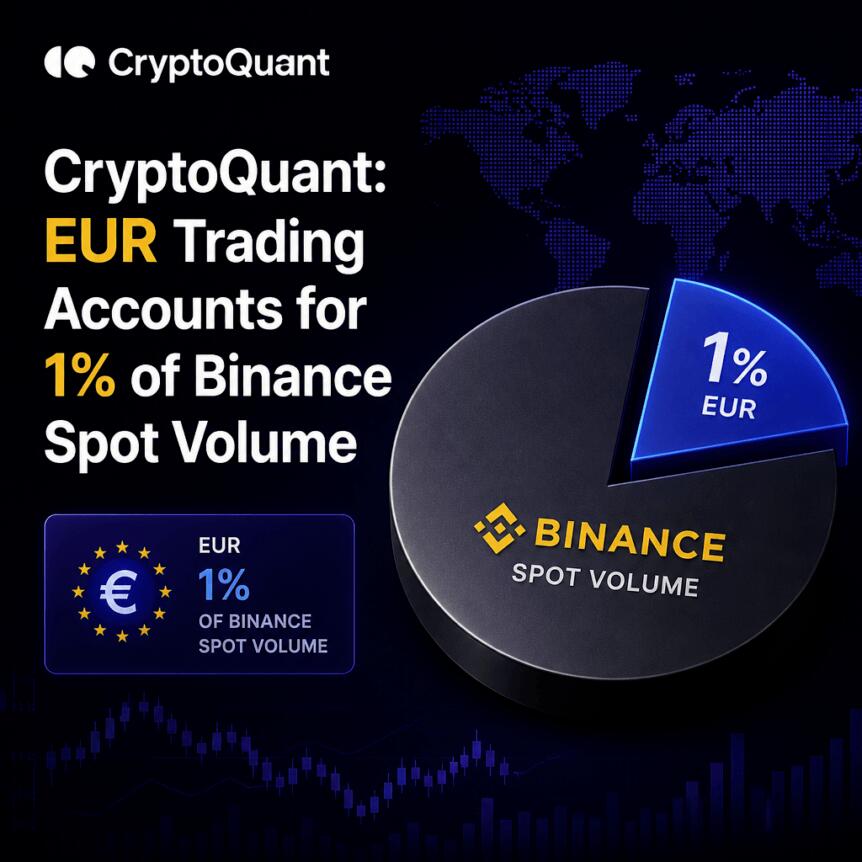
As Europe approaches the MiCA framework deadline on July 1, Binance’s exposure to euro-based trading activity remains modest—but regulatory friction could still reshape how the exchange serves EU customers. CryptoQuant analyst Maartunn told Cointelegraph that euro (EUR) spot trading accounts for roughly 1% of Binance’s global spot volume, suggesting that any setback tied to European licensing may not immediately affect the exchange’s overall trading footprint.
That said, Binance still handles very large absolute volumes in EUR pairs. At the same time, reporting indicates Greek regulators may be preparing to reject Binance’s licensing application, a potential obstacle to the exchange’s ability to continue servicing EU residents under MiCA rules.
Key takeaways
- EUR-denominated spot trading is about 1% of Binance’s overall global spot volume, according to CryptoQuant analyst Maartunn.
- Even with that small share, Binance’s daily EUR-pair volumes can reach roughly $100 million to $250 million, with spikes above $600 million, based on CryptoQuant data.
- Greek regulators are reportedly preparing to reject Binance’s MiCA-related licensing application ahead of the July 1 transitional deadline.
- ESMA-based estimates cited by analyst Merlijn Geurds suggest only around 210 out of 1,200+ pre-MiCA-registered firms have obtained full authorization under MiCA.
- MiCA authorization already secured by several large exchanges means compliant “passporting” across EU member states is becoming available to some players while others face a longer transition.
Binance’s euro activity: small slice, meaningful totals
Binance is often viewed through the lens of global liquidity, but the euro market matters for regional access and compliance. Maartunn’s CryptoQuant analysis indicates EUR trading contributes only around 1% of Binance’s spot volume—an important detail when assessing how damaging a regulatory setback could be to the exchange’s business overall.
At the operational level, that small percentage still translates into substantial activity. CryptoQuant data cited in the article shows Binance’s daily EUR-pair volumes have typically ranged from about $100 million to $250 million in 2026, with occasional spikes above $600 million. For traders who focus on euro liquidity, the question is less whether Binance is “big” in Europe—more whether it can remain legally accessible as MiCA tightens.
For context, a December 2024 Kaiko report said Binance, along with Bitvavo, Kraken, and Coinbase, accounted for more than 85% of all euro-denominated crypto trading volume. The implication is that even if Binance’s EUR share is a minority of its total volume, it is still likely to be a major venue for euro-based trading demand.
Regulatory pressure intensifies before MiCA’s July 1 deadline
The regulatory timeline is now central to Binance’s European path. Earlier coverage from Cointelegraph reported that Greek regulators may be preparing to reject Binance’s licensing application ahead of MiCA’s transitional deadline on July 1. If accurate, a refusal could complicate Binance’s ability to continue serving EU residents—at least in the member state where the decision is pursued—depending on how the broader licensing and enforcement process plays out.
The practical market effect may vary. If Binance’s EU business is concentrated in specific jurisdictions, a rejection could lead to service restrictions or customer migration in those areas first. Meanwhile, Maartunn’s comment that Binance inflows are globally distributed suggests that the exchange may be less vulnerable to a “whole-platform” shock than regulators in Europe might hope for—or than some users might fear.
Still, global diversification doesn’t eliminate regional consequences. For euro-denominated traders, liquidity fragmentation can occur if access is limited on a country-by-country basis. Even a relatively small share of Binance’s overall volume can be significant in a single region’s order books, particularly when the larger market is already concentrated among a few major exchanges.
Passporting reality: some firms already cleared, others still waiting
MiCA’s most consequential feature for exchanges is the ability to operate across the EU using a “passporting” regime once authorization is granted. Several large platforms have already secured MiCA-related licenses or authorization mechanisms that enable them to offer services across member states.
According to the article, Bitvavo, Kraken, and Coinbase are among the major exchanges that have already obtained MiCA authorization. Their progress matters because it sets a benchmark for what markets can expect from compliant providers: continued access, more predictable operating conditions, and less friction for institutions and retail users trying to meet regulatory requirements.
In contrast, exchanges that are still navigating approvals face a more complex setup. Compliance under MiCA isn’t only about filing paperwork; it requires governance structures, compliance controls, and operational safeguards. The article points to how these obligations can be difficult for smaller firms and could lead to forced migrations or cutoffs for certain business models.
Why MiCA is driving consolidation among CASPs
The broader licensing bottleneck described in the article highlights why Binance’s situation is not isolated. Market analyst Merlijn Geurds, using estimates based on European Securities and Markets Authority (ESMA) data, suggested that only around 210 of more than 1,200 firms operating under pre-MiCA registration regimes have obtained full authorization under MiCA.
Geurds told Cointelegraph that the gap reflects the cost and complexity of compliance—particularly for organizations that lack mature governance, compliance, and operational risk controls. In his framing, the outcome is “consolidation by design,” where a smaller number of well-capitalized, licensed players can use MiCA passporting across all 27 EU states, while others face a harder road.
The investment implication is straightforward: as licenses become the gating factor for EU access, regulatory certainty can start to outperform raw market share. Traders and liquidity providers may gravitate toward venues with confirmed authorization, while firms still waiting for decisions risk losing users or seeing volumes shift to compliant alternatives.
Cointelegraph reported that it contacted Binance regarding the size of its European business and the potential impact of MiCA-related restrictions, but had not received a response by publication. That leaves some important questions open, especially around what operational steps Binance may take if approval paths narrow.
With MiCA’s July 1 deadline approaching, the next developments to watch are how Greek regulators ultimately decide on Binance’s application and whether similar decisions emerge in other EU jurisdictions. Even with a small EUR share of global spot volume, the exchange’s ability to remain legally accessible for euro traders could still determine where liquidity concentrates across Europe.
https://www.cryptobreaking.com/cryptoquant-eur-trading-accounts-for/?utm_source=blogger%20&utm_medium=social_auto&utm_campaign=CryptoQuant:%20EUR%20Trading%20Accounts%20for%201%%20of%20Binance%20Spot%20Volume%20
Comments
Post a Comment