
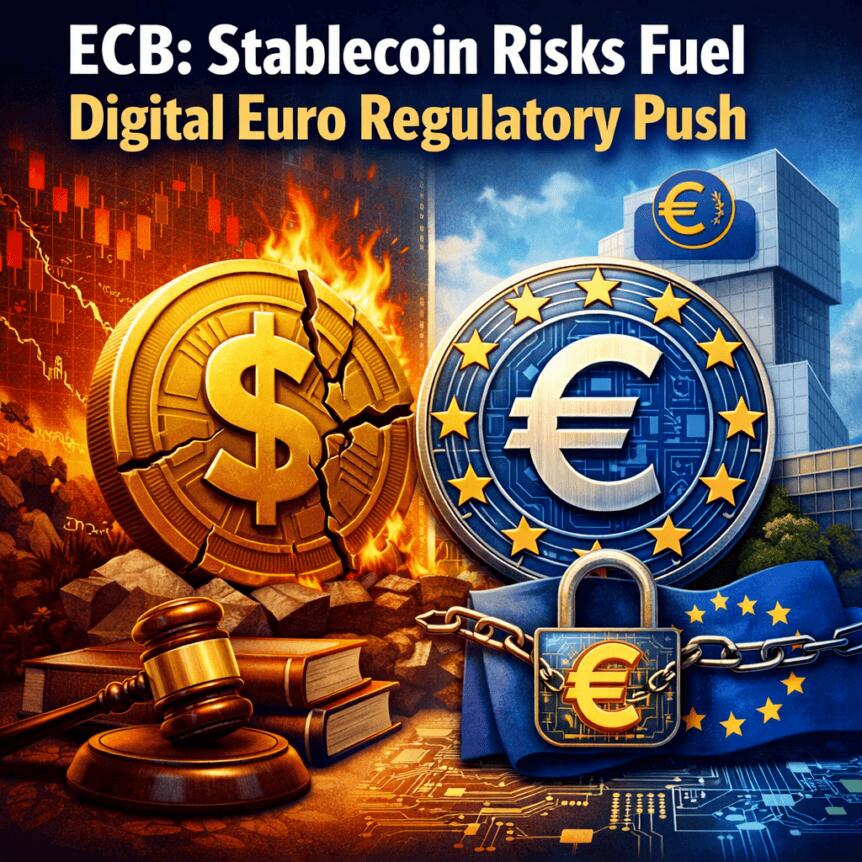
European Central Bank (ECB) Executive Board member Isabel Schnabel has warned that stablecoins could import traditional financial-market vulnerabilities into tokenized finance, while also reinforcing the case for modernizing public money through instruments such as a retail digital euro and tokenized central bank settlement. Her remarks come as Europe weighs how to shape the future of money in a rapidly evolving ecosystem of digital assets and on-chain finance.
Speaking at the 2026 Bank of Korea International Conference on Central Banks and the Future of Money in Seoul, Schnabel compared stablecoins to money market funds, underscoring that both can drive meaningful financial innovation but also carry systemic risks. “Stablecoins can offer useful financial innovation while also creating risks around bank disintermediation, runs, fire sales and monetary policy transmission,” she noted.
Central banks cannot remain passive observers of these developments. Private forms of money, once widely adopted, can shape the financial system in ways that are difficult to reverse. The proper response is not to resist innovation but to ensure it develops within a framework that preserves stability, monetary control and trust in the currency.
According to the ECB, Schnabel highlighted that the Eurosystem’s response to tokenized finance rests on two pillars: a retail digital euro and tokenized wholesale central bank money. In March, the central bank unveiled its Appia roadmap for Europe’s tokenized financial markets, with Pontes slated to provide a distributed ledger technology (DLT) settlement bridge to the Eurosystem’s TARGET services, planned to launch in the third quarter of 2026.
Schnabel argued that central banks should not resist innovation, but must modernize public money to preserve financial stability and monetary control. “Central banks cannot remain passive observers of these developments,” she said, adding that private forms of money, once widely adopted, can shape the financial system “in ways that can be difficult to reverse.” The proper response, she contended, is to ensure innovation unfolds within a framework that protects stability, monetary control, and trust in the currency.
Stablecoins are overwhelmingly dollar-pegged, while broader adoption could amplify US policy spillovers abroad, ECB data indicate. Source: European Central Bank
MiCA review sharpens stablecoin debate
The speech reinforces a European stance that simply promoting euro-denominated stablecoins is not sufficient to counter the dollar’s global reach. In a related thread, ECB President Christine Lagarde said on May 8 that stablecoins are not Europe’s best route to strengthening the euro’s international role; rather, Europe should build tokenized settlement infrastructure anchored by central bank money.
The European Union is currently reviewing the Markets in Crypto-Assets Regulation (MiCA), with a public consultation open until August 31 to determine whether the bloc’s crypto rules should be updated. The aim is to assess how MiCA should adapt to evolving stablecoin designs, settlement rails, and broader tokenized finance.
Industry participants are weighing in. Coinbase, in a Monday policy post, urged regulators to recalibrate MiCA’s approach to stablecoins—specifically on reserves, rewards and multi-issuance—and to clarify how regulated crypto firms can provide access to decentralized finance and global liquidity. Katie Harries, Coinbase’s director and head of policy for Europe and the Americas, argued that expanding reserves to high-quality sovereign assets and allowing non-interest incentives (such as cashback and loyalty points) could improve euro-stablecoins’ competitiveness.
The ECB has maintained a cautious line. On May 23, the bank warned EU finance ministers that loosening stablecoin rules could weaken bank lending and complicate monetary policy, even as policymakers debate whether Europe risks losing ground to dollar-backed tokens.
The MiCA debate sits at the intersection of stability, innovation, and market structure. As the EU considers updates to its crypto framework, authorities emphasize the need to balance competitive liquidity and consumer protections with the integrity of the financial system and monetary sovereignty. The broader policy question is whether Europe should pursue euro-denominated equivalents or invest in deeper, regulation-backed tokenized settlement infrastructure that remains anchored to central bank money.
Regulatory and policy implications for institutions
For regulated entities operating in Europe and globally, the evolving stance on stablecoins has concrete compliance and risk-management implications. Banks, exchanges, and custodians must assess how tighter or looser stablecoin rules affect balance-sheet treatment, reserve requirements, and liquidity planning. They must also anticipate how a more robust tokenized settlement layer could influence cross-border settlement, collateral management, and custody arrangements within a framework that preserves monetary sovereignty.
From a regulatory perspective, the ongoing MiCA review and the ECB’s broader program of digital euro and tokenized settlement signals a shift toward greater public-money governance in the design of tokenized finance. While innovation remains a priority, policymakers stress that developments should occur within a framework that maintains financial stability, predictable monetary transmission, and trust in the currency. This approach has direct implications for licensing, oversight, and the allocation of supervisory resources as digital assets and tokenized rails scale across markets.
The Appia initiative—centering on a DLT settlement bridge to TARGET services and designed to integrate with tokenized markets—illustrates the practical steps Europe is taking to operationalize tokenized finance within existing public-money rails. With a planned launch in the third quarter of 2026, Appia represents a concrete mechanism for linking tokenized assets to central-bank settlement infrastructure, potentially shaping liquidity, settlement finality, and risk controls across member states.
In this moment of policy recalibration, institutions should monitor two fronts: the regulatory trajectory of MiCA and Europe’s broader strategy for public-money-backed settlement infrastructure, and the pace at which tokenized wholesale and retail money can scale within stable, well-supervised ecosystems. The balance between fostering innovation and preserving financial stability will determine the region’s competitive stance in global digital finance and its influence on cross-border policy harmonization.
Closing perspective: As Europe weighs updates to MiCA and advances in digital euro and Appia-enabled settlement, institutions should prepare for regulatory developments that may redefine stablecoin design, custody, and settlement practices, while preserving the integrity of monetary policy and financial stability in a rapidly digitizing market landscape.
https://www.cryptobreaking.com/ecb-stablecoin-risks-fuel-digital/?utm_source=blogger%20&utm_medium=social_auto&utm_campaign=ECB:%20Stablecoin%20Risks%20Fuel%20Digital%20Euro%20Regulatory%20Push%20
Comments
Post a Comment