
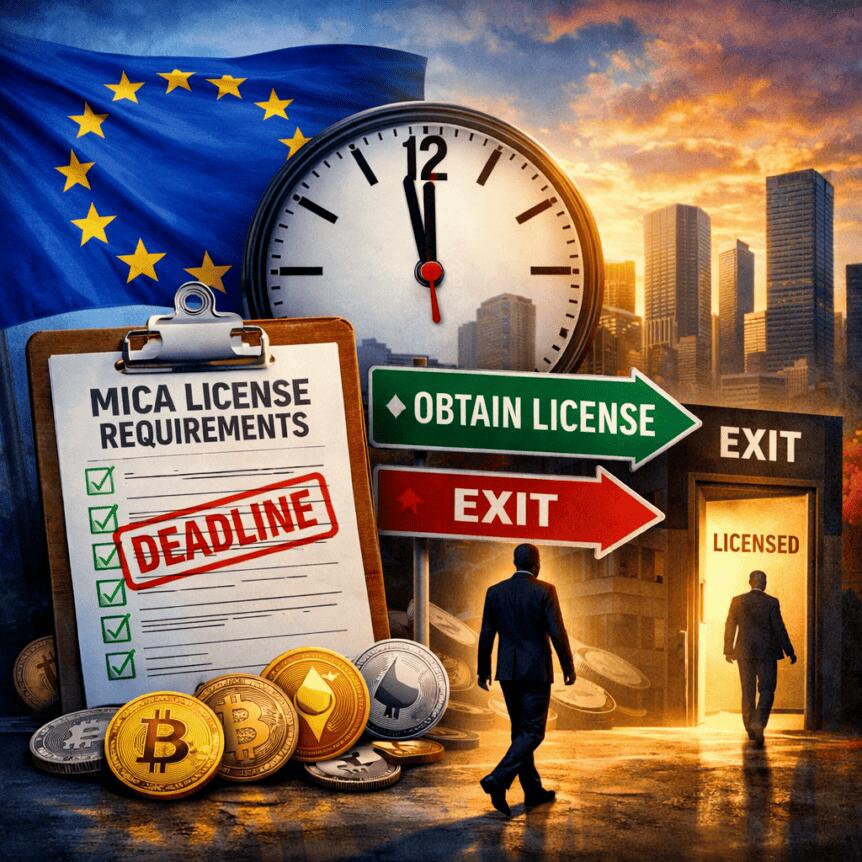
The European Union’s Markets in Crypto Assets Regulation (MiCA) reaches a pivotal juncture on July 1, when the transitional regime concludes and crypto asset service providers operating under national regimes must hold a MiCA licence or discontinue EU operations. According to ESMA, non-authorized entities will not be permitted to operate within the bloc from that date and should implement wind-down plans and client migrations rather than rely on an open-ended transitional status while awaiting a decision.
The deadline raises the prospect that some firms will suspend EU activities while their MiCA applications are under review, potentially disrupting access for millions of EU-based users who continue to engage with platforms not yet authorized under MiCA.
Key takeaways
- Effective July 1, any crypto asset service provider without a MiCA licence, operating under national exemptions, must cease EU operations or risk enforcement actions.
- Regulators have explicit enforcement tools to halt services, force client offboarding, publish firm names, and impose administrative fines for unauthorized activity under MiCA.
- France has authorised 19 CASPs so far, with about 25 additional applications under review, while unauthorized providers face criminal penalties (up to two years in prison and a 30,000 euro fine).
- Germany requires that providers previously operating under exemptions obtain licence by June 30, with enforcement measures possible where appropriate.
- Austria did not extend grandfathering under its pre-MiCA regime; no exchanges are operating without a licence in the country, with nine CASPs licensed by the FMA and a significant volume of MiCA applications still in process.
- Industry estimates suggest a sizable share of European users may still interact with non-MiCA-authorized platforms; OKX Europe’s analysis indicates that a substantial portion of active users may be on non-authorized exchanges.
- Major exchanges remain in the licensing process, including Bitget (Austria) and Binance (Greece); neither is currently listed among MiCA-authorized providers in the EU, with statuses evolving as regulators review applications.
National enforcement landscapes and licensing progress
France’s Autorité des marchés financiers (AMF) has authorised 19 crypto asset service providers to operate under MiCA, with roughly 25 applications still under review. The AMF emphasizes that from July 1, providers not licensed under MiCA must cease their activities within the French market. The regulator has also signaled that it can blacklist firms, issue public warnings, and seek court orders to block access to sites targeting French users. Unauthorized activity is treated as a criminal offence with potential penalties including prison time and fines.
Germany has adopted a national implementation approach that includes a licensing requirement for providers previously operating under exemptions. BaFin, its national regulator, indicated that a licensing window closes by June 30, and enforcement may be applied where appropriate as regulators review ongoing applications. The German stance aligns with MiCA’s directive for national authorities to grant immediate enforcement powers against unauthorised services.
Austria presents a stricter posture by choosing not to extend any grandfathering for virtual asset service providers under its pre-MiCA regime. The post-transition environment is designed so that no exchanges operate without a licence. The Finanzmarktaufsicht (FMA) has licensed nine CASPs to date, and it notes that MiCA-related applications are significant, though it does not disclose pending figures.
Legal risk, enforcement tools, and what the end of transitional periods means for providers
Industry legal counsel stress that simply having a MiCA application in progress does not shield a CASP from the July 1 deadline. Firms continuing to serve EU clients without an authorised MiCA framework will be operating unlawfully and cannot expect business-as-usual treatment once transitional protections lapse. MiCA itself equips member states with clear authorities to order an immediate halt to services, mandate client offboarding, publicly name non-compliant firms, and impose administrative fines for unauthorized activity. This creates a path for rapid, targeted action by regulators against non-compliant platforms.
These enforcement provisions bear significantly on the operational dynamics across the EU, potentially triggering abrupt wind-downs, forced migrations of clients to compliant platforms, and heightened scrutiny of cross-border service provision. The end of transitional periods also intersects with broader regulatory expectations around AML/KYC compliance, consumer protection, and ongoing supervisory oversight of licensing practices across member states.
Impact on users and market structure
The potential disruption extends beyond the regulated landscape into user access and liquidity across the European market. Analysis shared with Cointelegraph by OKX Europe suggests a sizable portion of European crypto users may still be active on platforms that are not MiCA-authenticated. OKX Europe quantified a period from May 2025 to May 2026 during which 18.5 million crypto app downloads occurred in Europe; approximately 7.6 million of those downloads, or 41%, were for exchanges not appearing on the independent MiCA-authorized provider register maintained from ESMA and national datapoints. OKX cautions that app-install data undercounts user activity due to browsers or earlier-app usage, and thus estimates may not capture all active users. OKX Europe CEO Erald Ghoos described this as a meaningful exposure, noting that many users may still rely on non-authorized platforms through multiple access channels.
The European Securities and Markets Authority (ESMA) has not provided a public estimate of how many EU users remain on unauthorised platforms, citing the absence of non-public information. The regulatory framing underscores a transition in market structure: as MiCA entrants consolidate, a period of adjustment is expected where users migrate to licensed venues or where enforcement narrows the field of available services. This shift has potential implications for cross-border banking relationships, stablecoin integration within regulated rails, and the standardization of licensing and supervisory practices across jurisdictions.
Active applicants and ongoing licensing momentum
Not all major exchanges have achieved MiCA licensure. Bitget has applied for a MiCA licence in Austria in 2025 and indicated it expects regulatory approval in the second quarter of 2026; it has stated it will refrain from offering EEA services until authorization is granted. Binance has pursued a MiCA licence in Greece via the Hellenic Capital Market Commission and is not listed among MiCA-authorized providers in the EU as of now. Binance did not respond to requests for comment on its application status. The ongoing review processes for these and other providers will shape the pace at which non-localized regional operations convert to fully MiCA-compliant activity.
These licensing trajectories illustrate how enforcement timelines, national regulatory interpretations, and the resources available to review applications will influence the competitive landscape. For exchanges of scale, the MiCA licensing process functions not merely as a compliance hurdle but as a potential market access gate that can determine cross-border growth and consumer reach within the EU’s single market framework.
Closing perspective
As the July 1 deadline approaches, the EU’s MiCA framework moves from principle to practice, pushing providers toward formal licensing, wind-down planning, or exit from the EU market. The evolution will test regulatory coordination among member states, map user exposure across compliant and non-compliant platforms, and redefine the structural dynamics of crypto service provision in Europe. Forward-looking vigilance will be essential for institutions tracking licensing trajectories, enforcement actions, and the practical implications for compliance, risk management, and customer continuity in a transitioning market.
https://www.cryptobreaking.com/eu-mica-deadline-forces-crypto/?utm_source=blogger%20&utm_medium=social_auto&utm_campaign=EU%20MiCA%20Deadline%20Forces%20Crypto%20Firms%20to%20Obtain%20Licenses%20or%20Exit%20
Comments
Post a Comment