
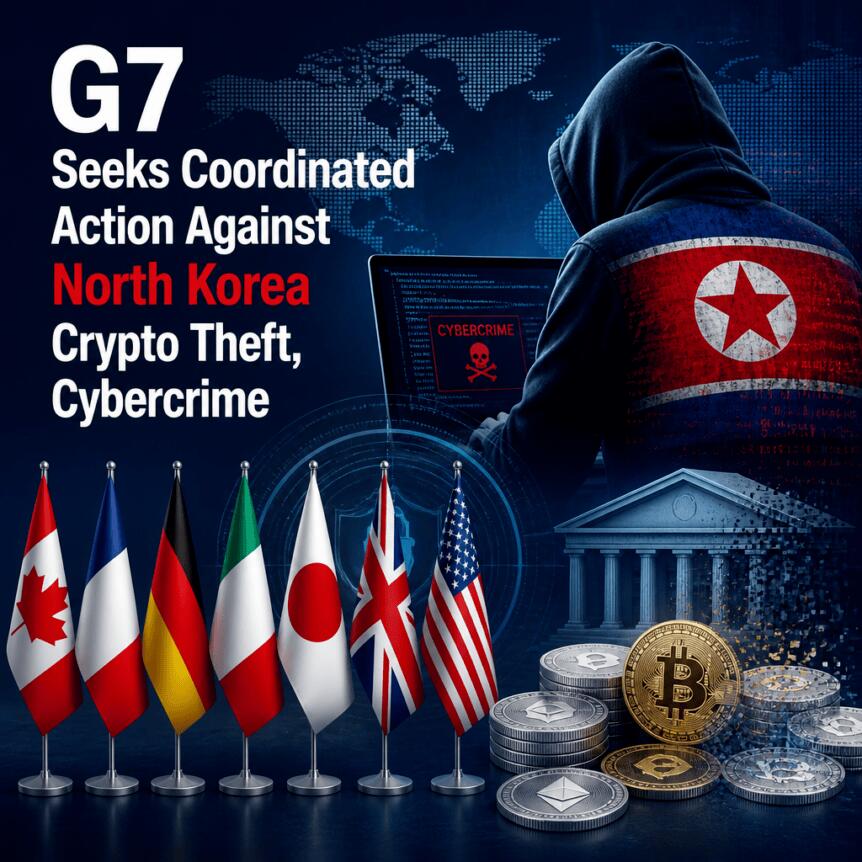
Leaders from the Group of Seven (G7) have renewed their push for coordinated action against North Korean cryptocurrency thefts and related cybercrime. The renewed appeal was included in a statement adopted at this week’s G7 summit in Évian-les-Bains, France, as governments continue to connect DPRK-linked cyber activity with funding for the country’s nuclear and ballistic missile programs.
The G7 statement expresses “deep concern” about North Korea’s weapons ambitions and reiterates that institutions such as the United Nations and security researchers have linked crypto theft to those national security priorities. However, the leaders stopped short of specifying enforcement steps, leaving unclear how members should translate the call into concrete measures for exchanges, investigators, or service providers.
Key takeaways
- The G7 adopted a renewed call for joint action targeting North Korean cryptocurrency thefts tied to weapons financing.
- While the statement references UN and researcher findings, it does not detail specific operational measures such as exchange screening or sanctions.
- The push builds on a similar G7 reference from its June 2025 summit in Canada, when the chair urged members to address “DPRK cryptocurrency thefts fueling” military programs.
- Recent high-profile hacks linked to North Korean actors underscore the ongoing threat environment, including the Drift Protocol and Humanity Protocol incidents.
- Chainalysis reports that DPRK-affiliated actors stole at least $2 billion in crypto during 2025, bringing the attributed total to at least $6.75 billion.
A coordinated response urged—but implementation remains vague
At the center of this week’s update is a diplomatic message: G7 leaders again flagged North Korean cyber activity as a serious geopolitical and security issue. In the statement, they emphasize “deep concern” regarding North Korea’s nuclear and ballistic missile programs and note that relevant bodies have drawn links between those programs and crypto theft.
Notably, the statement does not spell out how G7 countries should respond. It does not mention commonly discussed tools in this context, including systematic exchange monitoring, targeted sanctions frameworks, or countermeasures against mixing services frequently associated with crypto laundering. For market participants, that matters: without clearer directives, enforcement approaches may differ across jurisdictions and timelines, leaving gaps that attackers can exploit.
It also signals that the G7 remains focused on the financing pathway rather than solely on the cyber intrusion itself—an emphasis that aligns with broader efforts to disrupt illicit proceeds even when direct attribution to state-linked actors is difficult.
How the latest call ties back to mid-2025
This renewed push did not appear from nowhere. The G7’s June 2025 summit in Canada already included an explicit reference to DPRK crypto theft. According to the summary from the 2025 meeting, the group’s chair urged members to jointly address “DPRK cryptocurrency thefts fueling” North Korea’s nuclear and ballistic missile programs.
This time, the message is effectively refreshed rather than transformed: leaders once again highlight the same underlying connection between stolen digital assets and military financing. The absence of operational detail, however, suggests the bloc may still be negotiating how far to go on enforcement cooperation—especially in areas where jurisdictional authority, regulatory definitions, and private-sector obligations can vary widely.
Recent hacks keep pressure on regulators and exchanges
The G7’s statement arrives alongside a stream of high-profile incidents widely suspected to involve DPRK-affiliated actors. Earlier coverage referenced a roughly $285 million Drift Protocol exploit in April and a $36 million breach of the Humanity Protocol in June.
These cases matter beyond their immediate losses. Large exploits can quickly produce large volumes of crypto that must be handled in ways compliant with evolving anti-money-laundering expectations. When proceeds circulate, investigators and compliance teams often have to act under tight deadlines—especially if stolen funds move across multiple platforms, networks, or custody arrangements.
For the broader ecosystem, such hacks also reinforce the argument that cyber defense and financial controls cannot be treated separately. Even if a breach is contained quickly, the financial workflow that follows can still enable illicit actors to convert stolen value into assets that can be used for strategic ends.
2025 theft volume: fewer attacks, larger returns
Independent estimates underline why the issue remains a top priority for policymakers. According to Chainalysis, North Korean hackers stole at least $2 billion in crypto during 2025. That figure pushes the all-time total attributed to DPRK-affiliated actors to at least $6.75 billion.
Chainalysis also reported an important shift in the pattern of activity. The firm said the attackers generated bigger returns in 2025 even though they executed fewer confirmed attacks. The report attributes this to tactics such as embedding information technology workers inside crypto companies and using social engineering—such as impersonating recruiters and investors—to gain access to internal systems.
These details suggest that attackers may be optimizing for access and leverage rather than relying solely on opportunistic technical exploits. If that approach continues, organizations may need to broaden their threat models, placing greater emphasis on insider risk, identity verification, and internal access controls—not just external application or protocol security.
Security firms and UN-linked assessments continue to point to weapons financing
Additional reporting cited by the article reinforces the link between crypto theft and military funding. On May 15, a CrowdStrike report described North Korean actors as the largest threat group targeting crypto users by value stolen. CrowdStrike said the campaigns prioritized high-value targets and that the proceeds were “almost certainly laundered to fund the regime’s military programs.”
Meanwhile, North Korea has rejected allegations that it poses a cyber threat. In a May 3 statement carried by KCNA, a Foreign Ministry spokesperson accused the United States of spreading false information and characterized claims of a North Korean cyber threat as politically motivated “slander.”
The contradiction is typical in this area: attribution-based findings from investigators and cybersecurity firms are often contested by the accused state. For investors and builders, the practical takeaway is not to resolve the dispute rhetorically, but to recognize that the operational risk—whether one frames it as state-directed or state-tolerated—remains substantial and persistent.
Readers should watch whether the G7’s renewed language leads to more specific, enforceable guidance for market participants—particularly around exchange controls, compliance expectations, and how governments coordinate across borders. Until concrete steps follow, the gap between political messaging and operational implementation may remain a vulnerability that DPRK-linked actors continue to test.
https://www.cryptobreaking.com/g7-seeks-coordinated-action-against/?utm_source=blogger%20&utm_medium=social_auto&utm_campaign=G7%20Seeks%20Coordinated%20Action%20Against%20North%20Korea%20Crypto%20Theft,%20Cybercrime%20
Comments
Post a Comment