
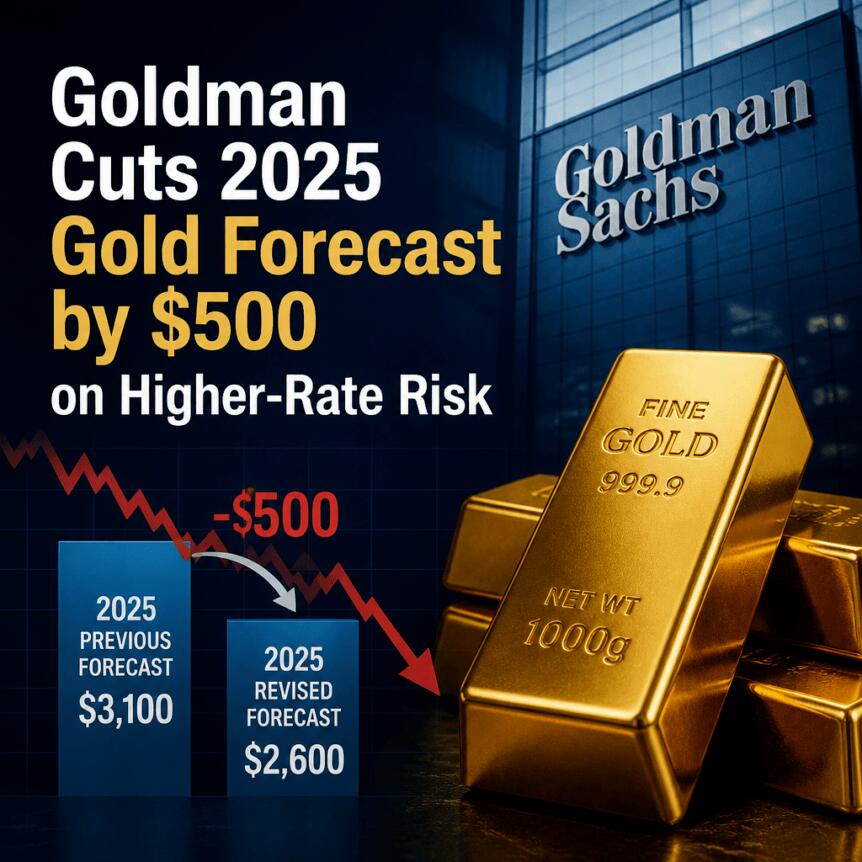
Goldman Sachs has cut its year-end gold forecast by $500 per ounce, citing expectations that the US Federal Reserve will not cut interest rates this year. The revision reflects a broader repricing of “easy money” assumptions—one that could ripple through both traditional safe-haven demand for bullion and the risk appetite that supports cryptocurrencies.
In a note cited by Bloomberg, Goldman Sachs commodity analysts Lina Thomas and Daan Struyven said their view remains “structurally constructive but tactically cautious,” with downside risk in the near term and upside potential over the medium term. The bank’s new target places gold at $4,900, down from an earlier estimate of $5,400.
Key takeaways
- Goldman Sachs lowered its year-end gold forecast to $4,900 per ounce, attributing the change to expectations of no Fed cuts in 2026.
- The downgrade assumes potential rate-cut timing shifts to March 2027 and December 2027.
- Delayed interest-rate cuts can pressure both gold and Bitcoin, since lower rates typically support speculative demand.
- Gold is trading close to key technical territory, with Cointelegraph noting it has fallen more than 22% from its January all-time high.
Gold forecast cut as rate-cut timing slips
The revision is rooted in the macro backdrop. Goldman Sachs is assuming that the next Fed rate cuts could be pushed out to March 2027 and December 2027, a change that can matter because gold does not generate yield. When rates remain higher for longer, cash and bonds become relatively more attractive—raising the opportunity cost of holding bullion.
Goldman’s analysts framed the outlook as a mix of longer-term optimism and short-term caution. While they still see structural support for gold, they warned that tactical pressure could persist as markets price in fewer near-term liquidity tailwinds.
Why higher-for-longer rates matter to crypto
Cryptocurrency investors often treat interest rates as a key driver of liquidity conditions. The article’s underlying thesis is consistent with how the market has historically behaved: when rates fall, the environment tends to improve for high-duration assets and speculative positioning.
Conversely, a delay in US rate cuts can weigh on digital assets. Lower rates typically reduce the cost of capital and can encourage risk-taking, which often benefits assets such as Bitcoin. If expectations for easing are pushed further out, the same “liquidity improves” narrative weakens.
This transmission mechanism is not limited to crypto sentiment. It also connects to gold’s own behavior: as rates stay elevated, bullion may face headwinds even when broader uncertainty keeps demand for a hedge intact. The result can be a period where both gold and cryptocurrencies soften simultaneously, not because the hedge thesis disappears, but because the opportunity-cost argument becomes harder to ignore.
Market pressure builds: CPI prints and Middle East conflict
Gold’s decline has been unfolding against a difficult demand backdrop. Last week, analysts warned that Bitcoin and gold could face additional pressure this year after US inflation data reinforced the idea that policy easing may be delayed. Cointelegraph pointed to a 4.2% year-on-year increase in the US Consumer Price Index in May, alongside ongoing conflict in the Middle East.
In addition to inflation, geopolitical risk can complicate the rate outlook through energy and risk-premium channels. The article notes that the conflict in the Middle East has also taken a toll on both assets. For traders and investors, that matters because it can keep markets focused on macro variables rather than idiosyncratic catalysts.
Approaching psychologically important levels in gold
The downside focus is reinforced by current positioning in gold. Since its January all-time high of $5,327 per ounce, gold has declined by more than 22%, according to the data referenced by Cointelegraph. Bitcoin, meanwhile, is down 28.3% since January, highlighting that the pressure has not been limited to a single asset class.
Gold is now only about $135 away from testing the $4,000 area—an inflection point not seen since November, according to GoldPrice. While forecasts are long-range and markets can overshoot both directions, the proximity to a major round-number level may increase sensitivity to new macro prints, Fed-related expectations, and any changes in geopolitical risk.
The “easy money” story that helped drive gold to record highs earlier this year may be losing some momentum if investors increasingly believe rates will stay restrictive for longer. As the opportunity cost of holding non-yielding assets rises, the market may need a stronger catalyst—such as clearly falling inflation or evidence of improving liquidity—to reverse course.
HashKey Group senior researcher Tim Sun told Cointelegraph: “Only when inflation drops, rate cuts become viable, and liquidity improves alongside lower capital costs, will the overall risk appetite truly reverse.”
What to watch next
With the debate now centered on whether rate cuts are truly off the table for 2026—and on how quickly liquidity expectations can recover—markets will likely monitor incoming inflation data and Fed-related messaging closely. Cointelegraph also referenced CME’s FedWatch tool, which shows a high chance of rates staying the same or rising in the remaining months of 2026 compared with the current target range of 3.5% to 3.75%.
https://www.cryptobreaking.com/goldman-cuts-2025-gold-forecast/?utm_source=blogger%20&utm_medium=social_auto&utm_campaign=Goldman%20Cuts%202025%20Gold%20Forecast%20by%20$500%20on%20Higher-Rate%20Risk%20
Comments
Post a Comment