
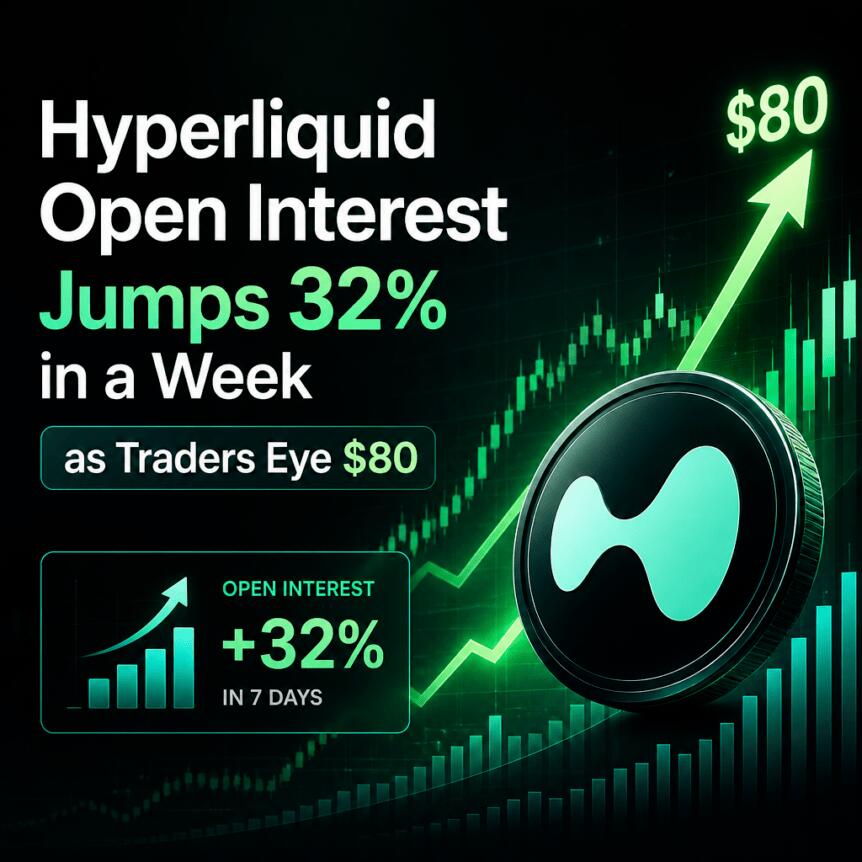
Hyperliquid has emerged as a rare bright spot in a sluggish crypto derivatives backdrop, with its native token HYPE surging to a new all-time high of $76.90 on Tuesday. The move came alongside a sharp expansion in HYPE futures activity: aggregate open interest rose 32% over the prior week to reach the $3 billion mark, even as the token later pulled back to around $73.
That combination—rising open interest alongside a rally—has traders weighing whether the latest momentum is being sustained by organic demand or amplified by leverage. While HYPE’s price action has drawn attention, Hyperliquid’s broader product strategy, including “TradFi” perpetuals, appears to be playing a significant role in keeping volumes resilient.
Key takeaways
- HYPE futures open interest reached $3 billion, up 32% week-over-week, even as HYPE retreated from its $76.90 all-time high.
- Funding on HYPE perpetuals stayed below the neutral 6% level for the past week, suggesting weaker bullish leverage pressure than many rallies would imply.
- Hyperliquid DEX volumes have held up in a broader market where DEX activity reportedly declined 57% over six months.
- Hyperliquid’s TradFi perpetuals have accumulated more than $2.9 billion in open interest, outpacing Bitcoin’s $2 billion in the same snapshot.
- Despite the momentum, valuation and dilution concerns remain: the token’s FDV is cited at $71.3 billion based on circulating and maximum supply figures.
Derivatives demand stays elevated, but leverage signals look mixed
According to CoinGlass, HYPE futures open interest climbed 32% from one week earlier, reflecting a notable step up in participation. The token’s rally was also strong over a short window—HYPE was reported up 44% over five days—but what matters for traders is whether new positions are likely to unwind quickly.
The details around perpetual funding provide one useful clue. As cited from Laevitas, the annualized funding rate on HYPE perpetuals remained below the neutral 6% threshold throughout the past week. In practice, that tends to indicate that the market is not paying unusually high premiums to stay long—often interpreted as weaker demand for purely bullish leverage.
At the same time, open interest increased. That combination suggests short sellers may be adding exposure even after HYPE’s price gains. The report also raises a plausible mechanism: contributors with tokens locked in the system could be hedging part of their positions as the market moves.
Market structure remains important here. If open interest growth is largely driven by hedge flows or two-sided strategies rather than one-directional leverage, rallies can persist longer—though the risk of volatility still remains whenever participants are forced to rebalance.
Hyperliquid’s TradFi perpetuals keep volumes from fading
While the HYPE rally captured headlines, the larger explanation offered is that Hyperliquid’s trading stack is not dependent solely on crypto-native pairs. The platform has launched “traditional finance” perpetual contracts tied to well-known benchmarks and assets, including S&P 500, Nasdaq 100, crude oil, SpaceX, Micron, gold, silver, and Google.
In the snapshot cited, open interest in these TradFi contracts exceeded $2.9 billion, which the article notes is substantially higher than the $2 billion open interest in Bitcoin. That comparison matters for investors because it signals that a material share of derivatives interest on Hyperliquid is being pulled from outside the most crowded segments of the crypto market.
On the DEX side, the report points to resiliency as well. While aggregate DEX volumes reportedly fell 57% over the previous six months, Hyperliquid stood out with $9.6 billion in activity. According to the cited figures from DefiLlama, Hyperliquid held a 53% share of perpetual trading volumes, far ahead of Binance (14%), Bybit (9%), and Bitget (8%).
Hyperliquid’s emphasis on “constant innovation” is also framed through examples such as pre-IPO trading of SpaceX shares, referenced by earlier coverage noting a synthetic SPX C price reaching a premium and a whale opening a long position. The implication for readers is straightforward: when a derivatives venue offers familiar exposures in a 24/7 format, it can attract flows even when broader on-chain trading cools.
Valuation debate returns as FDV towers over current circulation
Not all of the story is about momentum. The article highlights token supply math that can affect how traders think about upside and risk. CoinMarketCap data cited in the piece states that HYPE’s circulating supply was 253.41 million on Tuesday, versus a maximum supply of 953.92 million. Using those figures, the fully diluted value (FDV) is calculated at $71.3 billion.
That FDV is presented as comparable to the market capitalization of Aon Plc (AON), which the report describes as around $70 billion. Regardless of whether that comparison is the most meaningful for crypto valuation, it underscores the core issue: the token’s implied fully diluted size is large relative to its current circulating float, making the market sensitive to expectations about dilution timing and any release schedule.
This is where the tension sits. Hyperliquid’s growth and revenue potential may support long-term optimism, but valuation frameworks investors use—especially those sensitive to token unlocks—can cap how far the market is willing to price near-term gains.
The report also connects the bull case to Hyperliquid’s revenue generation and potential expansion into Real World Assets (RWA) trading. However, beyond those directional claims, readers should watch for more concrete evidence on how RWA volumes translate into durable earnings or sustainability for the HYPE token economy.
Institutional interest is a recurring theme, but confirmation matters
Beyond on-chain metrics, the article points to signaling from broader market narratives. It cites commentary from former Boston Federal Reserve Chair Eric Rosengren in relation to Hyperliquid’s performance, and references a “highly bullish” report from Citrini Research. Separately, it notes that HYPE exchange-traded funds (ETFs) have reportedly gathered $208 million since launch, which is positioned as a sign of institutional demand.
For investors, these are supportive indicators—but they are not the same thing as sustained capital inflows. The key question is whether the ETF narrative aligns with derivatives positioning and whether spot demand remains intact if funding and leverage conditions change.
With HYPE currently below its all-time high, the path toward the $80 level described in the report is framed as plausible, but not guaranteed. If funding stays subdued and open interest growth continues to be driven by broad participation rather than one-sided leverage, that would strengthen the case for extended momentum. Conversely, a rapid shift upward in funding toward persistently bullish levels could suggest the rally is becoming more dependent on leverage than organic demand.
For the weeks ahead, readers should track three things closely: how HYPE funding behaves relative to that 6% neutral mark, whether HYPE futures open interest keeps rising without a corresponding increase in aggressive long pressure, and how TradFi/RWA perpetual launches impact both DEX volumes and sustained derivatives market share.
https://www.cryptobreaking.com/hyperliquid-open-interest-jumps-32/?utm_source=blogger%20&utm_medium=social_auto&utm_campaign=Hyperliquid%20Open%20Interest%20Jumps%2032%%20in%20a%20Week%20as%20Traders%20Eye%20$80%20
Comments
Post a Comment