
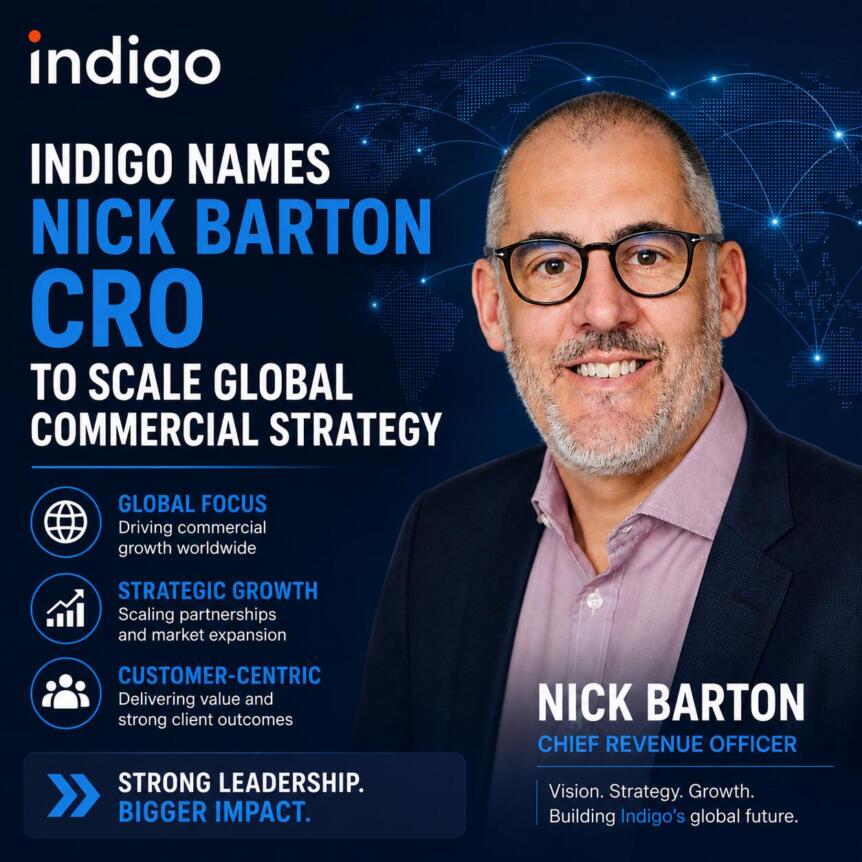
Indigo Telecom Group has appointed Nick Barton as its Chief Revenue Officer (CRO), a move aimed at strengthening the company’s commercial strategy as it scales service capabilities across its global footprint. The appointment comes as digital infrastructure providers face ongoing pressure to deliver consistent operations, measurable service quality, and dependable execution at hyperscale.
Indigo, which positions itself as an operational partner for critical infrastructure, operates in more than 90 countries under a single unified model. Its services are designed around delivery, support, field engineering, and 24/7 service operations, areas where buyers increasingly prioritize standardization and accountability, not only project delivery.
New CRO role targets commercial strategy and international growth
Barton joins Indigo from Aqua Comms, where he served as Chief Commercial Officer. Before that, he held senior commercial roles at Verizon Business and Colt Technology Services. Indigo said the CRO mandate will include leading commercial strategy, driving international growth, and deepening relationships across subsea, data centre, cloud, carrier, fixed, and mobile networks.
In practice, Indigo’s focus aligns with a broader market trend. As hyperscalers and network operators expand globally, they increasingly seek partners that can deliver consistent service across geographies while maintaining tight operational control. In that context, commercial leadership is closely linked to customer experience, service delivery performance, and the ability to scale while keeping service standards intact.
Why revenue leadership matters in infrastructure services
Unlike product-led businesses, providers of network and infrastructure operations often compete on execution quality and ongoing reliability. For buyers, the decision is rarely limited to pricing. It also depends on whether a supplier can meet service-level expectations, coordinate field and remote teams efficiently, and manage incidents with clear ownership and escalation paths.
Indigo’s appointment of a CRO suggests an intent to translate its operating model into stronger go-to-market performance, particularly with customers that require consistent operational outcomes. Indigo has emphasized an approach that unifies operational processes across markets, which can be a differentiator when selling to organizations that standardize vendors and service expectations globally.
Background across telecom enterprise and infrastructure operators
Indigo highlighted Barton’s more than 25 years of industry experience. His prior roles at Verizon Business and Colt Technology Services reflect a commercial and enterprise telecom background, while his most recent position at Aqua Comms indicates familiarity with network operations and international connectivity, particularly in areas related to critical infrastructure support.
While Indigo did not outline specific targets in the announcement, the scope of the CRO role spans multiple network segments. That breadth matters because buyers in this sector often evaluate suppliers across a portfolio of services, including deployment support, network operations, and incident management. Bringing those capabilities together is often tied to longer-term contracting and account expansion.
Indigo’s operating model as a commercial foundation
Indigo operates across 90+ countries under one unified model, according to the company. It brings together delivery and support functions, field engineering, and 24/7 operational control, supported by network and security operations centres and a global service desk.
The company also stated that it manages more than 30,000 incidents annually, emphasizing clarity in ownership, escalation, and accountability. For buyers, incident handling is a key part of total service performance, particularly where downtime or degraded performance can have downstream consequences across applications, connectivity, and customer operations.
By appointing a CRO with hyperscaler and international connectivity context, Indigo is signaling that it wants commercial execution to be closely coupled to service delivery strengths. In telecommunications and infrastructure operations, aligning revenue growth with operational rigor can be difficult, especially as service coverage expands.
Momentum includes deals tied to subsea and NOC capabilities
Indigo pointed to additional recent activity alongside the appointment. It referenced Heads of Terms with Aqua Comms to explore the acquisition of a network operations centre (NOC) capability, as well as a partnership with Trans Pacific Networks to support subsea operations across the US and Asia.
These initiatives, combined with a CRO hire, indicate continued investment in operational capacity tied to critical connectivity. For the market, subsea and cross-region operations are typically complex, with demanding uptime expectations and logistical challenges. Expansion in those areas usually requires both operational maturity and commercial alignment, particularly around contract structures and service guarantees.
Implications for hyperscale service outsourcing
Hyperscalers and carriers often consolidate vendors to reduce complexity and improve accountability. The ability to provide consistent service in multiple countries under a shared operating model can influence procurement decisions. In that environment, commercial leadership can be as important as engineering or operational staffing, because it shapes how service value is packaged, sold, and managed across accounts.
Indigo’s CRO appointment suggests the company wants to intensify its commercial focus as it scales. The near-term question for customers and partners will be whether that scaling improves responsiveness, service quality, and account expansion outcomes, especially in high-stakes operational categories such as subsea, network security, and always-on operations.
For now, the company has not provided further financial guidance or detailed performance targets associated with Barton’s appointment. Still, the decision reflects a familiar pattern in infrastructure services, where executive commercial leadership is brought in to help translate operational capability into growth with global customers.
https://www.cryptobreaking.com/indigo-appoints-nick-barton-cro/?utm_source=blogger%20&utm_medium=social_auto&utm_campaign=Indigo%20names%20Nick%20Barton%20CRO%20to%20scale%20global%20commercial%20strategy%20
Comments
Post a Comment