
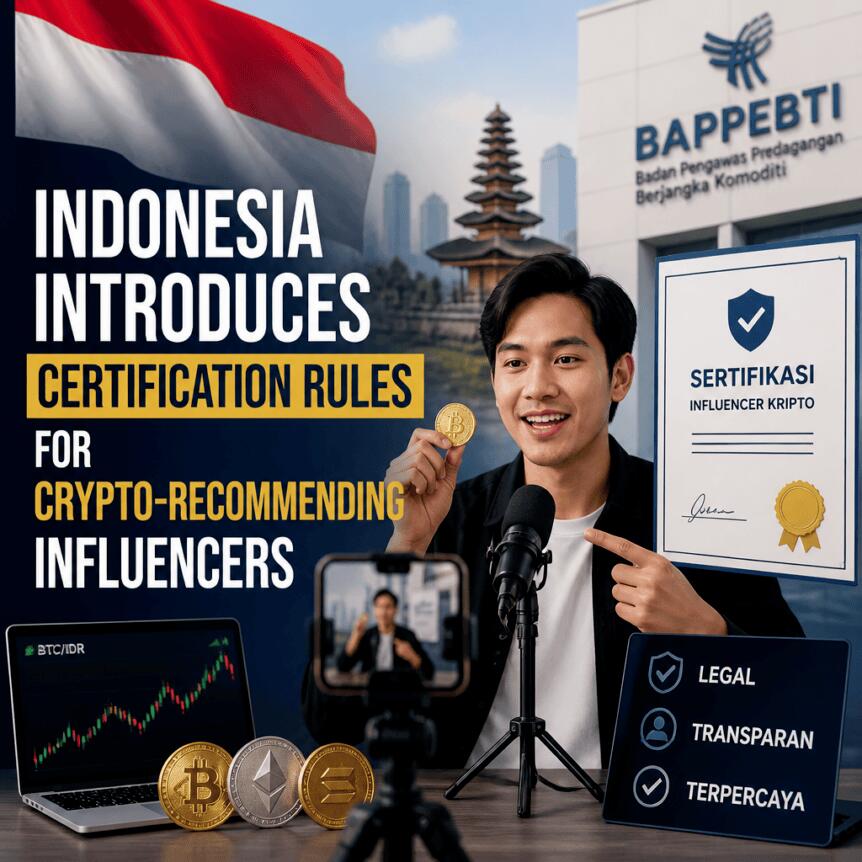
Indonesia is moving to tighten how crypto and other digital financial assets are marketed on social media by requiring certain influencers to hold competency certifications before they can recommend these products. The change, issued by the country’s financial regulator, aims to bring “financial influencer” activity under clearer compliance rules as oversight of online promotions expands.
Under Financial Services Authority (OJK) Regulation No. 6 of 2026, announced Wednesday, individuals who recommend digital assets must obtain relevant competency certifications unless they are already covered by a separate licensing requirement. The rule also restricts which tokens can be recommended and how promotional content must be produced and distributed.
Key takeaways
- OJK Regulation No. 6 of 2026 requires competency certification for influencers recommending digital assets, unless they already fall under another licensing framework.
- Influencers may only recommend digital assets listed on authorized exchanges, limiting recommendations to assets recognized by regulators’ approved venues.
- Service providers promoted by influencers must be licensed, and marketing campaigns must be run through regulated financial services businesses.
- Regulators globally are increasingly treating influencer promotions as a compliance issue, with countries like Australia, the UK, and the Philippines updating guidance or rules.
What OJK’s rule changes for Indonesian finfluencers
Indonesia’s regulator is targeting the intermediary role influencers often play between regulated financial products and retail audiences. OJK’s regulation establishes a compliance pathway for people who recommend digital assets—an approach designed to reduce the risk that promotions operate outside the accountability framework applied to licensed financial firms.
Specifically, the regulation states that individuals making digital-asset recommendations must hold competency certifications unless they already meet a licensing requirement under a separate regime. This is intended to ensure that influencers engaging in promotional activity have the necessary competence to do so within the regulatory expectations for financial sector communications.
The rule also narrows the universe of assets and counterparties influencers can mention. Influencers are limited to recommending only digital assets that are listed on authorized exchanges. On the services side, any service provider influencers recommend must itself be licensed, ensuring that both the asset’s listing status and the provider’s regulatory standing align with the framework OJK is trying to enforce.
Finally, OJK’s regulation requires that marketing campaigns be conducted through regulated financial services businesses, which are responsible for the promotional content. Those campaigns must then be distributed through the businesses’ official communication channels. In practice, this shifts responsibility away from unmanaged influencer-led content toward regulated entities that must own and manage the promotional material.
Machine translated excerpt of the OJK announcement. Source: OJK
Indonesia follows a wider global trend on influencer enforcement
Indonesia is not acting in isolation. Over the past few years, regulators in multiple jurisdictions have clarified that social media promotions can fall under existing financial services rules—especially when influencer content amounts to advice, product arrangement, or marketing that resembles an authorized financial advertisement.
In Australia, the Australian Securities and Investments Commission (ASIC) addressed the issue in March 2022, noting that influencers may require a financial services license if their content amounts to financial advice or helps arrange transactions. ASIC also warned that licensed financial firms could face liability for misconduct involving influencers they engage.
In the United Kingdom, the Financial Conduct Authority (FCA) issued guidance in 2024 indicating that unauthorized influencers may commit a criminal offense if they promote regulated financial products without approval from an appropriately authorized firm. The FCA’s stance reflects an enforcement mindset: influencer promotions are treated as part of the regulated marketing ecosystem, not merely as informal speech.
The UK’s approach became more visible in enforcement activity. On April 24, the FCA spearheaded an international “week of action” campaign against illegal finfluencers, involving 17 regulators. The effort included enforcement actions, consumer awareness work, and educational programs aimed at influencers who want to operate responsibly.
According to the FCA, it submitted 120 account-takedown requests covering 1,267 illegal financial advertisements that reached at least 2.3 million social media accounts in the UK. The scale of takedowns underscores why regulators are increasingly focusing on platforms and distribution pathways, not only on the influencers themselves.
FCA “week of action” press release
How the Philippines’ crypto marketing restrictions fit the pattern
Beyond general influencer rules, some regulators have started crafting crypto-specific marketing restrictions. In 2025, the Philippines introduced rules that cover endorsements and paid promotion formats across digital channels, including social media posts, podcasts, livestreams, and certain paid educational content.
Under the Philippines framework, crypto asset service providers are required to disclose their authorized third-party marketers to the Securities and Exchange Commission. This approach aims to make promotional networks more traceable and accountable—meaning that even when marketing is delivered by influencers, the underlying authorization and responsibility must remain linked to regulated service providers.
The Philippines model echoes the logic of Indonesia’s OJK approach: reduce the grey area where influencers can amplify crypto offers while regulated entities claim limited oversight. By requiring disclosures and licensing alignment, regulators attempt to ensure that promotional activity can be connected back to authorized market participants.
Philippines SEC crypto marketing restrictions (2025)
Why these rules matter for investors and for the market
For retail audiences, influencer-driven recommendations can feel more like personal tips than formal marketing—yet the potential for harm is similar to traditional advertising. By requiring competency certification, limiting asset recommendations to listings on authorized exchanges, and insisting that promotional content is handled by regulated businesses, OJK is effectively tightening the chain of responsibility.
For markets, the shift can influence how crypto brands allocate budgets and how exchanges and service providers engage promoters. If influencers must either hold certification or fall under a licensing structure, and if promotional content must originate from regulated entities through official channels, compliance costs rise—along with the incentives for regulated firms to formalize their marketing processes.
At the same time, regulators’ focus on enforcement—visible in the UK’s account takedown numbers—suggests that future compliance will likely be judged by practical outcomes, such as whether illegal promotions can be removed quickly and whether promotional content can be linked to authorized parties.
As Indonesia implements OJK Regulation No. 6 of 2026, readers should watch how the certification requirement is operationalized, what qualifies as “recommendation” versus general discussion, and whether regulators provide further guidance on how influencers and exchange-listed digital assets should be matched under the new framework.
https://www.cryptobreaking.com/indonesia-introduces-certification-rules-for/?utm_source=blogger%20&utm_medium=social_auto&utm_campaign=Indonesia%20Introduces%20Certification%20Rules%20for%20Crypto-Recommending%20Influencers%20
Comments
Post a Comment