
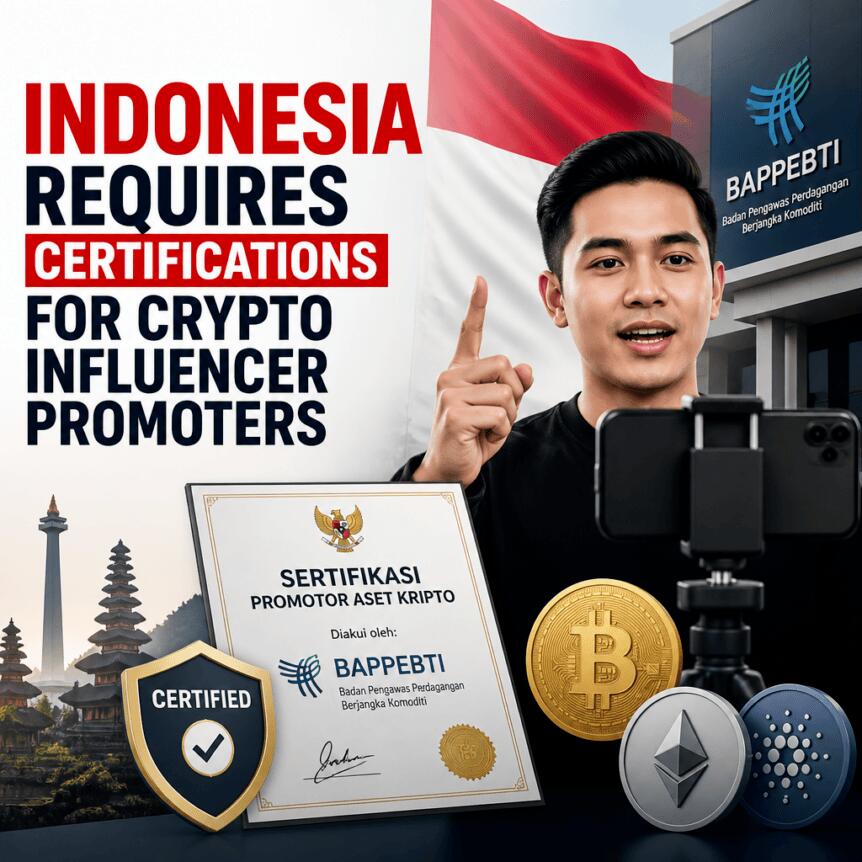
Indonesia’s financial regulator has moved to tighten rules governing “finfluencers,” requiring certified competency for individuals who recommend crypto and other digital financial assets. The change signals a broader push to bring social-media promotions within formal financial-consumer protection and licensing frameworks.
Under Financial Services Authority Regulation (POJK) No. 6 of 2026, announced Wednesday, individuals who provide recommendations about digital assets must hold competency certifications unless they are already covered by a separate licensing requirement. The regulation also limits what influencers can recommend and sets conditions on how marketing is carried out and by whom.
Key takeaways
- Competency certification required: POJK No. 6 of 2026 introduces competency certification obligations for influencers recommending digital assets.
- Scope restricted to authorized listings: Influencers may recommend only digital assets that are listed on authorized exchanges.
- Licensed service-provider rule: Any service providers recommended by influencers must be licensed.
- Marketing must route through regulated businesses: Promotions must be carried out by regulated financial services businesses responsible for the content and distributed via their official communication channels.
Indonesia’s POJK No. 6 of 2026: what changes
Indonesia’s Financial Services Authority (OJK) is framing the regulation as part of its expanded oversight of financial promotions on social media. POJK No. 6 of 2026 focuses on the behavior of “financial information deliverers,” which includes influencers who promote crypto and other digital financial products.
Practically, the regulation creates a compliance pathway and a gatekeeping mechanism. Influencers providing recommendations about digital assets are expected to obtain competency certification unless they fall under another licensing regime. This approach differs from rules that rely only on whether a promoter is formally acting as a licensed intermediary; it instead adds a targeted competency requirement for social-media recommendation activity.
The regulation also narrows the promotional universe. Influencers are permitted to recommend only digital assets that appear on authorized exchanges, which reduces the risk of promoting unapproved offerings. In addition, any service provider promoted alongside such recommendations must be licensed, tying influencer marketing to the status of the underlying entities offering access to regulated services.
Finally, POJK No. 6 of 2026 imposes content and channel controls. Marketing campaigns must be run through regulated financial services businesses, which are responsible for the promotional content. The campaigns must then be distributed through those businesses’ official communication channels. For compliance teams, this structure is significant: it places accountability on regulated firms to ensure that promotional material is aligned with requirements and that distribution does not occur solely through third-party influencer channels outside the regulated firm’s control.
Why certification and channel rules matter for compliance
For institutional stakeholders, influencer promotion requirements are not merely reputational issues—they can create legal exposure, distribution-risk, and documentation gaps across marketing operations.
Certification requirements can affect onboarding and contracting. Firms that engage finfluencers may need to verify whether individuals recommending digital assets have the required competency certification or whether their activities fall under an alternative licensing framework. This can change due diligence procedures, recordkeeping expectations, and the compliance review workflow for campaigns.
Authorized-asset constraints also alter governance. The requirement that influencers recommend only assets listed on authorized exchanges means that firms must maintain an up-to-date inventory of eligible assets and align campaign content with that list. It introduces an ongoing monitoring obligation, especially if exchange authorization status changes or if new assets are promoted in response to market developments.
Licensed-provider requirements shift scrutiny toward partnerships. Even where an influencer’s role is limited to promotion, POJK No. 6 of 2026 conditions recommendations on the licensing status of service providers involved in the promoted services. That makes it necessary for regulated businesses to verify licensing and ensure that contracts with marketing partners do not result in promotion of non-compliant counterparties.
Channel control and content responsibility are likely the most operationally consequential element. By requiring that campaigns be distributed through regulated financial services businesses’ official channels, the regulation may limit the ability of influencers to independently disseminate promotional materials. This creates clearer lines of responsibility for compliance monitoring and supports a record trail for regulators and internal audit.
Indonesia’s move in a broader finfluencer enforcement trend
Indonesia is not acting in isolation. Several jurisdictions have tightened their approaches to influencer marketing tied to regulated financial products, reflecting a wider recognition that social-media endorsements can function as financial promotion and, in some cases, as de facto advice or transaction facilitation.
In March 2022, the Australian Securities and Investments Commission (ASIC) stated that influencers may require a financial services license when content constitutes financial advice or helps arrange transactions. ASIC also highlighted potential liability risks for licensed financial firms that engage influencers who engage in misconduct—an important reminder that regulated entities can face enforcement consequences tied to how they structure third-party arrangements.
In the UK, the Financial Conduct Authority (FCA) issued guidance in 2024 indicating that unauthorized influencers may commit a criminal offense when promoting regulated financial products without appropriate approval from an authorized firm. In a later enforcement push, the FCA led an international “week of action” on April 24, reporting participation from 17 regulators and describing account-takedown efforts affecting a large volume of illegal financial advertisements reaching substantial social media audiences.
Elsewhere in the region, the Philippines introduced crypto-specific marketing restrictions in 2025, covering endorsements, sponsored content, social media posts, podcasts, livestreams, and certain paid educational content. Under those rules, crypto asset service providers must disclose authorized third-party marketers to the Philippine Securities and Exchange Commission—again reinforcing the theme that regulators are seeking greater visibility and accountability in the influencer ecosystem.
Potential implications for market participants in Indonesia
POJK No. 6 of 2026 is likely to change how firms in Indonesia plan, approve, and document digital-asset promotional activities. Companies operating as regulated financial services businesses may face pressure to adjust marketing governance so that influencer campaigns are routed through official channels and supported by compliance oversight of both the content and the parties involved.
For exchanges and other market intermediaries, the authorized-list condition creates a compliance dependency on exchange authorization status. For platforms and service providers partnering with influencers, the licensing requirement means that marketing arrangements must be treated as a regulatory-sensitive activity, not simply a branding exercise.
Cross-border considerations also matter. Influencer marketing often spans jurisdictions, and promotional content created for one market can be repurposed elsewhere. Firms will need to assess how Indonesian requirements interact with local rules in other countries—particularly where the same campaign is distributed through global social-media accounts that may not distinguish between audiences subject to different regulatory standards.
Closing perspective
Indonesia’s POJK No. 6 of 2026 adds certification, licensing, and channel controls aimed at reducing compliance risk from crypto promotions on social media. Market participants should monitor OJK implementation details—such as how competency certification is administered and verified—and align influencer contracting, asset eligibility checks, and distribution workflows accordingly.
https://www.cryptobreaking.com/indonesia-requires-certifications-for-crypto/?utm_source=blogger%20&utm_medium=social_auto&utm_campaign=Indonesia%20Requires%20Certifications%20for%20Crypto%20Influencer%20Promoters%20
Comments
Post a Comment