
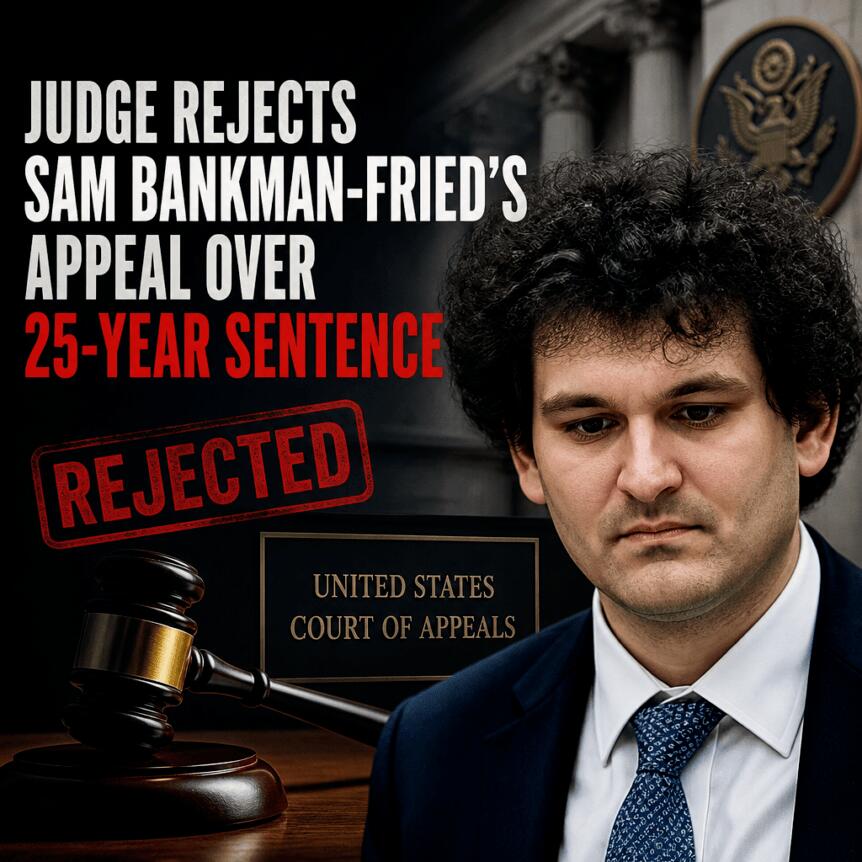
Sam Bankman-Fried has failed to overturn his fraud conviction in a federal appeals court, securing no relief from the 25-year prison sentence that followed the collapse of FTX. A unanimous three-judge panel of the US Court of Appeals for the Second Circuit rejected his bid, concluding that the government’s case was, in the court’s words, “conservatively stated, robust,” according to Reuters.
The ruling means Bankman-Fried remains bound to the sentence imposed in 2024, where the conviction stemmed from fraud and conspiracy charges related to the multibillion-dollar failure of FTX. The decision also arrives while he pursues an additional legal path: a request for a presidential pardon that was formally submitted to the US Department of Justice Office of the Pardon Attorney earlier this month.
Key takeaways
- Bankman-Fried’s appeal was rejected unanimously by the Second Circuit, leaving his 25-year prison sentence in place.
- The appeals court characterized the government’s evidence as “robust,” affirming that the conviction should stand.
- The decision does not end his efforts—Bankman-Fried is still pursuing clemency through the presidential pardon process.
- Public statements from President Donald Trump suggest clemency is unlikely, despite his history of granting at least one high-profile pardon.
Second Circuit rejects Bid for relief
In rejecting Bankman-Fried’s request for relief, the Second Circuit panel concluded that the trial and the government’s presentation of the case were sufficiently supported under the standards for overturning a criminal conviction. As reported by Reuters, the court’s unanimous ruling underscored that the prosecution’s case was strong and appropriately described.
Judge Barrington Parker’s written remarks, as quoted in the case reporting, emphasized the contrast between Bankman-Fried’s public reassurances and the conduct alleged in the prosecution. Parker wrote that while Bankman-Fried was publicly assuring customers, investors, and regulators that FTX customer funds were safe, he allegedly used FTX as “his own personal piggy bank,” spending customer funds on items including real estate, political contributions, and investments.
For observers who have followed FTX’s collapse and its aftermath, this appeal outcome matters beyond the individual defendant: it reinforces the judiciary’s willingness to treat the case as more than an industry failure, but as fraud and conspiracy serious enough to withstand appellate scrutiny.
A separate front: presidential pardon effort
Even with the appeals court setback, Bankman-Fried is continuing to challenge his situation through clemency. Cointelegraph reported earlier that he has formally applied for a presidential pardon from US President Donald Trump, with the request appearing on the US Department of Justice Office of the Pardon Attorney website in early June.
This pardon process represents a different type of review from an appeal. Where appellate courts evaluate legal errors and the strength of the record, clemency is discretionary and typically influenced by political and public considerations rather than courtroom standards.
Bankman-Fried has said in an interview with Fox Business that he is “absolutely” seeking a presidential pardon. However, the odds appear limited based on prior statements.
Trump’s prior comments and past pardons
According to reporting referenced in the article, Trump told The New York Times in January that he had no plans to pardon Bankman-Fried. A White House spokesperson, meanwhile, declined to comment on the clemency request, and Bloomberg pointed back to Trump’s earlier remarks in connection with the formal pardon application.
Still, the president has granted high-profile pardons before. The article notes Trump pardoned Ross Ulbricht, the founder of the darknet marketplace Silk Road, shortly after returning to office. Ulbricht had been serving two life sentences plus 40 years before the pardon in January 2025.
That example is often cited in discussions about whether clemency is politically plausible. But it also highlights an asymmetry: Bankman-Fried’s case is widely associated with mainstream financial fraud narratives in regulated markets, while Ulbricht’s case is commonly framed around the legality of the Silk Road marketplace and Bitcoin’s role as a payment method. Even when both outcomes involve pardons, the political calculus can differ markedly.
What the appeals ruling signals for the broader crypto legal landscape
The Second Circuit’s decision lands in a period when the crypto industry remains under intense regulatory and legal pressure following high-profile collapses. For market participants, the practical takeaway is that the legal system continues to treat major exchange failures and related conduct as potential criminal matters that can survive multiple layers of review.
Bankman-Fried’s appeal failure also suggests that arguments aimed at overturning convictions—at least in this instance—face a high bar once a conviction is supported by a trial record and withstands initial judicial scrutiny. While the outcome of a presidential pardon is not governed by appellate standards, the court’s affirmation narrows the room for incremental relief through the justice system itself.
In the near term, investors and builders are likely to focus less on legal “hopes” for reversal and more on the clemency track. Yet the public record around Trump’s earlier statements provides a caution flag: even where pardons are possible, expectations may be mismatched with political reality.
As the DOJ pardon process unfolds and the President’s stance remains the decisive variable, readers should watch two things closely: any movement on the clemency request and the continued stability of the criminal-legal outcome despite further attempts to seek relief.
https://www.cryptobreaking.com/judge-rejects-sam-bankman-frieds/?utm_source=blogger%20&utm_medium=social_auto&utm_campaign=Judge%20Rejects%20Sam%20Bankman-Fried’s%20Appeal%20Over%2025-Year%20Sentence%20
Comments
Post a Comment