
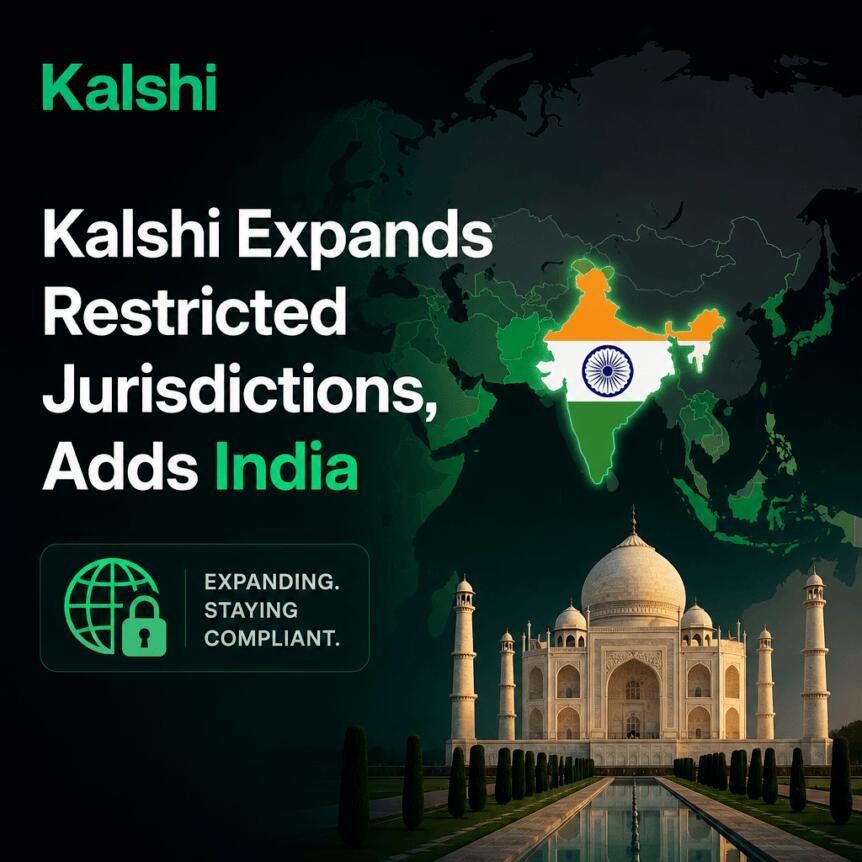
Kalshi has restricted access from India, according to an updated members’ agreement posted by the prediction market platform. The change reflects a widening pattern of national crackdowns on prediction markets, particularly when regulators view certain contracts as crossing into illegal gambling or politically sensitive territory.
In the updated document, Kalshi says it now lists 55 restricted jurisdictions, meaning residents of those locations cannot access the platform. India’s regulatory posture has already been explicit: in April, the country’s Ministry of Electronics and Information Technology warned VPN providers to stop enabling access to “illegal and blocked online betting and prediction market platforms.”
Key takeaways
- Kalshi added India to its restricted jurisdictions list, blocking Indian residents from using the platform under its updated members’ agreement.
- The agreement now covers 55 locations where access is restricted, expanding Kalshi’s compliance footprint.
- Regulators increasingly target access methods, with India warning VPN providers against facilitating entry to banned prediction markets.
- Sports and political contracts face heightened scrutiny across multiple jurisdictions, with recent enforcement actions spanning Europe and Southeast Asia.
India restriction marks another compliance shift for Kalshi
Kalshi’s latest update comes through a revised members’ agreement document, which functions as the platform’s formal terms governing where its services can be accessed. By moving India into the restricted set, Kalshi reduces legal and regulatory exposure in a market where regulators have previously signaled that some prediction-market activity falls under prohibited categories.
The April warning from India’s Ministry of Electronics and Information Technology was directed at VPN providers, instructing them to avoid facilitating access to “illegal and blocked online betting and prediction market platforms.” That matters because it links the restriction to a broader enforcement approach: even if a user attempts to bypass geographic limitations, intermediaries that enable access could face regulatory consequences.
Kalshi’s move also adds momentum to a trend investors and users should watch: prediction markets are increasingly being evaluated not only by what they offer, but by how those offerings are accessed and framed under local law.
Europe and Asia show how quickly bans can spread
India is not an isolated case. In May, Spanish authorities blocked access to Polymarket and Kalshi, citing local gambling laws, according to earlier coverage from Cointelegraph. Around the same time, Indonesia blocked access to Polymarket after it listed contracts tied to whether President Prabowo Subianto would leave office before the end of his term—an example of how political contract themes can accelerate enforcement attention.
Elsewhere, regulators have also moved against platforms operating in similar areas. Cointelegraph previously reported that countries including Singapore, Poland, Portugal, Hungary, Ukraine, and Brazil have blocked or prohibited prediction market platforms such as Kalshi and Polymarket.
Taken together, these actions point to an asymmetry traders may want to understand: the platforms’ products may be marketed as prediction tools, but authorities often treat them through a gambling-licensing lens—especially when contracts are perceived as resembling betting on sports results or political outcomes.
Legislative and legal pressure in the US targets “political” trading
Scrutiny of prediction markets in the United States has intensified on both legislative and legal fronts. In January, US lawmakers proposed legislation aimed at restricting political prediction market trading by government officials, according to Cointelegraph’s earlier reporting. The initiative drew attention after a Polymarket user reportedly profited more than $400,000 on a contract tied to the removal of then-Venezuelan President Nicolás Maduro, raising concerns about insider trading.
Meanwhile, enforcement through lawsuits has continued to expand. Cointelegraph reported on Thursday that Kentucky was the latest state to sue five prediction market platforms, including Kalshi and Polymarket. The state alleged they were operating “unlicensed and illegal sports betting and gambling platforms,” reflecting how US regulators and state attorneys are framing these venues within existing gambling and licensing rules.
For participants, the key implication is that compliance risk is no longer confined to the most tightly regulated jurisdictions. Even platforms that operate at scale can face a patchwork of restrictions where different regulators focus on different aspects—access methods, contract types, or the licensing status of operations.
Why sports and political contracts keep drawing fire
Kalshi and Polymarket have become major venues for event-style contracts, with sports-related markets dominating usage. Defirate data, cited by Cointelegraph, places sports as the largest category on both platforms. It reported that Kalshi saw $328 million in daily volume attributed to sports betting, while Polymarket recorded $196 million in daily volume for the same category. These numbers help explain why regulators often concentrate on sports contracts: high trading volume can translate into a clearer public policy debate about whether the activity is effectively gambling.
Political contracts appear to attract an additional layer of concern. When predictions involve elections, leadership, or other state-related outcomes, regulators can view them as more closely tied to political influence—or at least as difficult to classify neatly under existing frameworks for lawful prediction vs. prohibited wagering.
Kalshi’s updated restriction list, alongside actions in Spain and Indonesia, underscores that these concerns are being operationalized through access blocks and legal action, not just public criticism.
Going forward, traders and users should watch whether Kalshi’s restricted-jurisdiction footprint continues to expand beyond India, and whether regulators further target circumvention tools like VPNs. With bans spreading across countries and lawsuits progressing in the US, the next signals to monitor are changes to platform access terms and any new enforcement steps aimed at the contract categories that attract the most volume.
https://www.cryptobreaking.com/kalshi-expands-restricted-jurisdictions-adds/?utm_source=blogger%20&utm_medium=social_auto&utm_campaign=Kalshi%20Expands%20Restricted%20Jurisdictions,%20Adds%20India%20
Comments
Post a Comment