
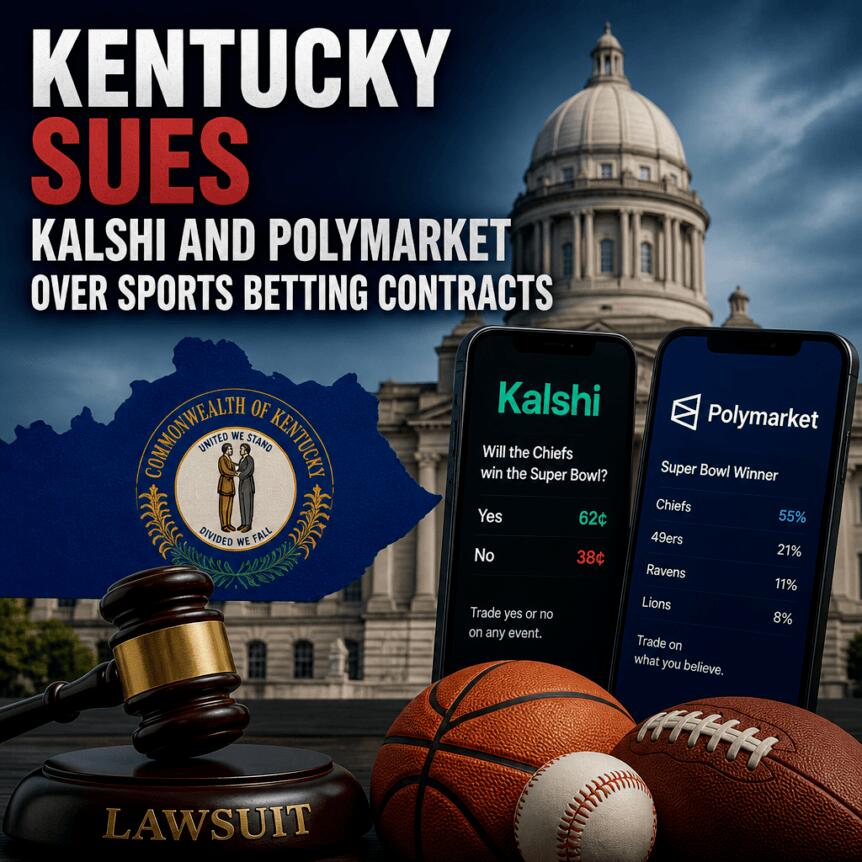
Kentucky has filed lawsuits against five prediction market platforms, escalating an ongoing legal dispute in the United States over whether certain prediction market “event contracts” constitute regulated commodities products or unlicensed sports betting. The complaints target Polymarket and Kalshi, and name Kalshi partners Coinbase, Robinhood, and Webull, alleging the platforms are effectively operating sports wagering in Kentucky without required state authorization.
The move adds to a broader pattern in which multiple states have challenged prediction markets under state gaming and consumer-protection statutes. It also highlights a central regulatory fault line in the US: states view sports-related event contracts as gambling that must be licensed locally, while prediction market operators argue the products are swaps that fall under the federal Commodity Futures Trading Commission’s (CFTC) jurisdiction.
Key takeaways
- Kentucky alleges Polymarket and Kalshi are “operating unlicensed and illegal sports betting and gambling platforms” in the state.
- The complaints also include Kalshi partners Coinbase, Robinhood, and Webull, raising questions about compliance exposure for distribution and brokerage relationships.
- State and federal authorities have taken opposing positions on jurisdiction, with the CFTC supporting the view that prediction markets can be regulated as swaps under commodities law.
- Several states have already issued cease-and-desist actions, and some disputes have reached federal courts with mixed outcomes.
Kentucky’s lawsuit and the jurisdictional dispute over event contracts
According to a statement by Kentucky Attorney General Russell Coleman, the lawsuits were filed in state court against Polymarket and Kalshi, with Kalshi partners Coinbase, Robinhood, and Webull also named. Kentucky’s position is that the platforms are conducting what it characterizes as sports wagering in Kentucky without a gaming license or compliance with state rules.
Kentucky’s filings frame the underlying contracts as “sports event contracts” that “fall squarely within the definition of ‘sports wagering’ under Kentucky law.” The complaint further alleges that the platforms fail to provide adequate support for identifying and assisting users who may have gambling problems, which Kentucky law requires operators to do.
For compliance teams and regulated entities, a key practical implication is that the lawsuits do not focus solely on the core trading interface. By naming partners involved in the broader ecosystem, the action signals that state regulators may treat affiliated distribution, brokerage, or marketplace relationships as part of the alleged unlicensed wagering operation.
Polymarket disputes Kentucky’s characterization. A Polymarket spokesperson told Cointelegraph that the lawsuit “runs counter to the CFTC’s established framework for regulating prediction markets” and that the company will address the claims through “the appropriate legal process.”
Kalshi’s response similarly emphasizes federal oversight. Jacki McGavick told Cointelegraph that Kalshi is “a federally regulated exchange,” asserting that “the CFTC is our regulator, not the states,” and arguing that courts have recognized this approach in prior disputes.
The CFTC did not immediately respond to a request for comment.
Why the CFTC-vs.-states conflict matters for institutional compliance
The Kentucky case sits within an expanding enforcement and litigation landscape. At least 17 other states have taken prediction market operators to court, and the disputes have drawn attention from the CFTC and the White House. The legal contention centers on regulatory classification—whether event contracts tied to sports are gambling products governed by state gaming laws or swaps governed by federal commodities regulation.
Multiple state authorities have argued that sports-oriented prediction products require state-level licenses and oversight. Prediction market operators have argued the contracts are swaps and therefore subject to the federal regime administered by the CFTC.
This position is reflected in the CFTC’s broader enforcement strategy. The CFTC has sued multiple states after they acted against prediction markets, asserting they were stepping into federal authority. The CFTC has also pursued jurisdictional disputes involving operators in response to state interventions.
For financial institutions and technology providers monitoring cross-border regulatory risk, these cases matter because they can influence how products are offered in individual states. Even when operators claim they are under federal regulation, state-level litigation can still translate into operational constraints, partner restrictions, and heightened compliance reviews—particularly around marketing, access controls, user disclosures, and consumer-protection measures such as responsible gaming tooling.
The uncertainty is amplified by the fact that courts have reached differing conclusions on core classification questions. For example, a Michigan federal judge ruled against Polymarket in a lawsuit brought by the operator against Michigan, finding that Polymarket’s sports event contracts were not swaps under the CFTC’s authority. Other courts have sided with prediction market operators in different matters, reinforcing that jurisdiction and classification issues may continue to produce inconsistent outcomes across circuits.
Precedent, ongoing appeals, and prior state actions
Kentucky’s filing follows a sequence of actions by multiple states, including cease-and-desist letters. Operators have responded by suing states—contesting, among other things, whether state actions conflict with federal commodities jurisdiction.
Several of the disputes have advanced through appeals courts. In April, the Third Circuit Court of Appeals ruled that New Jersey regulators could not prevent Kalshi from offering sports event contracts in the state. Meanwhile, the Michigan federal court decision against Polymarket demonstrates that not all litigation tracks in the same direction, and classification analysis can vary depending on the specific contractual structure and the court’s view of federal authority.
Separately, Kalshi and Polymarket have already been involved in litigation with Kentucky over taxes. Kentucky is seeking to collect a 14.25% tax on prediction market transaction fees, and the platforms have argued the state’s tax approach is discriminatory and exceeds federal authority.
The procedural posture of the cases also means the legal question is not confined to enforcement alone. Appeals decisions can reshape how states and federal regulators interact, affecting both licensing expectations at the state level and compliance assumptions at the federal level.
In parallel, political statements have added to the broader policy debate over federal regulatory primacy. In May, President Donald Trump said it was “critically important” that the CFTC’s exclusive authority over prediction markets be maintained, according to reporting by Cointelegraph.
What regulators and firms should watch next
Kentucky’s lawsuits are likely to intensify the recurring legal questions about classification, licensing, and consumer-protection obligations—especially for partners implicated in distribution or access. The key developments to monitor are (1) how Kentucky courts handle the jurisdictional challenge, (2) whether the cases are consolidated into broader appeals or addressed by higher courts, and (3) whether enforcement strategies shift toward requiring state-specific responsible gaming and consumer safeguards.
Until appellate courts provide more uniform guidance, prediction market operators and their institutional partners should anticipate continued state-level litigation risk, even where they rely on federal commodity regulation frameworks.
https://www.cryptobreaking.com/kentucky-sues-kalshi-and-polymarket/?utm_source=blogger%20&utm_medium=social_auto&utm_campaign=Kentucky%20Sues%20Kalshi%20and%20Polymarket%20Over%20Sports%20Betting%20Contracts%20
Comments
Post a Comment