
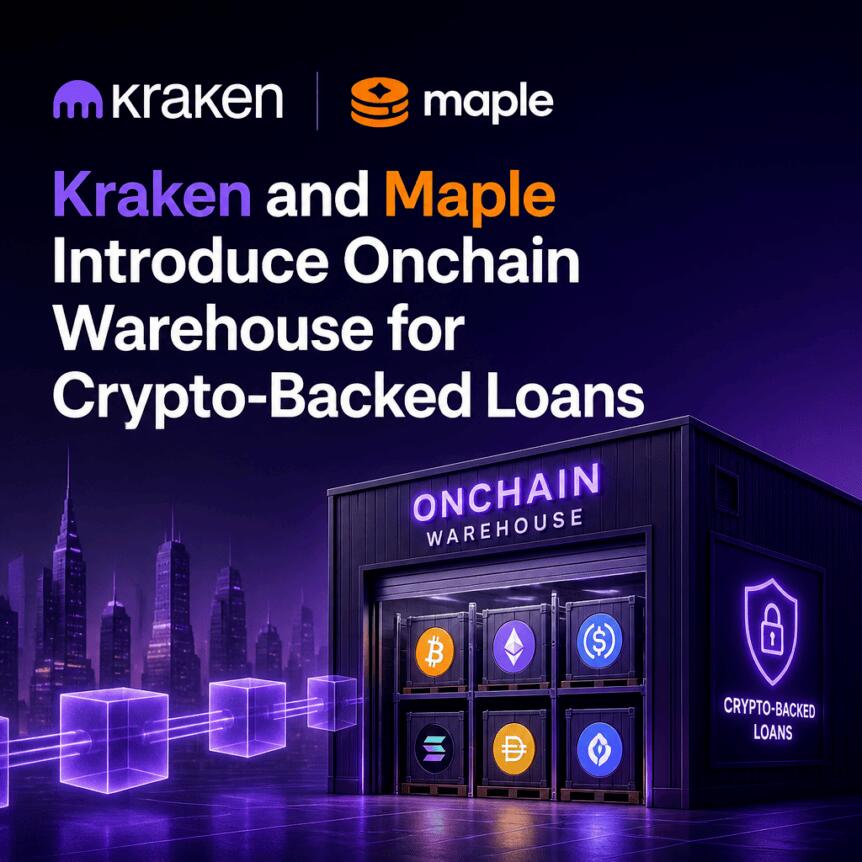
Kraken and Maple have teamed up to launch an onchain “warehouse financing” facility designed to support crypto-backed loans with a structure borrowed from traditional credit markets. The partnership aims to help Kraken expand its institutional lending operation while limiting the amount of balance-sheet capital it needs to deploy for each loan issuance.
In a Thursday announcement, the firms said the facility will fund Kraken’s OTC lending business using a bankruptcy-remote special purpose vehicle (SPV) and USDC-denominated financing. Maple is providing senior financing, while Kraken retains a stake in the transactions.
Key takeaways
- Kraken and Maple are applying a traditional warehouse/credit structure to crypto-backed lending, using a bankruptcy-remote SPV.
- Maple will supply senior financing for the loans, while Kraken will keep exposure through a retained stake.
- The facility is intended to allow collateral and loan performance tracking onchain, including Bitcoin and Ether-backed loans.
- Kraken affiliates are expected to originate, sell, and service loans, with third-party SPV administration by Zaria.
- The partners did not disclose the facility’s size or financing terms.
How the “onchain warehouse” structure works
Warehouse financing is a familiar concept in traditional markets: lenders provide capital that can support a stream of loans, while loan assets are packaged and managed in ways that can isolate risk. In this case, Kraken’s OTC lending is planned to be financed via an SPV intended to be “bankruptcy-remote,” meaning the loan collateral is structured so the borrower cannot simply file for bankruptcy to disrupt repayments and asset separation.
According to the announcement, Maple’s senior financing will be routed through the SPV, while Kraken will retain a stake. The SPV is also designed to support onchain transparency—Maple said the setup gives institutional lenders senior, overcollateralized exposure backed by Bitcoin and Ether, with collateral and loan performance tracked onchain.
That distinction matters for institutional participants who need predictable legal and operational processes in addition to technical visibility. Compared with many earlier crypto lending designs—often based on more direct counterparty structures—this approach borrows from established credit securitization mechanics to separate roles: originators, holders of collateral, financiers, and administrators.
Roles of Kraken Financial, Zaria, and Maple
The facility’s operational flow is split among several entities. Kraken affiliates will originate, sell, and service the loans while retaining a position in the transaction, according to the announcement.
Kraken Financial, described as a Wyoming-chartered Special Purpose Depository Institution, will hold the underlying collateral. Independent SPV administrator Zaria will oversee administration of the facility, while Maple provides senior financing through the SPV structure.
Kraken and Maple did not disclose the facility’s total size or any financial terms, leaving investors without key details such as leverage, pricing, or the expected scope of loan volumes. Those missing datapoints will likely be important for market participants assessing how “warehouse” capacity translates into real lending throughput.
Tokenized credit keeps pulling in institutional capital
The launch arrives as tokenized credit continues to broaden beyond early experiments. According to RWA.xyz data cited in the announcement, tokenized credit has grown to more than $6.2 billion in distributed value—up from roughly $1.87 billion a year ago. The same source is used to frame Maple as the largest platform in the sector, with approximately $1.4 billion in tokenized credit assets.
This matters because scaling tokenized lending depends on two linked developments: more institutional comfort with credit risk (including seniority and collateralization) and more infrastructure for tracking and managing loan performance. By tying credit exposure to onchain accounting while keeping the legal architecture anchored in an SPV, the partnership is positioning institutional lenders to evaluate risk with more real-time transparency than in purely offchain structures.
The firms’ move also fits into a broader post-2022 pattern in crypto finance, where lending businesses rebuilt after high-profile collapses. Failures involving Celsius and BlockFi, among others, accelerated scrutiny across counterparties, collateral practices, and liquidity management—pressuring the market to adopt more conservative structures and clearer risk segregation.
Broader lending momentum—and why it still isn’t uniform
Interest in tokenized credit has also been reinforced by mainstream finance research. Earlier coverage noted that in May, analysts at Bernstein suggested tokenized credit could be a large expansion vector for blockchain-based lending, estimating a potential addressable market of up to $4 trillion as tokenized credit expands beyond niche use cases into areas such as mortgages, auto loans, and small-business lending.
At the same time, not all lending is progressing evenly. While institutional-grade, collateralized products are gaining traction, parts of decentralized finance have faced setbacks. Earlier this month, lending protocol Radiant Capital said it would wind down after failing to recover from a $50 million exploit in 2024, citing an inability to replace lost funds or secure new capital. That contrast underlines a key tension in the sector: onchain lending is advancing where it can align incentives and reduce fragility, but many DeFi lending models still struggle when they encounter capital replacement and risk-control challenges.
In May, Kraken and Maple’s ecosystem context also included other moves toward tokenized lending capacity—such as Ripple securing a $200 million credit facility from Neuberger Berman to expand its institutional prime brokerage lending business. That financing was described as intended to support margin lending and other credit products for hedge funds, trading firms, and institutional clients. Together with the Kraken-Maple facility, these developments point to a recurring theme: regulated institutions and established asset managers are exploring credit lines and onchain settlement where they can better manage risk.
Going forward, the most important things to watch are whether the partnership reports concrete deployment figures—such as loan volume, onboarding pace, default or liquidation behavior, and how efficiently onchain tracking maps to real-world servicing—and whether other lenders adopt similar SPV-style architectures for crypto-backed credit. With the facility’s size and terms not yet disclosed, market participants will likely look for early operational signals to judge how quickly “onchain warehouse financing” can move from structure to sustained lending scale.
https://www.cryptobreaking.com/kraken-and-maple-introduce-onchain/?utm_source=blogger%20&utm_medium=social_auto&utm_campaign=Kraken%20and%20Maple%20Introduce%20Onchain%20Warehouse%20for%20Crypto-Backed%20Loans%20
Comments
Post a Comment