
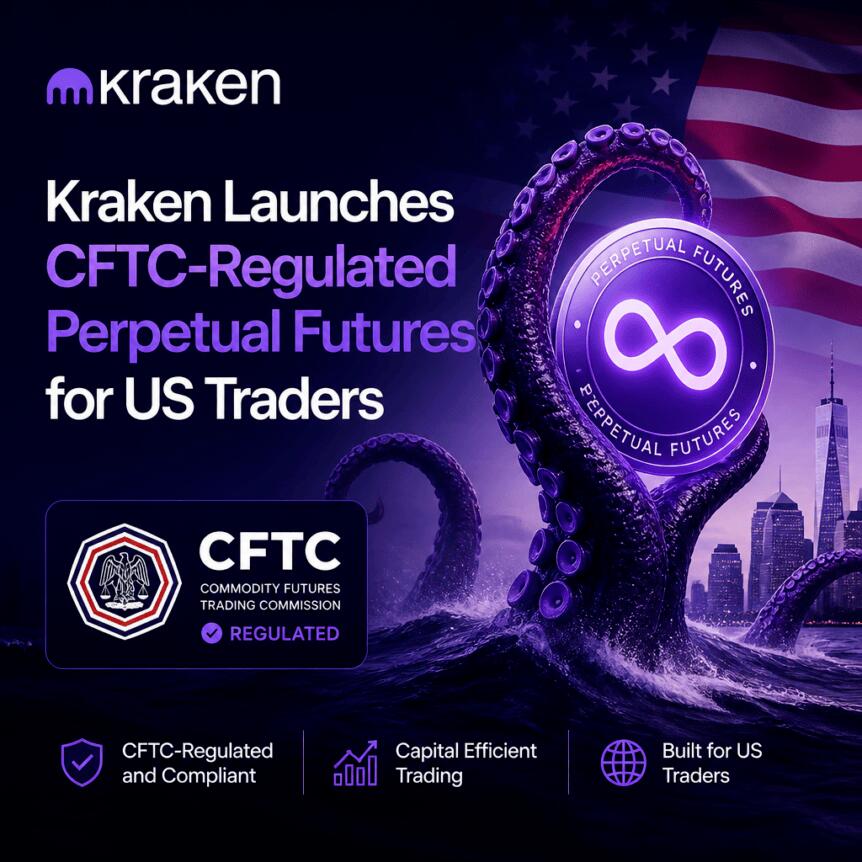
Kraken has moved to expand its onshore crypto derivatives footprint in the United States by launching perpetual futures trading for eligible US customers through its partner platform Bitnomial. The offering is now available via Kraken Pro, adding a US-regulated pathway to a contract type that has historically been dominated by offshore venues.
According to Kraken’s announcement, the new perpetual futures contracts share the same futures wallet as the exchange’s existing CME-listed crypto futures products. That design choice is aimed at simplifying account management for traders who want to handle both contract types through a single setup.
Key takeaways
- Kraken launched perpetual futures for eligible US users via Bitnomial on Kraken Pro.
- The contracts are tied to major assets including BTC, ETH, SOL, XRP, ADA, LINK, DOGE, LTC, and AVAX.
- Kraken says traders can use the same futures wallet for the new perps and its existing CME-listed crypto futures.
- The launch follows Kraken’s late-May plan to bring CFTC-regulated perpetual futures to the US through Bitnomial.
- It lands during an ongoing US push to bring crypto perpetual derivatives onto regulated venues after CFTC guidance and approvals.
Kraken’s onshore perp futures launch via Bitnomial
Kraken said the perpetual futures products are accessible through Kraken Pro. The exchange described the contracts as having no expiration date, a common feature of perpetual derivatives intended to keep market exposure continuously available for traders.
The asset list Kraken provided includes Bitcoin (BTC), Ether (ETH), Solana (SOL), XRP, Cardano (ADA), Chainlink (LINK), Dogecoin (DOGE), Litecoin (LTC), and Avalanche (AVAX).
In practical terms, Kraken highlighted an operational detail: the perpetual futures contracts use the same futures wallet as its existing CME-listed crypto futures. For traders, this matters because it can reduce friction when allocating margin and monitoring exposure across different derivatives products, rather than forcing separate account workflows.
Why the “perps” shift matters for US traders
Kraken positioned the launch against the broader market reality that perpetual futures have largely traded on offshore platforms rather than regulated US venues. In its announcement, Kraken stated that perpetual futures generated more than $60 trillion in global trading volume in 2025.
That scale helps explain why regulatory access is a key competitive battleground for exchanges and venues. For US-based traders—especially those who want regulated execution—access to perpetual exposure has historically been constrained, pushing activity toward non-US platforms.
Kraken’s move therefore represents a direct attempt to bring a widely used derivatives format closer to the regulatory “onshore” boundary, potentially giving domestic participants another option besides CME-linked futures and other regulated products.
How Kraken’s previous US steps set up this launch
Kraken did not introduce this capability in isolation. Over the past year, it has broadened its US-facing offerings in stages, including support for CME-listed crypto futures that began in July 2025, and the launch of margin trading for eligible US customers earlier this month.
Just before this perp futures rollout, Kraken had also outlined its intention to introduce CFTC-regulated perpetual futures through Bitnomial. That plan was detailed in a late-May announcement connected to Kraken’s acquisition of a federally regulated exchange months earlier.
The present launch follows that roadmap, with Bitnomial—acquired by Kraken’s parent, Payward, in April—serving as the platform through which the new perpetual contracts are offered.
US derivatives competition accelerates after CFTC actions
Kraken’s announcement arrives as US venues compete for a share of the crypto derivatives market by seeking regulatory approvals that enable perpetual products domestically. The CFTC has played a central role in signaling that it can support regulated structures for “perpetual” contracts.
On May 29, the CFTC approved Kalshi’s Bitcoin perpetual futures contract and issued a no-action position for Coinbase. Around the same time, Coinbase announced that its Coinbase Financial Markets unit would provide US institutional clients access to global crypto perpetual futures and options markets, which the company said account for roughly 80% of global crypto trading volume.
Kalshi also launched perpetual futures contracts on May 29, describing the product rollout as a major step beyond its prediction-market business.
The sequence reflects more than a single approval; it points to a months-long regulatory effort to reduce uncertainty around how perpetual derivatives can be structured and traded in the US. In a January address, CFTC Chair Michael Selig said the agency would use existing authority to support perpetual futures and other novel derivatives products, arguing that uncertainty had encouraged activity to shift offshore. Later remarks at the Milken Institute’s Future of Finance conference suggested the CFTC was working to establish a framework for “true perpetual futures” in the US.
Against that backdrop, Kraken’s launch can be read as part of a wider industry effort to compete under clearer rules—particularly as more venues test the boundaries of what the CFTC will allow in practice.
Looking ahead, market participants will likely watch how quickly liquidity forms in Kraken’s new contracts, whether traders shift meaningful volume from offshore platforms, and whether other US exchanges follow with their own onshore perpetual offerings. The next regulatory signals from the CFTC could further determine how fast the onshore perps ecosystem expands.
https://www.cryptobreaking.com/kraken-launches-cftc-regulated-perpetual/?utm_source=blogger%20&utm_medium=social_auto&utm_campaign=Kraken%20Launches%20CFTC-Regulated%20Perpetual%20Futures%20for%20US%20Traders%20
Comments
Post a Comment