
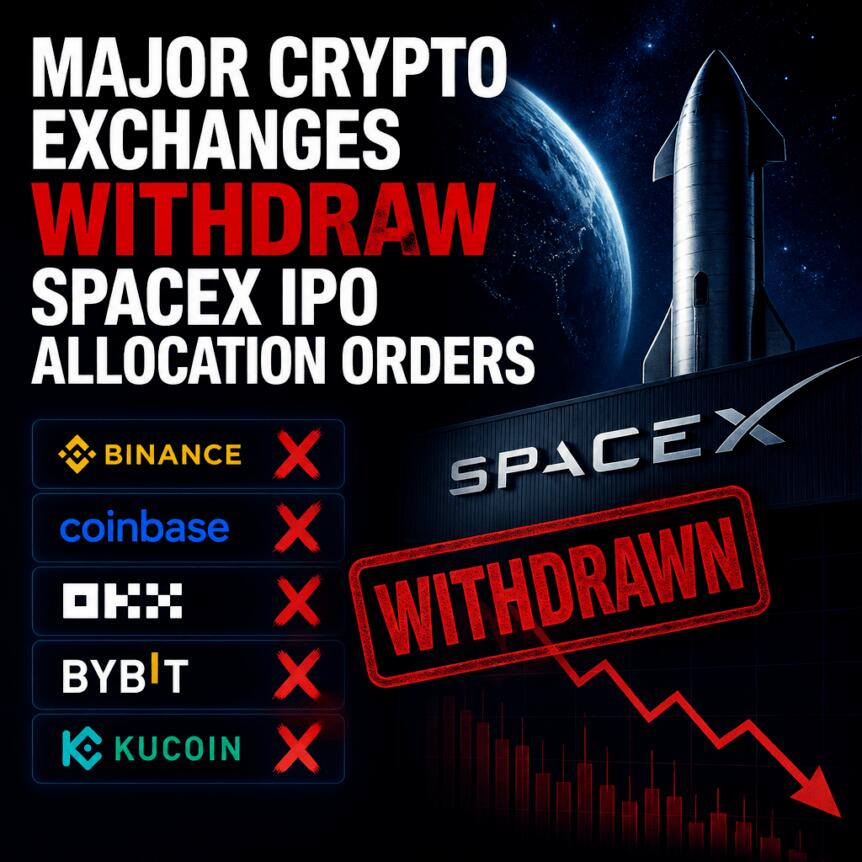
Major crypto trading and wallet platforms have canceled their tokenized access campaigns tied to SpaceX’s IPO after the company began trading on the Nasdaq on Friday. Bybit, Binance, Bitget Wallet and MEXC all said they were unable to obtain SpaceX allocations through xStocks, leaving participants without the promised shares and triggering refunds.
SpaceX’s IPO—reported as more than four times oversubscribed—raised $75 billion. Shares opened at $150, above the $135 IPO price, and closed the day at $161.11, valuing the company at more than $2 trillion.
Key takeaways
- Bybit, Binance, Bitget Wallet and MEXC canceled tokenized SpaceX IPO campaigns after xStocks could not deliver underlying allocations.
- Several platforms linked their failure to the same delivery bottleneck—xStocks’ inability to provide the underlying assets.
- Refunds are being processed for affected users, but no SpaceX allocation distribution is expected from these campaigns.
- The episode highlights operational and settlement risks for tokenized access to high-demand traditional IPOs.
Cancellation across multiple crypto platforms
The cancellations followed SpaceX going public on the Nasdaq on Friday, ending the tokenized IPO access windows these platforms marketed to users. The common thread across announcements was that the platforms did not receive allocation support from xStocks, the conduit used to provide tokenized access.
Bybit was among the first to suspend its effort. Through its “Bybit IPO Express,” the exchange had previously announced tokenized access to SpaceX using xStocks. In its cancellation notice, Bybit cited xStocks’ inability to deliver underlying assets, adding that “no SpaceX allocations were received” and that subscribed users would not receive allocations.
Binance’s tokenized IPO campaign faced a similar outcome. Earlier, Binance had reported strong interest, stating the campaign attracted more than $557 million in USDC deposits. But Binance later said it could not proceed due to “circumstances outside of our control.” Binance Wallet was also reliant on xStocks, tying its outcome to the same underlying delivery issue.
Bitget Wallet and MEXC likewise indicated they would refund users after failing to secure xStocks’ tokenized SPCX allocation. The cancellations underscore how tokenized IPO models can concentrate settlement dependencies on a single intermediary for allocation delivery.
What happened with xStocks and the allocation gap
Multiple platforms pointed to xStocks as the reason allocations could not be fulfilled. The key operational problem was not that demand for SpaceX was weak—reports leading into the IPO suggested significant oversubscription—but that the tokenized structure did not convert that interest into actual delivered allocations.
Bybit explicitly connected its inability to fulfill the campaign to xStocks’ failure to deliver underlying assets. Binance’s and the other platforms’ references to “circumstances outside of our control,” along with their confirmation that refunds would follow, aligned with that explanation.
For participants, the practical consequence was straightforward: subscriptions did not translate into SpaceX allocations delivered via the tokenized wrapper. Even with a completed IPO and a first day of trading that reflected high market confidence, the allocation mechanism for tokenized access failed to reach end users.
Why this matters for tokenized IPO access
This episode represents a setback for crypto platforms seeking to offer users a bridge to widely anticipated public offerings. Tokenized IPO access has been positioned as a way to bring retail and crypto-native users closer to traditional markets, especially when demand is intense and allocations are scarce.
However, the SpaceX cancellations illustrate a recurring challenge: tokenized delivery depends on real-world allocation rights and the ability to source and settle underlying shares. When any part of that chain fails—particularly at the delivery stage—users can be left without the core benefit of the offering.
There is also a trust dimension. Earlier marketing emphasized access to a high-profile listing; after the cancellation, the focus shifted from participation to remediation. Bitget Wallet’s chief operating officer, Alvin Kan, said on X that refunds were being processed and acknowledged disappointment that the outcome did not materialize as expected. He also said the setback affected confidence in the industry, while expressing that the company would move forward.
Refunds begin, but questions remain
While the platforms have indicated that affected users will receive refunds, the broader implications for future tokenized IPO campaigns are less clear. Investors and traders watching this space should pay close attention to whether platforms adjust their structures, add additional intermediaries, or change how they handle allocation delivery risk for future high-demand listings.
With SpaceX now publicly traded, the immediate question is how quickly and cleanly refunds are handled—and whether other upcoming tokenized IPO offerings will proceed under tighter operational safeguards. The next test for the model will be whether failures like this remain an exception or become a pattern when real-world allocation delivery runs into constraints.
https://www.cryptobreaking.com/major-crypto-exchanges-withdraw-spacex/?utm_source=blogger%20&utm_medium=social_auto&utm_campaign=Major%20Crypto%20Exchanges%20Withdraw%20SpaceX%20IPO%20Allocation%20Orders%20
Comments
Post a Comment