
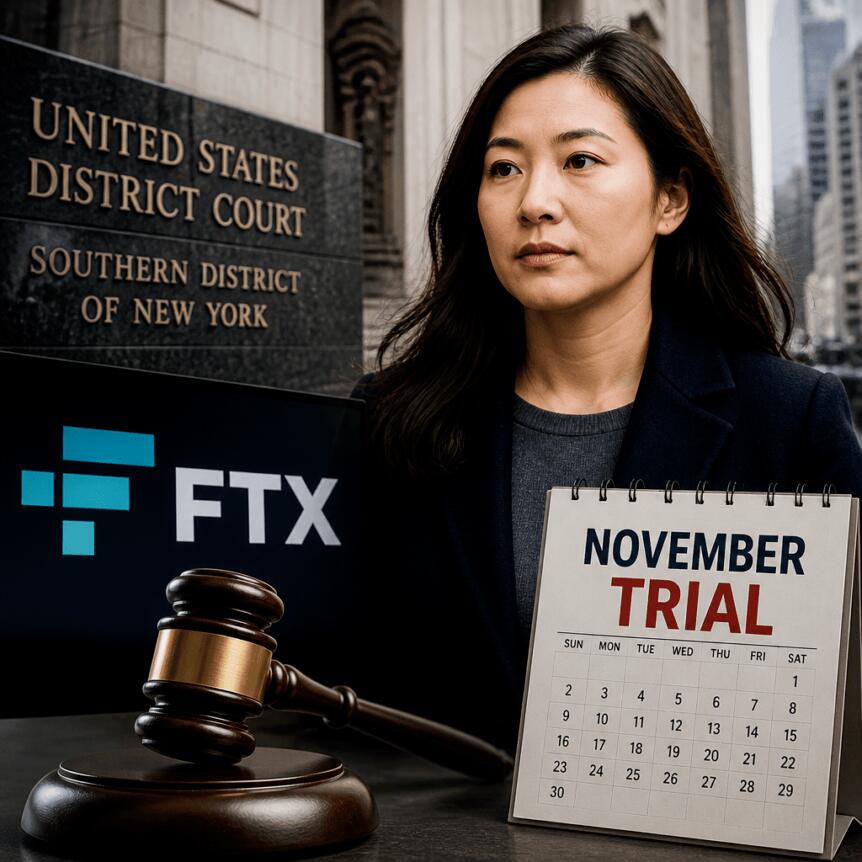
Michelle Bond, the wife of Ryan Salame—former co-CEO of FTX Digital Markets—has been scheduled for trial in November following delays tied to motions connected to Salame’s plea agreement. The proceeding comes as prosecutors pursue remaining criminal accountability related to the 2022 collapse of FTX, an episode that has since reshaped regulatory scrutiny of crypto-linked political activity and financial crime controls.
On Wednesday, U.S. District Judge George Daniels of the Southern District of New York set Bond’s trial to begin on Nov. 9. Bond faces four charges alleging violations of U.S. campaign finance law, stemming from prosecutors’ claims that FTX-related money was used to improperly support a 2022 congressional bid.
Key takeaways
- Judge George Daniels ordered Michelle Bond’s criminal trial to start on Nov. 9 in the Southern District of New York.
- Bond is charged with four offenses related to alleged campaign finance violations connected to the 2022 U.S. House race in New York’s 1st district.
- Prosecutors alleged that Ryan Salame used FTX funds in a “sham” payment arrangement, which they said violated campaign finance rules.
- The case is part of the final criminal track arising from FTX’s 2022 bankruptcy, following convictions and prison sentences for other key figures.
Bond’s trial date set amid motion-related delays
Bond’s schedule reflects procedural disputes that have continued since the charges were brought. A week earlier, Judge Daniels denied a motion by Bond seeking dismissal of the indictment. According to reporting by Cointelegraph, the defense argued that prosecutors had promised Salame he would not be charged if he pleaded guilty—an issue that, if accepted, could have materially affected Bond’s exposure.
With the dismissal attempt rejected, the court moved forward to establish a firm trial start date. For compliance and legal teams, the decision is significant because it underscores how plea negotiations and alleged assurances can become contested topics in later proceedings involving related defendants, even when one defendant has already resolved the matter through a plea agreement.
Alleged campaign finance conduct tied to the FTX collapse
Bond’s case is anchored in an August 2024 indictment. Prosecutors alleged that Bond and Salame “illegally funded” Salame’s political activity by using FTX resources to support a 2022 campaign for the U.S. House of Representatives.
The government’s allegations include that Salame used $400,000 of FTX funds as part of a “sham” payment intended to comply on paper while violating campaign finance laws in substance. Bond reportedly ran as a Republican in New York’s 1st congressional district, though she lost in the primary to Nicholas LaLota.
From an institutional perspective, the case illustrates a recurring enforcement theme: where crypto-related business failures intersect with political contributions, prosecutors may pursue campaign finance statutes in addition to financial fraud and related offenses. That creates additional compliance expectations for crypto firms and their leadership regarding the provenance of funds, controls around payments, and documentation that can withstand scrutiny across regulatory regimes.
How the plea deal with Salame shaped the remaining proceedings
Ryan Salame pleaded guilty and ultimately received a 7.5-year prison sentence, concluding his own criminal case. Authorities alleged that, as part of a conspiracy to make unlawful political contributions, Salame and others used money linked to FTX to support political activity. Salame later attempted to vacate his plea, arguing that prosecutors had misled him regarding whether Bond would face charges. Ultimately, he reported to prison in October 2024, leaving the dispute to continue within his wife’s case.
Bond’s trial therefore sits at the end of a broader U.S. prosecution landscape stemming from FTX’s collapse and its aftermath. The government’s pursuit of multiple individuals tied to FTX has included defendants who received prison time, as well as cooperation outcomes that reduced sentences for some witnesses.
In addition to Bond’s expected trial, the FTX criminal docket has largely reached resolution for several other participants. Sam “SBF” Bankman-Fried and Caroline Ellison—former Alameda Research CEO—were convicted or sentenced in separate proceedings. Two other former executives, Nishad Singh and Gary Wang, were given time served after testifying against Bankman-Fried at trial, reflecting the structure of cooperation-driven outcomes.
Parallel litigation: Bankman-Fried’s appeal and pardon bid
While Bond’s matter moves toward trial, Sam Bankman-Fried remains at a different procedural stage. Authorities convicted him on seven felony charges and sentenced him to 25 years in prison in 2024. Although Bankman-Fried sought to appeal his conviction and sentence, the Second Circuit recently rejected his appeal, leaving limited avenues for relief.
Separately, Bankman-Fried has pursued clemency routes, including applying for a presidential pardon from Donald Trump. However, as the appellate process has narrowed, the practical pathway to freedom is now tied either to further legal escalation to the U.S. Supreme Court or to executive action via pardon—an uncertainty that continues to shape the political and legal discourse around the case.
For institutional observers, this matters less because it affects crypto markets directly and more because it highlights how high-profile crypto fraud enforcement can diverge into distinct tracks: courtroom adjudication, sentencing appeals, and executive clemency. These overlapping tracks can influence how defense strategies and prosecutorial positions are evaluated in future cases with similar fact patterns involving financial wrongdoing and political or public-facing conduct.
Closing perspective
Bond’s Nov. 9 trial date sets a clear procedural next step, but unresolved questions around the indictment’s dismissal arguments—and how courts treat alleged assurances connected to plea deals—could still be consequential if litigated through motions and pretrial rulings. As the remaining FTX-related prosecutions narrow toward final outcomes, compliance professionals should watch how courts evaluate links between crypto-linked funding flows and regulated activity outside the financial sector, including campaign finance rules.
https://www.cryptobreaking.com/manhattan-judge-sets-november-trial/?utm_source=blogger%20&utm_medium=social_auto&utm_campaign=Manhattan%20Judge%20Sets%20November%20Trial%20for%20FTX%20Exec’s%20Wife%20on%20Finance%20Charges%20
Comments
Post a Comment