
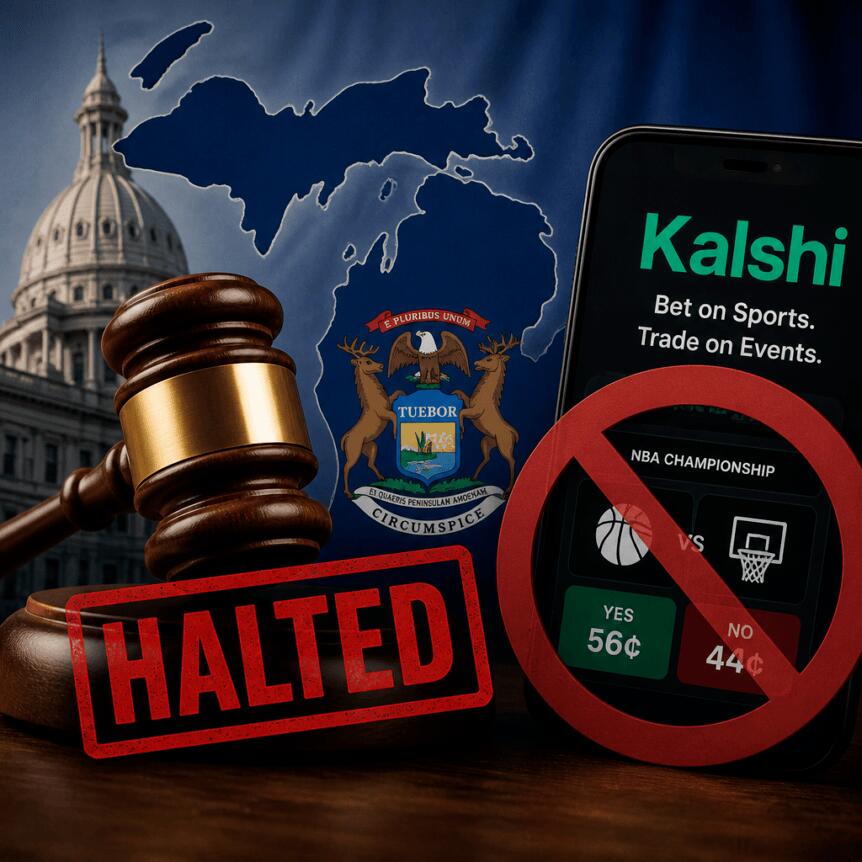
A Michigan judge has temporarily blocked Kalshi from allowing residents to place bets on sporting events while the state pursues claims that the platform is violating gambling laws. The decision, issued by Ingham County Circuit Court Judge Rosemarie Aquilina, is set to last 14 days and expires on July 13.
According to a court filing provided through a Thomson Reuters Law360 document, the court said Kalshi could be fined $120,000 for each day it fails to meet the order’s geolocation requirements. Aquilina also argued that Michigan residents risk “irreparable harm” by being “exploited by Kalshi's sports betting operation masquerading as an investment opportunity.”
Key takeaways
- Michigan’s temporary restraining order halts Kalshi’s sports event betting for now and emphasizes compliance with geolocation requirements.
- Kalshi faces financial exposure under the order, with a cited $120,000-per-day penalty for noncompliance.
- The move follows similar court-ordered pressure in Nevada and ongoing litigation involving multiple prediction market platforms.
- Prediction market sports activity has surged during the FIFA World Cup, with record trading volumes reported by Dune.
- Regulatory scrutiny is intensifying as states and the CFTC challenge the legal classification of event contracts.
Michigan’s temporary block targets geolocation compliance
Ingham County Circuit Court Judge Rosemarie Aquilina granted a temporary restraining order against Kalshi, restricting the company’s sports betting-related offerings to Michigan residents. The court order is tied to geolocation rules, meaning the platform must ensure users are properly excluded or restricted based on location before the order runs its course.
Per the filing, failure to comply can trigger substantial daily penalties. The order’s short duration—14 days—signals an escalation rather than a final resolution, but it also adds immediate operational risk for prediction market operators that rely on broad national access.
Michigan’s action also fits into a wider pattern: regulators and courts across the US have been testing where prediction markets fall within gambling law frameworks, even when operators frame their products as market-like event contracts.
Kalshi joins a growing list of prediction market legal setbacks
This latest Michigan development adds to the pressure Kalshi has faced in other jurisdictions. The article’s referenced reporting notes that Nevada issued a temporary ban on Kalshi earlier in March, making Michigan the second state to impose a court-ordered restriction on Kalshi’s sports event contracts.
Beyond Kalshi, the broader prediction market sector is also under legal scrutiny. On June 17, Kentucky sued five prediction market platforms—including Kalshi and Polymarket—accusing them of operating unlicensed sports betting. According to the same coverage, more than a dozen other states have also taken prediction market operators to court.
Federal regulators are involved as well. The US Commodity Futures Trading Commission (CFTC) has sued several states, arguing that event contracts already subject to federal oversight fall under the CFTC’s exclusive authority.
For users and traders, the practical effect is uncertainty about where and how these markets can legally operate. For operators, it raises compliance burdens and can force changes to access controls, product design, or both—especially when courts act quickly through temporary restraining orders.
World Cup momentum lifts prediction market volumes
While court cases continue to unfold, trading activity in prediction markets has remained active during major sporting events. The article points to sports betting activity rising in prediction markets since the start of the FIFA World Cup.
According to Dune data cited in the report, daily taker volume—a measure of contracts bought or sold by traders filling existing orders—reached a record $713 million on June 20. That high point came more than a week after the tournament started on June 11.
On a broader time basis, the report also cites Defirate data showing sports as the leading category on two of the largest prediction markets. Monthly sports betting volume rose 40% to $9.5 billion on Kalshi and increased 175% to $5.3 billion on Polymarket.
Separately, a referenced Bernstein report predicted that the 2026 FIFA World Cup would generate more than $3 billion in incremental sports betting handle and add between $5 billion and $10 billion in consumer prediction market volume. While that forecast focuses on a future tournament, the World Cup’s current trading lift provides evidence that such demand forecasts may be based on repeatable patterns rather than one-off hype.
From betting to crypto onboarding: new users find the chain
The surge in World Cup-linked trading is also tied, in at least one dataset, to crypto user discovery. The report states that Polymarket has acted as an onboarding layer for new cryptocurrency users, with about 60% of World Cup bettors interacting with the blockchain for the first time during their prediction market entry.
That figure comes from a Bitget Wallet study of 857,000 users, shared with Cointelegraph. The report adds that the “World Cup winner” contract alone generated over $3.5 billion in trading volume on Polymarket, based on platform data for the event.
These points matter because they underscore a key tension in the regulatory debate: prediction markets are often marketed as a trading experience, yet the mechanics frequently route users through blockchain-based infrastructure. Even when users treat the activity as entertainment or wagering, it can still create measurable crypto engagement—potentially increasing the visibility of these markets to regulators.
What to watch next
With Michigan’s restraining order set to expire on July 13 and new enforcement dynamics playing out across states, the next critical question is whether courts move from short-term blocks to longer remedies, and how prediction market platforms adjust geolocation and access controls under mounting legal pressure.
https://www.cryptobreaking.com/michigan-judge-halts-kalshis-sports/?utm_source=blogger%20&utm_medium=social_auto&utm_campaign=Michigan%20Judge%20Halts%20Kalshi’s%20Sports%20Betting%20for%20State%20Residents%20
Comments
Post a Comment