
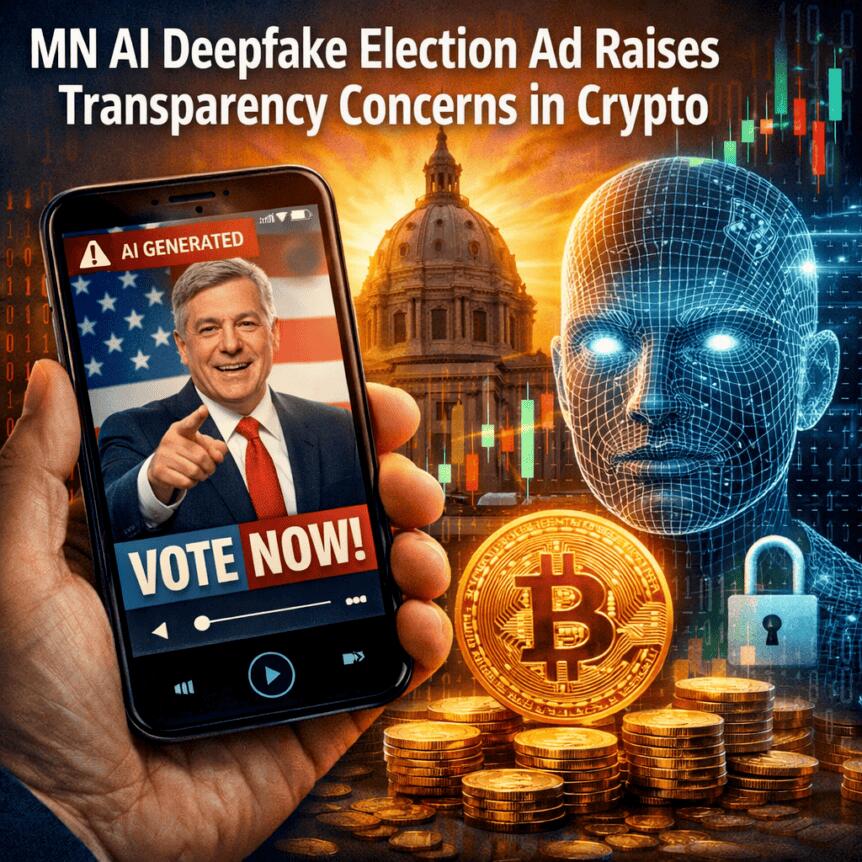
The United States is entering a broader debate over AI-driven deception in political advertising as the midterm cycle intensifies. A growing constellation of state laws, a cautious federal stance, and high-profile campaign examples are shaping how campaigns may use or be constrained by AI-generated content in the near term.
Industry observers and watchdogs say the moment highlights a fundamental tension: AI can expand reach and persuasion for campaigns, but it also risks undermining trust if audiences cannot readily verify authenticity. Several developments this year illuminate where the policy terrain stands and where it might move next.
Key takeaways
- State-level patchwork: Roughly 28 states have disclosure requirements for political ads, with many penalties civil in nature; Minnesota’s 2023 law also contemplates criminal penalties for certain deepfake disclosures as elections approach.
- High-profile Minnesota case: An AI-generated ad targeting a Minnesota political race raised questions about deepfake legality and political norms, triggering responses from lawmakers on both sides of the aisle.
- Federal guardrails are cautious: The Federal Elections Commission emphasizes disclaimers and bans fraudulent misrepresentation, but has not launched a comprehensive AI rulemaking; broader federal legislation has repeatedly stalled.
- Legislative momentum and pushback: A bipartisan draft bill would preempt state AI regulations, drawing pushback from civil liberties groups that warn about overreach and the need for safeguards.
A patchwork of state rules governs AI in political ads
Across the United States, regulation of AI in political messaging has largely fallen to state governments. While about a quarter of states implement clear disclosure requirements for AI-generated content, most rules carry civil penalties rather than criminal consequences, and enforcement varies widely. Minnesota sits at the intersection of evolving policy and high-profile test cases.
In Minnesota, a campaign ad tied to the Senate primary drew scrutiny for its use of AI-generated imagery that appeared to resemble Lt. Gov. Penny Flanagan. Flanagan herself referenced the spot on BlueSky, noting that voters might soon see a TV ad “starring something that... kind of looks like me.” The episode underscored how AI can blur lines between genuine endorsements and deceptive representations.
The law in Minnesota already has a recent history of addressing AI deception. A 2023 measure, introduced by lawmakers concerned about manipulated content, approved language that criminalizes certain uses of deepfakes within 90 days of an election when the creator knows the content is a deepfake or intends to influence an election. Critics say the law’s structure makes enforcement highly fact-specific, and whether a given ad crosses the line depends on context and intent.
Observers note that while the incident occurred after the Democratic-Farm-Labor (DFL) Party secured a nomination, the legal questions are not easily resolved by a single ruling. The broader state environment includes a notable chorus of concern: 40 DFL state legislators signed a statement condemning AI-generated deepfakes in political advertising, arguing that the technology undermines trust in elections.
Minnesota case highlights tensions between policy and campaigning
The North Star Dawn PAC, which supported a candidate aligned against Flanagan, issued the AI-generated ad that sparked the dispute. Its content, which depicted a figure resembling Flanagan with a symbolic payoff image, drew immediate pushback from Flanagan and her allies, who described the approach as deceptive and inappropriate for public discourse. A leading Minnesota lawmaker summarized the sentiment by saying the use of AI deepfakes “is unacceptable” regardless of political affiliation.
The episode fed into a broader debate about the pace at which campaigns adapt to AI tools. Critics argue that even where laws exist, the ethical and practical implications of AI in political advertising merit careful consideration beyond compliance. Campaign consultants and advertising executives have urged a measured approach, acknowledging both the persuasive potential of AI and the risk to voter trust.
In parallel, observers like DSPolitical’s Mark Jablonowski noted that most campaigns, across parties, would prefer to set standards that protect voters and uphold integrity, even as exceptions may occur. The Minnesota case thus serves as a testbed for how laws may be interpreted in dynamic media environments where AI content can be produced quickly and disseminated broadly.
Federal regulators and lawmakers wrestle with AI in elections
On the federal front, the landscape remains cautious and inconsistent. The Federal Elections Commission (FEC) maintains that election advertising must include clear and conspicuous disclosures for content distributed by a candidate’s committee, and it reiterates that fraudulent misrepresentation is prohibited. While the FEC has discussed AI-specific questions in various contexts, it has not undertaken a comprehensive rulemaking to govern AI in political ads.
Public advocacy and consumer groups have pressed for more formal guidance. In 2023, Public Citizen petitioned the FEC to initiate rulemaking to address AI in campaign materials, but the commission opted not to begin a formal process at that time, arguing that existing fraud provisions already cover deceptive content regardless of the technology used.
Legislative efforts at the federal level have faced a slow trajectory. The REAL Political Advertisements Act—intended to establish more explicit AI-related rules—failed to pass in Congress. The broader political environment has historically shown limited appetite for sweeping AI regulation, even as concerns about safety, accuracy, and accountability mount.
Nevertheless, lawmakers continue to explore options. In June, a bipartisan draft bill proposed by Rep. Lori Trahan and Rep. Jay Obernolte would preempt state laws aimed at regulating AI model development, raising questions about how to balance innovation, consumer protection, and electoral integrity. Civil liberties groups, including the ACLU, argue that preemption could hinder essential safeguards—advocating instead for a framework that preserves state authority to address local harms while ensuring privacy, non-discrimination, and AI safety.
A spokesperson for the ACLU framed the concern clearly: preemption could broaden the potential for AI-enabled harms if states lose tools to police transparency and safety measures. ACLU policy experts emphasize that states must retain authority to protect residents from abuses, hold tech companies accountable, and ensure AI is safe and trustworthy. In the broader debate, the absence of a robust, unified federal standard leaves states to chart their own paths, while federal agencies look for practical guardrails that can be implemented without stifling innovation.
As policymakers weigh these issues, observers will watch for the outcomes of ongoing enforcement and potential new rules at the state level, along with any further federal proposals. The Minnesota episode and related debates illustrate both the urgency of addressing AI-driven deception in elections and the complexity of aligning legal frameworks with rapidly evolving technologies.
What readers should watch next is how states respond to ongoing incidents and whether federal regulators move beyond general antifraud provisions to craft concrete guidelines for AI-generated political content. The balance between safeguarding electoral integrity and enabling technological innovation will determine the trajectory of AI in political advertising through the 2026 cycle and beyond.
https://www.cryptobreaking.com/mn-ai-deepfake-election-ad/?utm_source=blogger%20&utm_medium=social_auto&utm_campaign=MN%20AI%20Deepfake%20Election%20Ad%20Raises%20Transparency%20Concerns%20in%20Crypto%20
Comments
Post a Comment