
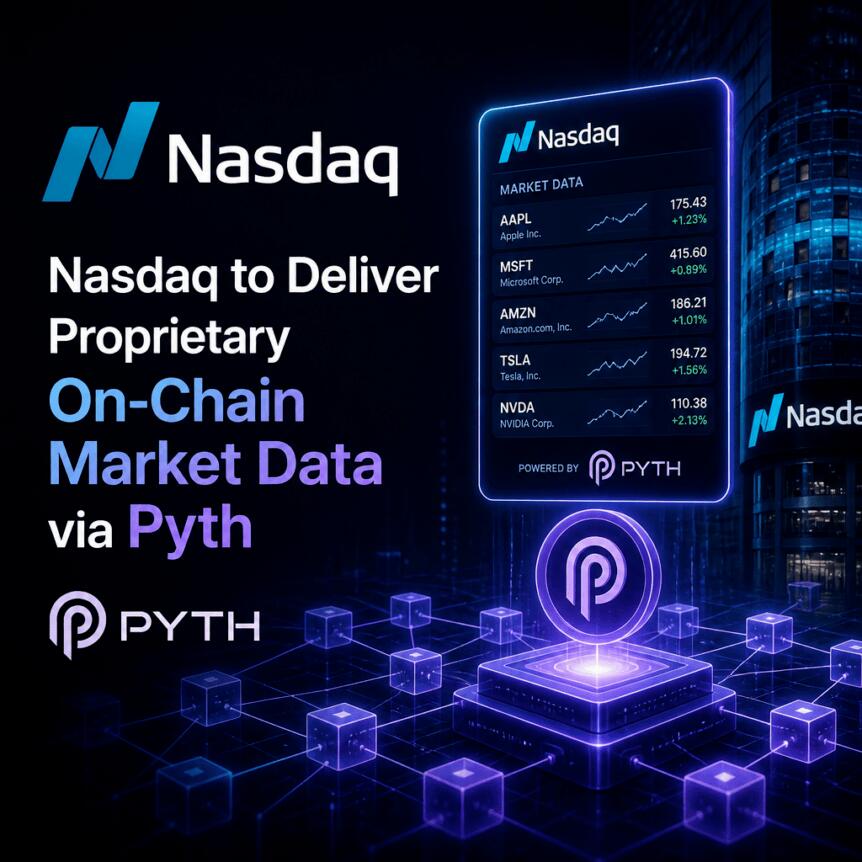
Nasdaq has chosen Pyth, an onchain financial data network, to distribute Nasdaq’s proprietary market data to blockchain applications and other software platforms, expanding how institutional trading feeds can be consumed by decentralized systems.
The collaboration begins with access to Nasdaq TotalView, the exchange’s depth-of-book data feed that captures every displayed bid and ask across price levels, along with order imbalance information around the opening and closing auctions. For traders and developers, the emphasis is on richer liquidity visibility than standard quote feeds, since a full order book can help power more informed execution, market-making analytics, and trading logic.
Key takeaways
- Nasdaq selected Pyth to make Nasdaq market data available to blockchain and other software platforms via onchain distribution.
- Initial coverage is Nasdaq TotalView, including full displayed order books and order imbalance data around opening and closing auctions.
- Pyth positions its integration as “single” access, aiming to simplify how applications obtain first-party market data.
- Nasdaq joins existing Pyth publishers such as Euronext, Tradeweb, Kalshi, Singapore Exchange (SGX FX), and the US Department of Commerce.
From exchange microstructure to onchain use
Traditional market data products typically serve low-latency trading systems and professional analytics, where order book visibility is critical. Nasdaq TotalView is designed for that purpose, offering a more complete picture of market liquidity by publishing the full displayed order book at each price level rather than relying only on top-of-book quotes.
By routing this type of feed through an onchain data network, Nasdaq is effectively lowering the integration barrier for applications that want to incorporate exchange-grade market information. According to Pyth, the service allows software applications to access first-party market data through a single integration, and it is intended for a range of use cases including blockchain applications, digital asset exchanges, prediction markets, and trading systems.
For builders, this matters because onchain trading and derivatives often struggle with a lack of consistent, high-quality market inputs. Depth-of-book and auction-related imbalance data can also support models that go beyond last-trade or index pricing, potentially improving how decentralized systems interpret liquidity conditions around times when participation and price formation are especially active.
Nasdaq’s broader digital-asset push
The Pyth partnership aligns with a series of moves by established exchange operators to expand into crypto-adjacent infrastructure and regulated market services.
In March, Nasdaq expanded its tokenization efforts through an agreement with crypto exchange Kraken and its infrastructure affiliate Backed to develop infrastructure aimed at linking traditional equities with blockchain networks. The company has framed this as part of a larger push to integrate tokenized assets with existing capital markets rails.
Nasdaq has also continued to deepen its regulated crypto derivatives strategy. The SEC approved Nasdaq’s proposal to list Bitcoin index options tied to the Nasdaq Bitcoin Index, with trading pending approval from the Commodity Futures Trading Commission. In parallel, Nasdaq partnered with CME Group to launch cryptocurrency index futures that track a basket of seven digital assets, including Bitcoin, Ether, Solana, and XRP, as part of its broader regulated derivatives lineup.
Exchange peers and the race for crypto product scope
Nasdaq is not alone in expanding beyond legacy exchange offerings. ICE—the parent of the New York Stock Exchange—has taken steps into crypto futures by partnering with OKX to launch perpetual futures tied to ICE’s Brent crude and West Texas Intermediate oil benchmarks. The announcement was described as the first product under that partnership.
ICE CEO Jeffrey Sprecher has also argued that regulators should allow traditional exchanges to offer 24/7 onchain perpetual futures. The core point is competitive: regulated venues should be able to contend with crypto-native platforms that already operate perpetual products around the clock.
While Nasdaq’s current Pyth deal is centered on market data distribution rather than trading products, it fits the same competitive theme—improving the ability of institutional-grade infrastructure to connect with blockchain applications. In practice, data access is often a prerequisite for building or operating decentralized systems that can respond to real liquidity conditions.
What to watch next
Investors and developers should keep an eye on how Nasdaq TotalView data is rolled out through Pyth beyond the initial scope, and whether additional Nasdaq market data offerings follow. As onchain applications increasingly seek higher-fidelity inputs, partnerships like this could become a differentiator for decentralized trading and prediction systems—provided integration remains practical and latency or data quality expectations can be met in real-world deployment.
https://www.cryptobreaking.com/nasdaq-to-deliver-proprietary-on/?utm_source=blogger%20&utm_medium=social_auto&utm_campaign=Nasdaq%20to%20Deliver%20Proprietary%20On-Chain%20Market%20Data%20via%20Pyth%20
Comments
Post a Comment