
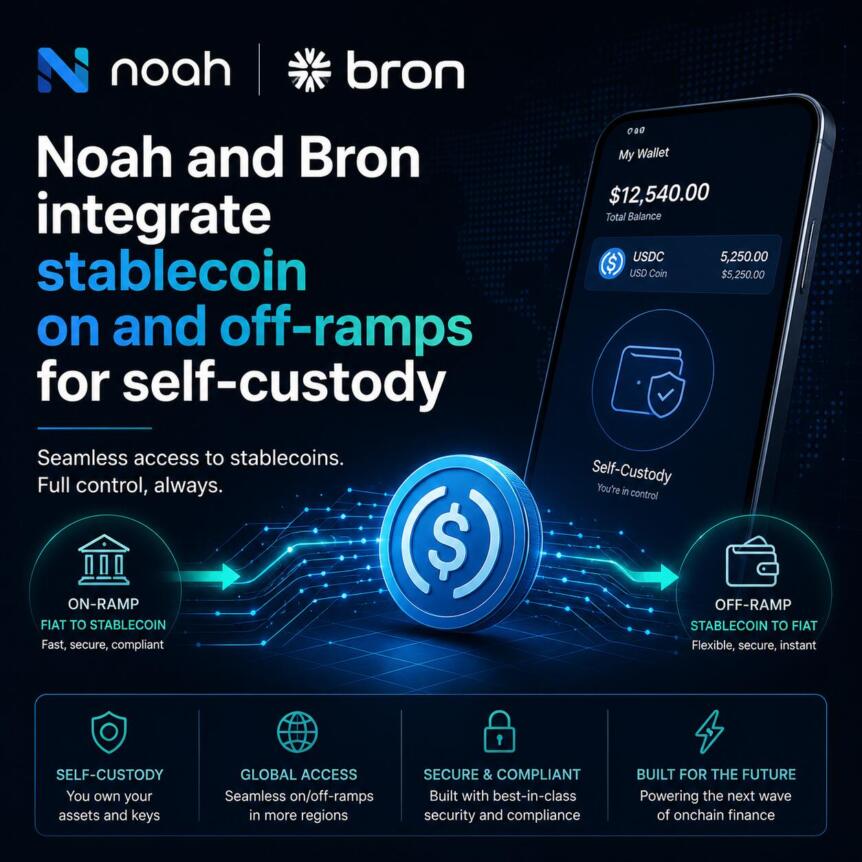
Partnership targets a key adoption gap: connecting on-chain custody with funding rails
On-chain self-custody remains one of crypto’s defining value propositions, but it often runs into a practical problem: getting funds in and out smoothly. This is the gap a new partnership between stablecoin infrastructure provider Noah and self-custody wallet startup Bron is attempting to narrow.
Both companies announced they are integrating Noah’s stablecoin on- and off-ramp capabilities into the user experience around Bron’s non-custodial wallet. The goal, according to the companies, is to make it easier for users to fund their self-custody wallets with stablecoins and to withdraw back when needed, while keeping the wallet’s security model intact.
Noah brings stablecoin rails, Bron focuses on MPC security
Noah describes its role as payments infrastructure for fintechs, exchanges, marketplaces, and other businesses operating across jurisdictions. The company says its platform supports account issuance, settlement, and global payouts, and that it is used for stablecoin-based money movement through blockchain payment rails.
Bron, meanwhile, positions its wallet as non-custodial and built on multi-party computation (MPC). In the company’s model, the wallet is designed to eliminate seed phrases and reduce single points of failure. The announcement outlines a three-party MPC architecture for transaction authorization, with separate cryptographic components distributed across the user’s device, Bron’s platform, and an independent third party selected by the user for recovery. Bron says no single party can reconstruct signing material or initiate transactions unilaterally.
What the integration changes for users
The companies say the integration will enable Bron users to access “seamless” stablecoin on- and off-ramp functions powered by Noah’s network. In practical terms, the addition is aimed at streamlining the steps involved when a user wants to move from traditional money sources into stablecoins, then into self-custody, or do the reverse for withdrawals.
For high-net-worth individuals and other users who transact across markets, stablecoins can serve as a bridge between different currencies and payment environments. Noah’s stated emphasis is on enabling virtual accounts for dollar origination and payouts across international jurisdictions, which aligns with broader industry patterns where stablecoins are increasingly used for remittances, cross-border transfers, and other time-sensitive value movement use cases.
The companies also frame the partnership as a way to reduce friction between conventional financial infrastructure and self-custody experiences. That positioning reflects a recurring theme in crypto payments: security and ownership models can be compelling, but mainstream adoption depends on smoother rails, clearer compliance workflows, and fewer operational steps for end users.
Why stablecoin rails plus self-custody is gaining attention
Stablecoins have evolved from speculative instruments into infrastructure for real payments and treasury activity. Industry participants frequently point to stability relative to major fiat currencies, faster settlement compared with legacy systems, and programmability on public blockchains as reasons for adoption.
However, stablecoin usage often still depends on off-chain connections to regulated entities. On-ramps and off-ramps are one of the most important interfaces in that chain, because users typically need compliant ways to convert fiat into digital assets and back. Meanwhile, self-custody wallets emphasize user control and cryptographic safeguards, but they can be harder to use if funding and withdrawal paths are fragmented.
By combining Noah’s on/off-ramp infrastructure with Bron’s MPC-based wallet design, the companies are effectively trying to address two sides of the same problem: access and control. The integration does not change the underlying custody model described by Bron, which remains non-custodial and centered on MPC authorization and recovery mechanics, according to the announcement.
Institutional-style security claims, and the compliance question
Both companies highlight trust and security. Bron emphasizes protections such as delayed transfer features, hidden vault concepts, biometric authentication, and guardian-based recovery mechanisms, in addition to its MPC approach. Noah’s role, as described, is tied to regulated infrastructure for money movement and partner services.
What remains unclear from the announcement is the depth of integration at the product and jurisdiction levels. For example, on- and off-ramp availability can vary depending on local regulations, user verification requirements, and partner routing. The companies do not provide a list of supported countries, token types beyond stablecoins generally, or integration timelines beyond the partnership announcement date.
For users and enterprise partners evaluating similar deployments, the operational details are typically as important as the cryptography. Stablecoin onboarding, withdrawal timing, fee structures, and compliance controls can determine whether the “frictionless” promise translates into a consistent experience.
Industry implications: fewer steps to custody, potentially wider participation
If the integration performs as intended, it could make self-custody more accessible for users who do not want to rely on exchange custody. It also fits a broader market direction where wallet providers increasingly partner with payment and compliance layers, rather than trying to build end-to-end fiat connectivity themselves.
At the same time, the partnership illustrates how stablecoin infrastructure is becoming a core layer for crypto user journeys. As stablecoins are used more frequently in payments and cross-border value transfers, the companies that control the user-facing rails, whether through APIs, checkout flows, or treasury payouts, may play outsized roles in mainstream adoption.
What’s next
Noah and Bron framed the partnership as a step toward connecting traditional finance infrastructure with secure self-custody, without compromising on the ownership model the wallet is designed around. For the market, the key question will be practical: whether the integrated on- and off-ramp experience is consistent across jurisdictions and whether it meaningfully reduces the operational burden for users.
As stablecoin adoption continues to expand beyond trading, integrations like this one signal a shift toward complete user journeys, from onboarding through custody and onward to withdrawals, rather than treating each stage as a separate product.
https://www.cryptobreaking.com/noah-bron-stablecoin-on-off/?utm_source=blogger%20&utm_medium=social_auto&utm_campaign=Noah%20and%20Bron%20integrate%20stablecoin%20on%20and%20off-ramps%20for%20self-custody%20
Comments
Post a Comment