
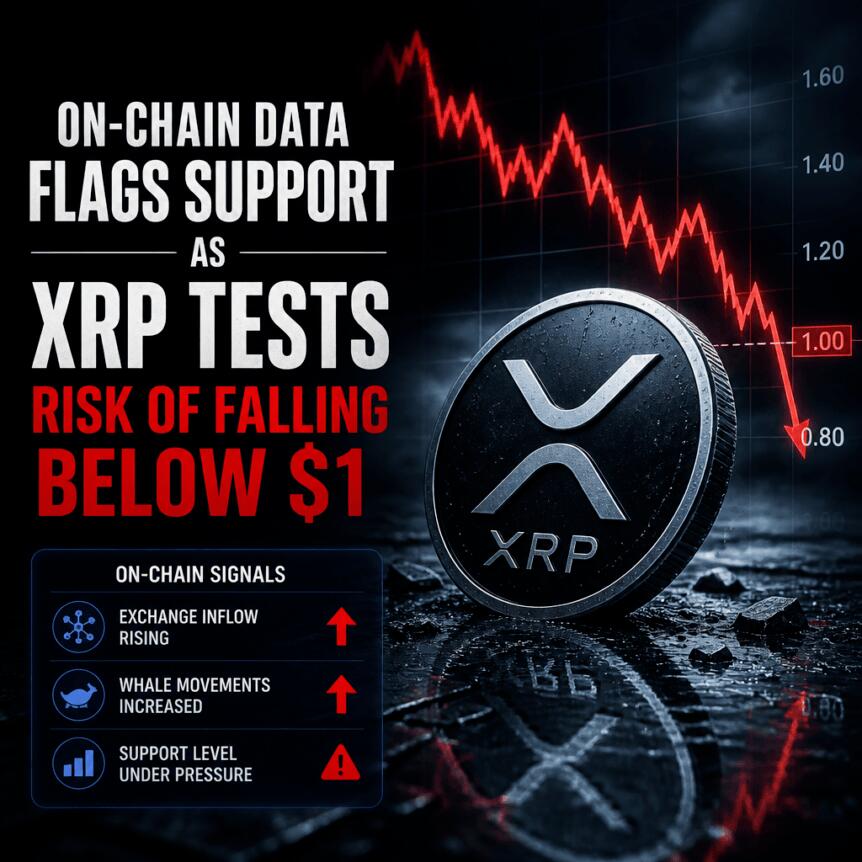
XRP is trading just above $1 and is testing what traders often treat as psychologically important support. While the market price remains under pressure, multiple on-chain signals suggest the token’s network positioning and capital flows may be improving.
CryptoQuant data highlighted shrinking XRP held on major exchanges, seven straight days where withdrawals have outpaced deposits on Binance by transaction count, and continued positive whale accumulation. In parallel, spot XRP exchange-traded funds (ETFs) have gathered meaningful inflows since April, including $243 million in cumulative net purchases.
Key takeaways
- Binance’s XRP reserve has fallen to its lowest level since March, with roughly 100 million XRP leaving over the past month.
- On Binance, XRP withdrawals have exceeded deposits for seven consecutive days since June 17, based on transaction counts (not token volume).
- Whale flows on a 90-day moving average have remained positive throughout the quarter, indicating net accumulation by large holders.
- Spot XRP ETFs have drawn $243 million in cumulative inflows since April, with June inflows totaling $31 million.
- Technically, XRP remains in a broader bearish structure on higher timeframes and is approaching a potential demand zone between $1 and $0.63.
Exchange reserves keep sliding
One of the clearest on-chain themes in recent days is the continued reduction of XRP sitting on exchanges. Crypto analyst Amr Taha pointed out that Binance’s XRP reserve dropped to about 2.68 billion XRP as of June 25, down from roughly 2.78 billion XRP on May 12.
That shift followed an outflow of approximately 100 million XRP from the exchange over the past month, marking what CryptoQuant described as the lowest Binance reserve level since March. Among major trading venues, Binance led in absolute outflows, while other platforms showed smaller but still notable declines.
CryptoQuant data also showed that Upbit’s XRP reserve eased to about 2.48 billion XRP on June 25 from approximately 2.51 billion XRP on May 31. Bybit’s holdings declined to about 82 million XRP from around 92 million XRP on June 2, with Bybit recording the steepest percentage drop among the tracked exchanges.
Withdrawals outpacing deposits on Binance
The story isn’t only about balances—it’s also about flow behavior. Taha flagged a significant change in Binance’s activity: XRP withdrawal transactions have exceeded deposits for seven straight days since June 17.
On June 23, the seven-day withdrawal share climbed to 53.8%, the highest reading since June 2024, while deposits fell to 46.1%, the weakest level since 2024. Importantly, CryptoQuant’s metric tracks transaction counts rather than the total amount of XRP moved.
Even so, the direction of the imbalance matters for how traders interpret positioning. A withdrawal-led stretch typically implies that users are moving coins off the exchange more frequently than they are sending them in, which can reduce readily available liquidity for short-term selling pressure—at least in aggregate.
Whale accumulation supports the flow picture
Large holders appear aligned with the exchange-reserve trend. CryptoQuant data cited in the reporting showed XRP whale flows on a 90-day moving average have stayed positive throughout the quarter at about 5.143 million XRP per day.
In practical terms, positive whale flows generally suggest that large wallets have been adding to positions rather than distributing at scale over the period. While whale activity does not guarantee a near-term price reversal, it can change the balance of who is absorbing supply during downturns.
Spot XRP ETFs add a separate layer of demand
Institutional-style demand has also contributed to a more supportive backdrop. According to SoSoValue’s ETF tracking, spot XRP ETFs recorded $2 million in net inflows on June 24. That helped lift June’s total net inflows to $31 million.
Since April, cumulative net inflows across spot XRP ETFs have reached $243 million, the figure referenced alongside the on-chain flow updates. For investors, ETF inflows are notable because they represent sustained access to XRP exposure through regulated market structures, which can complement—or at times counter—retail-driven volatility.
Price remains weak, but a key chart area is coming into focus
Despite improving on-chain signals, XRP’s price action still reflects a market that has not fully found stabilization. The token was reported trading near $1.01, which was cited as its lowest level of 2026 at the time of the coverage. This placed XRP close to its first move below $1 since November 2024.
With XRP down about 43% year-to-date, traders are watching for whether any bounce can materialize from a defined technical region. The coverage pointed to a potential demand area within a “fair value gap” between $1 and $0.63. That zone corresponds to an unfilled price gap created during a sharp rally in late 2024, and such gaps are frequently monitored by market participants for possible mean-reversion buying if declines extend.
At the same time, higher-timeframe structure remains bearish, according to the analysis summarized in the article. So even if a local demand zone attracts buyers, broader market trend conditions may continue to limit upside follow-through until the structure shifts.
Long-range accumulation thesis still on the table
Beyond near-term technicals, the reporting also included a longer-term view from Versan Aljarrah, founder of Black Swan Capitalist. In commentary shared on X, Aljarrah argued XRP has spent years building an accumulation range, with higher lows appearing on both weekly and monthly timeframes.
The thesis frames prolonged consolidations as setups for stronger breakouts once the range eventually resolves. Aljarrah’s target—$10—implies a move around 900% from current levels, a projection that underscores the bullish end of a spectrum that remains dependent on a confirmed breakout rather than a single bounce.
For now, investors may want to track whether exchange outflows and ETF inflows continue to line up with price stabilization—especially as XRP approaches the $1 to $0.63 area. The next decisive question is whether on-chain strength can translate into a trend shift on higher timeframes, or whether the market continues treating the $1 region as a breakdown point.
https://www.cryptobreaking.com/on-chain-data-flags-support/?utm_source=blogger%20&utm_medium=social_auto&utm_campaign=On-Chain%20Data%20Flags%20Support%20as%20XRP%20Tests%20Risk%20of%20Falling%20Below%20$1%20
Comments
Post a Comment