
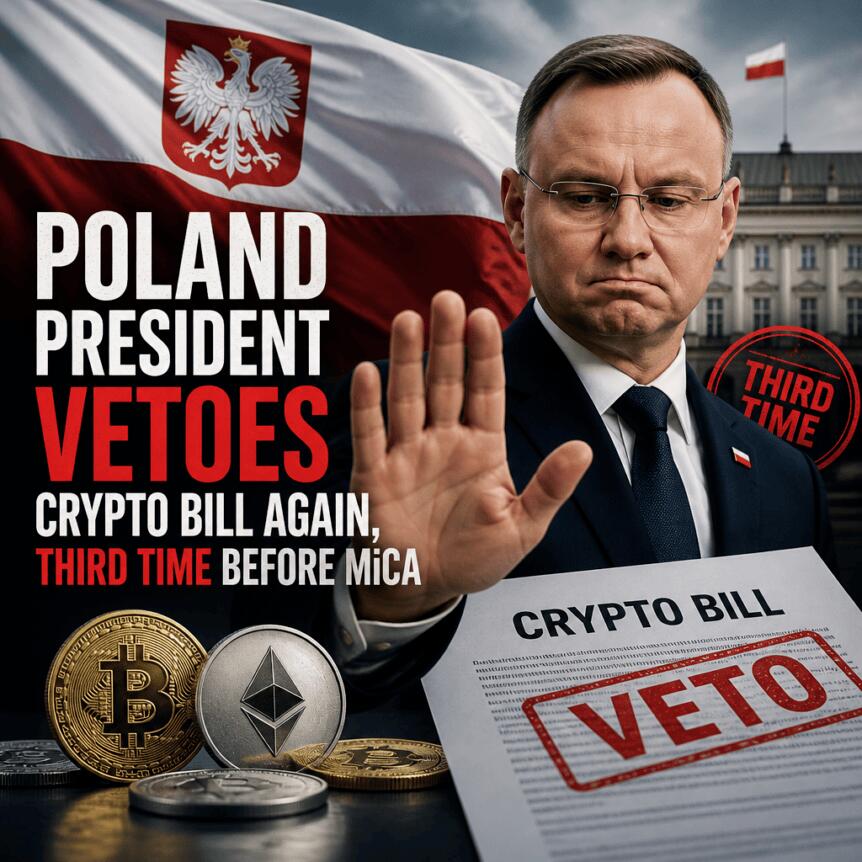
Poland’s President Karol Nawrocki has vetoed a crypto regulation bill for the third time, despite the measure’s stated goal of bringing the country in line with the European Union’s Markets in Crypto-Assets (MiCA) framework.
Nawrocki said he supports regulating cryptocurrencies, but argued that the government adopted only one of 16 amendments proposed by his office. He added that the latest text was nearly identical to the two previous drafts he rejected, prolonging a regulatory gap as the EU approaches its next major deadline for MiCA compliance.
Key takeaways
- President Karol Nawrocki vetoed Poland’s MiCA implementation bill for the third time.
- The veto delays Poland’s alignment with MiCA just weeks before the EU transitional period ends on July 1.
- After July 1, crypto asset service providers without a MiCA license may lose the legal basis to serve EU clients.
- Poland remains the only EU member state without domestic MiCA implementation, intensifying legal uncertainty for local firms.
- The political dispute has also coincided with heightened enforcement attention, including a prosecutor probe into Zondacrypto.
A third veto threatens MiCA readiness
The latest rejection pushes Poland further away from adopting MiCA at the national level. MiCA’s transitional phase is due to end on July 1, after which crypto asset service providers operating in the EU will generally need to hold a MiCA license or risk losing the ability to service EU customers.
Poland is currently the only EU country without domestic legislation implementing MiCA, a position that can make firms based in Warsaw, Kraków, and other Polish cities especially exposed to compliance and continuity risks. If providers cannot rely on a domestic legal framework for MiCA-related operations, they may face uncertainty over licensing pathways and their ongoing ability to offer services to EU users.
Nawrocki’s stance centers on amendments. He said he supports regulating the crypto market but objected because his office’s proposed changes were not fully incorporated. In his remarks Thursday, he claimed the bill submitted to his desk was nearly the same as earlier drafts that he vetoed.
Earlier, Polish politics had already stalled on the issue. The veto arrives with only limited time for parliament to respond in a way that can still meet the EU schedule, raising questions about how quickly the domestic process can restart and whether lawmakers can achieve a version that satisfies the presidency.
Parliament and the presidency fail to break the deadlock
This third veto deepens a broader institutional standoff over crypto oversight. It follows a period of legislative gridlock in which Poland’s parliament attempted to undo the second veto but fell short.
According to earlier coverage, lawmakers did not reach the 263 votes needed to override Nawrocki’s second veto in an April vote. The bill is backed by Prime Minister Donald Tusk’s government and is designed to align Poland with MiCA.
Nawrocki has previously defended his opposition by citing concerns that the bill would impose excessive regulation, offer limited transparency, and place a burden on small businesses. Supporters of the measure, however, have warned that delays leave the market exposed—both for consumers and businesses—potentially increasing the risk of fraud and abuse.
On Thursday, Tusk publicly criticized the president’s move in a post on X, writing: “It sounds unbelievable, but the president has vetoed the cryptocurrency bill again. He seems more entangled in it than everyone thought.”
Regulatory delays come as enforcement attention grows
While the political process has remained stuck, scrutiny of Poland’s crypto sector appears to be increasing. Prosecutors are investigating one of the country’s largest crypto exchanges, Zondacrypto, over suspected fraud and money laundering allegedly involving 2,000 customers with alleged links to Russian organized crime, according to earlier Cointelegraph reporting.
Zondacrypto CEO Przemysław Kral has denied accusations that funds were misappropriated.
For market participants, the juxtaposition is stark: instead of clarifying the domestic regulatory environment through MiCA implementation, Poland’s legislative uncertainty continues alongside high-profile legal inquiries. That combination can complicate compliance decisions for exchanges and other service providers—especially when firms must simultaneously respond to enforcement risk and prepare for EU licensing standards.
What changes after July 1—and what remains uncertain
The operational consequence of MiCA’s end of transitional period is straightforward: crypto asset service providers will need a MiCA license to continue servicing EU clients under the framework’s rules. Because Poland has not yet adopted domestic MiCA legislation, the timing amplifies the risk that Polish-based firms without the relevant licensing posture could face interruptions or require restructuring to keep serving EU users.
However, the precise impact for each operator depends on its current status—how it provides services, which customer base it serves, and whether it can obtain the required license in time. What readers should watch next is whether Poland’s lawmakers can craft and pass a revised bill that the president is willing to sign, and whether enforcement developments like the Zondacrypto case accelerate calls for faster compliance.
https://www.cryptobreaking.com/poland-president-vetoes-crypto-bill/?utm_source=blogger%20&utm_medium=social_auto&utm_campaign=Poland%20President%20Vetoes%20Crypto%20Bill%20Again,%20Third%20Time%20Before%20MiCA%20
Comments
Post a Comment