
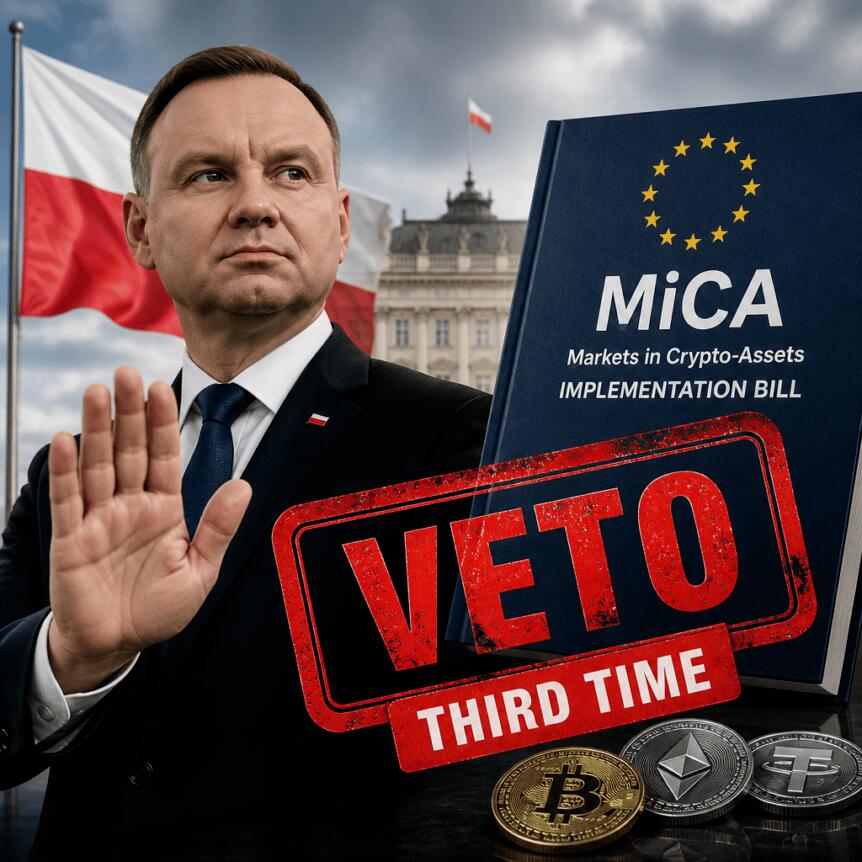
Polish President Karol Nawrocki has vetoed a cryptocurrency regulatory bill for the third consecutive time, again citing concerns that the government did not incorporate key amendments proposed by his office. The decision postpones Poland’s domestic implementation of Europe’s Markets in Crypto Assets (MiCA) framework at a critical moment ahead of the EU’s transitional deadline.
Poland is currently the only EU member state without a domestic MiCA transposition mechanism. As the July 1 end of MiCA’s transitional period approaches, crypto asset service providers may face heightened legal uncertainty if they cannot rely on a Polish legal basis to service EU customers.
Key takeaways
- President Karol Nawrocki vetoed Poland’s MiCA implementation bill for the third time, arguing only one of his office’s proposed changes was included in the latest draft.
- The veto delays Poland’s alignment with MiCA, leaving the country as the only EU member state without a domestic MiCA implementation.
- After July 1, non-licensed crypto asset service providers risk losing the legal basis to offer services to EU clients under MiCA.
- The political dispute coincides with intensifying law-enforcement scrutiny of the Polish crypto sector, including a probe involving major exchange Zonda.
Third veto delays MiCA adoption as EU deadline nears
According to information posted by the President’s office, Nawrocki said Thursday that while he supports regulating the crypto market, the government adopted only one of 16 key amendments put forward by his office. He also argued the bill’s latest version was nearly identical to the prior drafts he rejected.
Third vetoes of this type are consequential for compliance planning: firms operating in Poland—and those seeking to serve EU customers—depend on national implementation to understand licensing pathways, supervisory expectations, and the domestic legal framework supporting MiCA obligations.
The practical impact is magnified by timing. MiCA includes a transitional period during which certain requirements can be prepared for, but that window ends on July 1. After the end of the grace period, crypto asset service providers will be expected to operate under a MiCA license or stop servicing EU clients.
In this context, Poland’s lack of domestic implementation creates a regulatory coordination risk for the sector. If Polish legislation remains unsettled, service providers based in Poland may confront uncertainty over how they can legally continue cross-border business within the EU once transitional arrangements lapse.
Why Poland’s missing MiCA implementation matters for firms
MiCA is designed to establish a harmonized EU-wide regulatory regime for crypto asset service providers. Even where firms may anticipate that EU-level rules ultimately govern conduct, licensing and operational compliance often rely on domestic legislative execution and the establishment of competent national supervisory arrangements.
Poland’s situation—being the sole EU member state without domestic MiCA implementation—means compliance teams may need to track both EU requirements and the status of Polish law closely, particularly for activities that depend on licensing eligibility and supervisory processes. For institutional stakeholders such as regulated financial institutions, onboarding counterparts, custody providers, and market infrastructure operators, this can affect due diligence conclusions and risk assessments.
From a policy perspective, the repeated veto also highlights how constitutional and political processes can interfere with the speed of regulatory transposition—leaving firms to manage legal ambiguity during critical implementation windows. While MiCA aims for uniformity, the path to uniformity can still diverge due to national legislative delays.
Political dispute unfolds alongside increased enforcement attention
Thursday’s veto decision comes as scrutiny of Poland’s crypto sector intensifies. Prosecutors are reportedly investigating Zonda, one of Poland’s largest crypto exchanges, for suspected fraud and money laundering tied to alleged activity involving 2,000 customers and alleged links to Russian organized crime.
The investigation follows a report by blockchain analytics and research platform Recoveris. Recoveris alleged that Zonda may have been insolvent based on a sharp decline in the exchange’s hot wallet balances, according to reported coverage.
Earlier in April, Zonda’s CEO Przemysław Kral claimed that a cold wallet containing approximately 4,500 Bitcoin (BTC) was inaccessible. He said the private keys were intended to be handed over by Zonda founder and former CEO Sylwester Suszek, who has been missing since 2022. Kral denied allegations that he misappropriated funds.
The enforcement dimension is relevant for regulatory monitoring because AML/CFT issues, custody and reserve transparency, and fraud allegations often intersect with licensing and prudential expectations under MiCA. Even where investigations are ongoing and outcomes remain unknown, institutions typically treat such matters as material to counterparty risk management and compliance governance.
Prime Minister Donald Tusk criticized the veto in an X post, writing that “the president has vetoed the cryptocurrency bill again,” implying the matter is politically entangled.
What to watch as Poland’s legal framework remains unsettled
With MiCA’s transitional period ending on July 1, Poland’s next steps—whether the bill is revised and re-submitted, and how legislators address the amendment disputes raised by the President—will be central to reducing regulatory uncertainty for market participants. At the same time, continued investigations into exchanges such as Zonda may further shape how regulators and supervisors prioritize enforcement and compliance expectations during the transition to MiCA-aligned operations.
https://www.cryptobreaking.com/poland-president-vetoes-mica-implementation/?utm_source=blogger%20&utm_medium=social_auto&utm_campaign=Poland%20President%20Vetoes%20MiCA%20Implementation%20Bill%20for%20Third%20Time%20
Comments
Post a Comment