
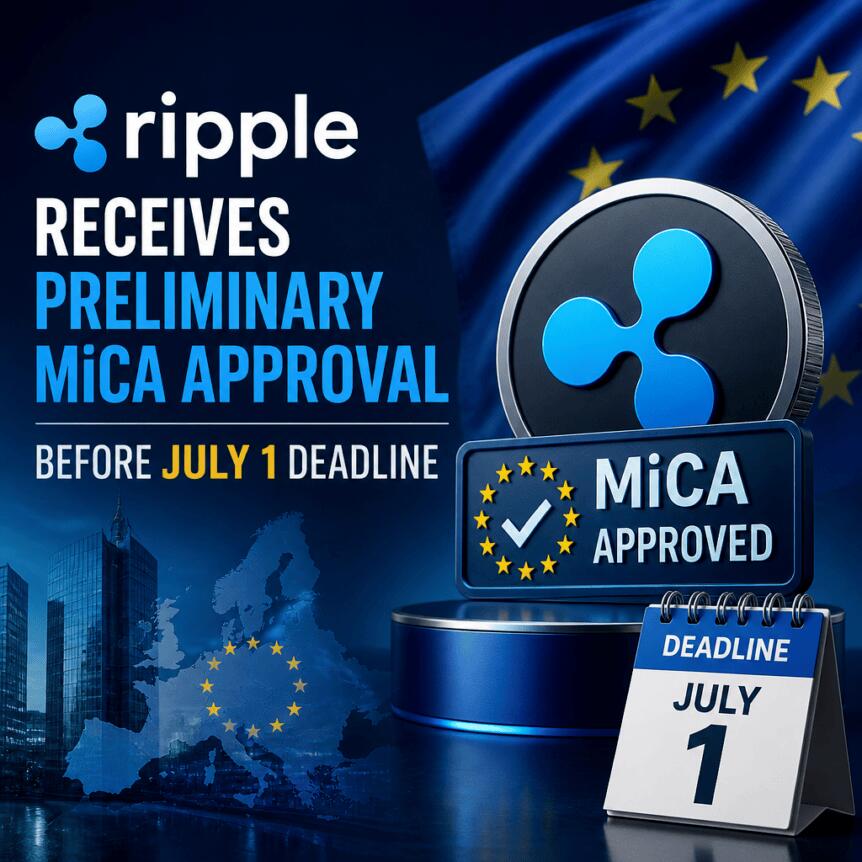
Ripple says Luxembourg’s financial regulator has granted it preliminary approval for a crypto asset service provider (CASP) license under the European Union’s Markets in Crypto-Assets Regulation (MiCA). The company framed the authorization as a step toward delivering MiCA-compliant crypto and stablecoin payment services to customers across the European Economic Area (EEA).
In a statement on Tuesday, Ripple said that once the CASP approval is finalized, it would allow the firm to operate under a single regulatory passport across all 30 EEA countries. The announcement arrives shortly ahead of July 1, when EU member states begin fully applying MiCA’s rules.
Key takeaways
- Luxembourg has granted Ripple preliminary MiCA CASP approval, moving the company closer to offering regulated crypto services across the EEA via passporting.
- Ripple is also building on an existing Luxembourg Electronic Money Institution (EMI) license, enabling payments and electronic money services region-wide.
- The “one integration” pitch centers on combining CASP and EMI authorizations to support crypto and stablecoin payments infrastructure.
- Ripple’s timing suggests it is positioning itself ahead of MiCA’s July 1 full application deadline.
- Europe remains a high-stakes proving ground for MiCA compliance, with other major players still working through approvals.
Why Ripple’s preliminary MiCA CASP approval matters
Under MiCA, crypto service providers in the EU can seek authorization as CASPs. Ripple said Luxembourg’s regulator granted it a preliminary green light for that role, with finalization required before the company can fully launch under the new framework.
Ripple’s core argument is that combining its CASP license pathway with its existing EMI status in Luxembourg will allow a broader set of services to be rolled out across the EEA. The company pointed to regulated access for banks, fintechs and other business customers—groups that typically look for well-defined compliance regimes before integrating crypto-related payment rails.
From EMI to a combined crypto payments setup
Ripple said its pending CASP license, together with the Electronic Money Institution license already held in Luxembourg, would enable a “full crypto asset and stablecoins payments infrastructure.” According to the company, the addition of CASP authorization would also make it possible to support these capabilities through a single integration for customers.
The move is tied to Ripple’s broader licensing strategy in Europe. Ripple previously received a full EU electronic money institution license in Luxembourg in February 2026. The new preliminary CASP step is therefore presented as an expansion from electronic money and cross-border payments toward MiCA-covered crypto asset services.
Europe’s MiCA deadline turns into a regulatory test case
Ripple’s CASP progress comes as MiCA implementation increasingly shapes how the crypto sector operates in Europe. The July 1 timeline has pushed firms to secure authorization before rules fully take effect.
Other market participants have faced a more uncertain path. Crypto exchanges and platforms have been racing to align with MiCA authorization requirements, and reports have suggested that some applications could face resistance. In particular, Reuters has reported that regulators in Greece may be preparing to deny Binance’s EU license bid for permission to offer services in the bloc, citing sources. The episode underscores that MiCA authorization outcomes may vary significantly by jurisdiction.
Ripple’s announcement also highlights how individual firms are attempting to convert existing regional licenses into MiCA-ready offerings. The company said it holds more than 75 regulatory licenses globally and referenced a UK CASP-related authorization it received from the Financial Conduct Authority in January 2026.
Institutional demand and “passport” expansion
Ripple’s management linked the timing to what it described as growing institutional interest in digital assets in Europe. Cassie Craddock, managing director of the UK and Europe at Ripple, said MiCA “has helped to unlock a new wave of institutional digital assets adoption,” adding that Ripple is seeing demand accelerate across the region.
For businesses evaluating crypto payments infrastructure, the practical issue is not just legality but portability. Ripple emphasized that final approval would enable it to serve customers across the entire EEA using a regulatory passport—an approach that can reduce duplication of compliance efforts compared with running separate authorizations per country.
Ripple also said Luxembourg’s updated CASP status is intended to support expansion into broader crypto asset activities in Europe, which it described as a leading region for its product footprint.
What to watch next
The key open item is whether Ripple’s preliminary CASP approval is finalized in time for the full effect of MiCA rules on July 1, and how quickly it can translate combined CASP and EMI authorizations into customer-facing services. As Europe continues to process MiCA applications, investors and partners will likely watch not just approvals, but the speed and scope of rollout across different jurisdictions.
https://www.cryptobreaking.com/ripple-receives-preliminary-mica-approval/?utm_source=blogger%20&utm_medium=social_auto&utm_campaign=Ripple%20Receives%20Preliminary%20MiCA%20Approval%20Before%20July%201%20Deadline%20
Comments
Post a Comment