
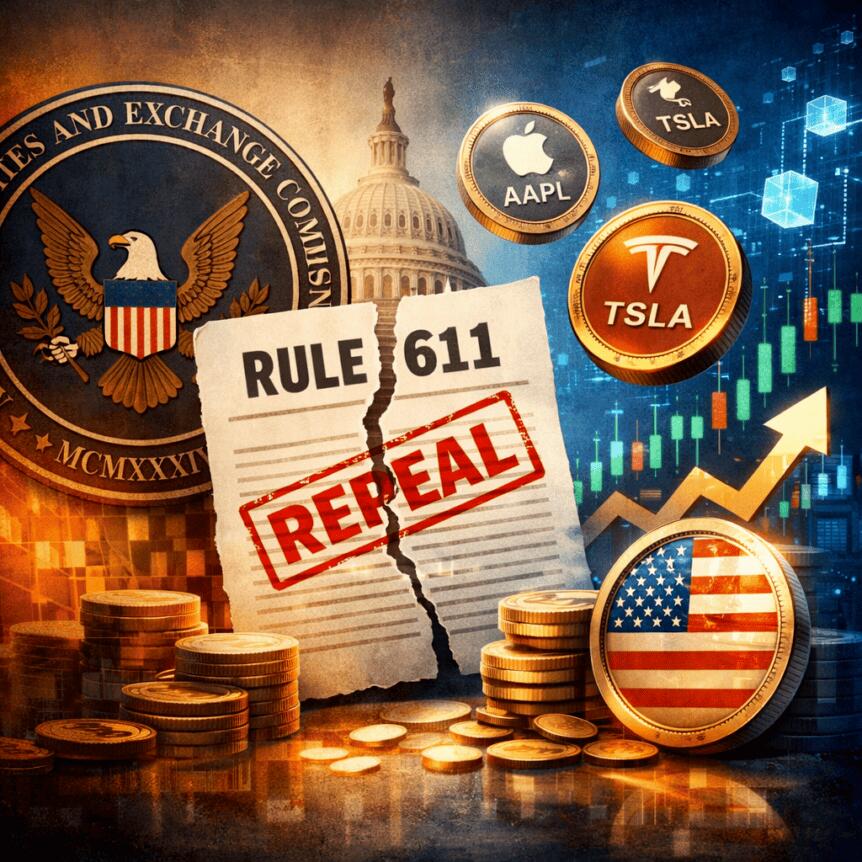
The U.S. Securities and Exchange Commission has proposed rescinding two core National Market System (NMS) rules, a move that could remove a substantial legal barrier to tokenized US stocks trading in decentralized finance (DeFi). The proposal targets Rule 611, which bans trade-throughs across exchanges, and Rule 610(e), which restricts displaying bids at the same or higher prices elsewhere. If adopted, the change would ease the path for tokenized equities to operate more freely within crypto trading venues.
The SEC said the changes would be considered as part of its ongoing effort to modernize the framework governing digital assets in U.S. markets. The agency opened a 60-day window for public comment on the proposal and will review responses before finalizing any rulemaking. The move follows the SEC’s broader emphasis on integrating crypto and blockchain technologies into existing market structures while safeguarding investors.
Key takeaways
- The SEC proposes scrapping NMS Rules 611 and 610(e), removing trade-through and bid-display constraints that currently apply to U.S. equities trading across exchanges.
- industry observers argue the change could unlock tokenized US stocks on DeFi platforms by eliminating a major regulatory hurdle that has constrained automated markets and cross-venue execution.
- Automated market makers (AMMs) in crypto face inherent alignment challenges with trade-through rules, as they execute at pool prices and cannot always stop a trade when a better quote exists elsewhere.
- Sources expect the SEC to replace the rules with a new best-execution framework, potentially allowing AMMs to operate under the updated regime.
- The proposal arrives amid broader regulatory activity around tokenized assets, including ongoing work under the SEC’s Project Crypto and prior discussions about tokenized stock trading plans.
Unlocking tokenized stocks: what the proposal changes
Industry participants have long argued that traditional guardrails—designed for a world of centralized venues—limit the efficiency and reach of tokenized equity trading. By rescinding Rule 611, which prevents a stock order on one exchange from trading at a worse price than on another venue, the SEC would remove a structural constraint that can hinder cross-platform arbitrage and execution quality. Likewise, eliminating Rule 610(e)’s bid-display prohibition could reduce the friction in displaying competitive quotes across multiple venues.
Galaxy Digital’s head of research, Alex Thorn, framed the potential shift as a major unlocking for tokenized stocks. “One of the biggest unlocks yet for tokenized stocks,” Thorn said, would come from removing a central barrier to trading alternatives on DeFi platforms. Thorn’s assessment highlights how the current rules interact with tokenized equities, where on-chain trading mechanisms operate with price discovery pooled from multiple sources rather than a single centralized order book.
Thorn emphasized that automated market makers (AMMs)—which pool assets to facilitate trades—would struggle under the existing regime, because their execution depends on pool prices rather than a single, live external quote. “AMMs can’t comply with trade-through rules as they are designed today; they ‘trade against whatever the pool price is,’” Thorn explained. He added that an AMM would also struggle to halt a trade if a better quote existed elsewhere, effectively risking constant violation of trade-through protections and potentially categorizing a tokenized stock pool as an illegal trading center under the current framework.
The SEC’s move is not happening in a vacuum. It comes as the agency has signaled a broader push to adapt regulatory structures to digital assets. Earlier coverage noted the SEC’s strategic emphasis on digital assets through 2030, and the agency has been weighing how to balance innovation with investor protection in this evolving space. The current proposal explicitly invites public input during the 60-day comment period, signaling that the agency may refine its approach in response to feedback from industry participants and other stakeholders.
As part of its broader policy arc, the SEC’s work intersects with ongoing discussions about tokenized stock trading plans. Reports from last month indicated the commission was considering a plan to allow tokenized stock trading but postponed release after exchanges raised concerns about execution and implementation. The new proposal could be seen as an alternative pathway toward enabling tokenized equities within a regulated framework, subject to stakeholder input and potential structural adjustments.
For readers tracking the regulatory backdrop, the SEC’s efforts should be viewed alongside ongoing explorations into how best to regulate digital assets while preserving market integrity and investor confidence. In parallel with the rules review, the agency’s broader strategy—often framed under headings like “Project Crypto”—reflects a desire to bring digital-asset activities into closer alignment with traditional market infrastructure where appropriate.
Context and what to watch next
The 60-day comment window is a crucial period for market participants, exchanges, token issuers, and developers building tokenized stock products. Revisions to the proposal could alter the shape of best-execution obligations, potentially adding clarity or constraints that affect how tokenized equities are traded in DeFi environments. Observers will be paying attention to whether the SEC settles on a formal best-execution framework as a successor to the rescinded rules and how that framework would accommodate AMMs and other automated trading mechanisms.
Related coverage confirms that the SEC’s digital-asset agenda has faced practical execution challenges, including discussions about how tokenized stocks will be integrated into regulated markets and the concerns raised by traditional exchanges about how such products would operate. Those discussions underscore the balance regulators seek between enabling innovative access to markets and maintaining protections for investors.
Readers should watch for the agency’s response to public input and any subsequent rulemaking steps. If the best-execution approach is adopted, it could mark a meaningful turning point for the alignment of on-chain trading with established market protections, potentially accelerating the deployment of tokenized stock trading platforms within a regulated ecosystem.
Source: Alex Thorn, Galaxy Digital; coverage of SEC initiatives and tokenized stock discussions referenced in ongoing reporting on Project Crypto and related regulatory developments.
Can Robinhood or Kraken’s tokenized stock offerings ever be truly decentralized? Industry debates continue as regulators weigh how to apply traditional market protections to innovative digital-asset trading formats. For now, the SEC’s latest proposal stands as a meaningful signal that the regulatory landscape for tokenized securities could be reshaped in the coming months, with implications for traders, issuers, and developers building in the tokenized-stocks space.
https://www.cryptobreaking.com/sec-to-scrap-rule-611/?utm_source=blogger%20&utm_medium=social_auto&utm_campaign=SEC%20to%20scrap%20Rule%20611,%20boosting%20tokenized%20US%20stocks,%20Galaxy%20says%20
Comments
Post a Comment