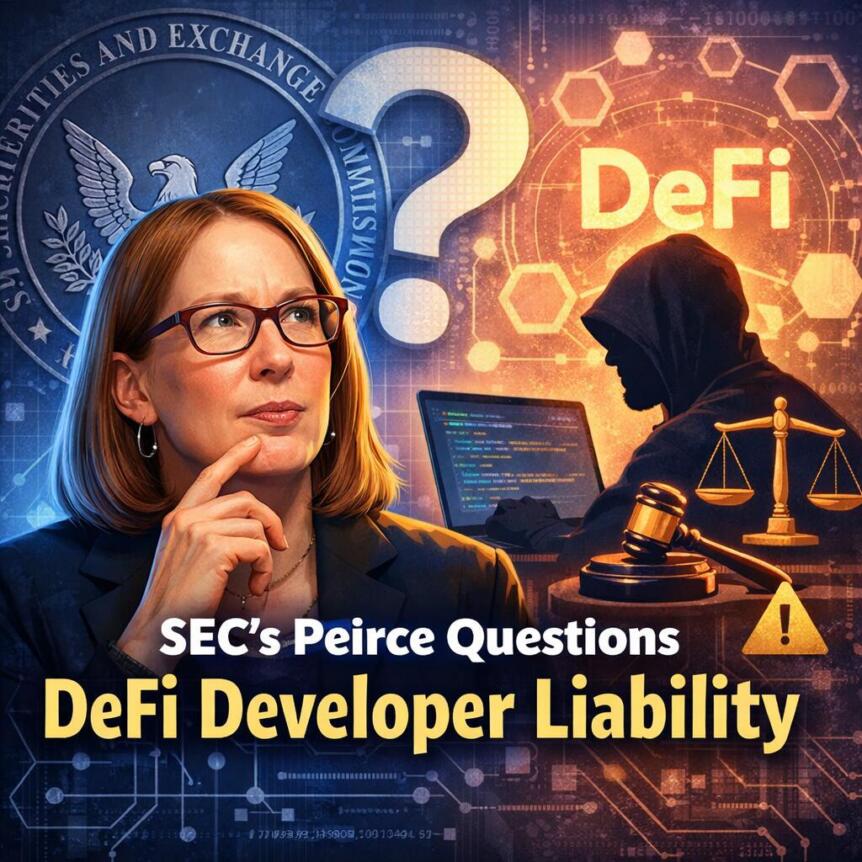
SEC’s Peirce Questions DeFi Developer Liability


SEC Commissioner Hester Peirce has reopened debate over DeFi developer liability after saying open-source blockchain developers should not face federal securities registration rules just because others use their software. Her remarks at the IC3 Blockchain Camp at Princeton University argued that regulators should separate code publication from market conduct.

https://x.com/CoinMarketCap/status/2062598811579494901?s=20

According to Peirce, the core issue concerns who actually performs the regulated act and that securities violations should fall on unlawful actors, not on developers who publish public software. The SEC staff’s April guidance on crypto user interfaces also frames the issue around interface providers, wallet tools, and transaction flows rather than the blockchain code alone.

Peirce Draws a Line Between Code and Conduct


Peirce said the SEC’s traditional categories fit intermediaries such as brokers, dealers, exchanges, and clearinghouses. She warned that extending those labels too far could place blockchain developers inside rules built for centralized finance. She also said open-source publication counts as protected speech, repeating the view that the SEC should not require approval for code that others later use.

Blockchains serve many purposes beyond securities transactions, and it matters because DeFi developer liability can expand quickly when regulators assume every on-chain tool exists to facilitate securities activity. Regulators should thus focus on conduct, not on proximity to conduct.

Staff Guidance Keeps the Interface Debate Open


The SEC staff statement issued on April 13, 2026, addressed “Covered User Interface Providers” that create or operate interfaces used to prepare crypto asset securities transactions. The staff said it would not object to broker-dealer registration relief in limited cases where providers meet detailed conditions.

The statement describes interfaces that convert user-selected transaction details into blockchain-legible commands, display market data, and provide educational material. It also limited the relief to providers that do not solicit specific transactions, do not take custody, and do not execute or settle trades. That framework makes DeFi developer liability a narrower question than many public debates suggest.

Crypto Task Force Pushes for Clearer Boundaries


The SEC’s Crypto Task Force says it aims to clarify how federal securities laws apply to crypto assets, protocols, and market infrastructure. The agency created the task force to draw clearer regulatory lines and recommend practical policy measures.

Peirce leads the task force and has pushed for clearer legal boundaries for crypto firms and developers. As the SEC reviews its approach, the dispute over DeFi developer liability remains central to how far securities rules should reach in decentralized systems.

https://www.cryptobreaking.com/secs-peirce-questions-defi-developer/?utm_source=blogger%20&utm_medium=social_auto&utm_campaign=SEC’s%20Peirce%20Questions%20DeFi%20Developer%20Liability%20

Comments

Popular posts from this blog

Mastercard Launches AI Agent Pay System With Ripple and Solana Help

Mastercard has launched Agent Pay for Machines, a payments system built for autonomous software agents. The service allows AI agents to send and receive payments without direct human action. It brings Ripple, Coinbase, and Solana Foundation into Mastercard’s push for automated digital commerce. Ripple Brings XRPL and RLUSD to Mastercard’s Agent Pay System Mastercard introduced Agent Pay for Machines on June 10 as a tool for machine-led payments. The system targets high-volume and low-value transactions across business and consumer use cases. It also supports automated settlement between software agents and connected machines. Ripple will support the system through the XRP Ledger and its RLUSD stablecoin. The company said that settlement will become more important as automated commerce grows. It also sees blockchain rails as useful for fast and rule-based payments. RippleX senior vice president Markus Infanger said XRPL and RLUSD support enterprise-grade agent payments. He said the tool...

Coinbase's x402 launches AI agents app store for payments

Coinbase-backed x402 has unveiled Agentic.market, a dedicated marketplace aimed at increasing the usefulness of AI agents by aggregating thousands of apps and services that agents can access without any API keys. The rollout positions the platform as a central hub for agents to discover, evaluate, and deploy capabilities across a standardized payments layer. Coinbase product lead Nick Prince described Agentic.market in a video posted on X as a storefront for discovering, comparing, and using x402 services. The marketplace is designed to give both humans and their AI agents access to a wide range of tools—from data feeds to consumer apps—without the friction of managing API credentials. A storefront for discovering, comparing, and using x402 services. Thousands of services. Zero API keys. Powered by x402. Prince added that the market offers a web interface for humans to browse and assess services, alongside a programming layer that lets AI agents autonomously search, filter, and integra...

Top Cryptocurrencies to Watch: BTC, ETH, BNB, XRP, Solana, Dogecoin & More

Market Analysis and Price Predictions for Key Cryptocurrencies Recent market dynamics reveal a cautious sentiment across the cryptocurrency landscape, with Bitcoin struggling to maintain levels above $90,000 and many major altcoins facing downward pressure. Indicators point toward reduced participation from both institutional and retail investors, raising concerns about a potential consolidation phase after notable gains earlier in the year. Bitcoin has fallen below $87,000, reflecting waning demand at higher price points. Institutional fund flows into BTC and ETH ETFs have turned negative, indicating a period of subdued market activity. Active addresses and Binance deposit/withdrawal activities are at annual lows, suggesting market indecision. Most leading altcoins are approaching support levels, with some poised for potential breakdowns. Tickers mentioned: Bitcoin, Ethereum, Binance Coin, XRP, Solana, Dogecoin, Cardano, Bitcoin Cash, Chainlink, Hyperliquid Sentiment: Neutral to Sli...