
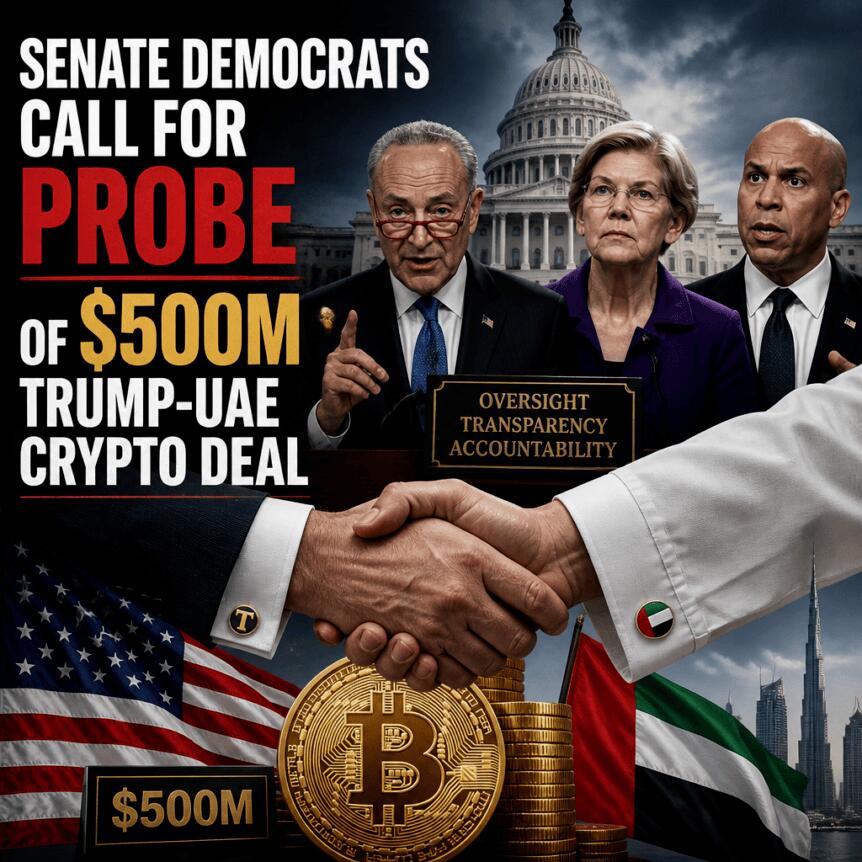
U.S. Senate Democrats have renewed pressure on Republican leaders to convene hearings into a reported $500 million arrangement connecting Donald Trump’s crypto-linked World Liberty Financial to Abu Dhabi-linked investors. In a letter to the chamber’s leadership, the lawmakers argue that Congress should examine whether the investment—and the administration’s subsequent actions—raised national security concerns or created conflicts of interest.
The request comes amid ongoing U.S. scrutiny of crypto regulatory policy, enforcement priorities, and cross-border dealings. For compliance teams and regulated entities, the episode highlights how crypto commercialization, stablecoin-linked payment structures, and foreign capital flows may intersect with sanctions and national security review frameworks.
Key takeaways
- Senate Democrats are urging Republican leaders to hold “immediate” hearings into a reported UAE-related investment in World Liberty Financial.
- The lawmakers ask for sworn testimony from Trump administration officials and want Congress to evaluate whether the investment influenced presidential actions.
- The letter cites concerns about potential national security exposure tied to U.S.–UAE technology and arms arrangements.
- Democrats also link the matter to broader concerns about weaker crypto enforcement, including exemptions from financial services regulations and dismantling elements of DOJ crypto enforcement.
- Past Democratic inquiries referenced by the letter include calls for CFIUS review and SEC-related questions connected to World Liberty Financial backers.
Democrats demand hearings over reported UAE investment
In their Tuesday letter, Senators Elizabeth Warren, Richard Blumenthal, Gary Peters, Dick Durbin, and Ron Wyden said Republican Senate leadership should convene hearings to examine the reported investment and its implications. The lawmakers asked that administration officials testify under oath, framing the request around what they characterize as unanswered questions regarding what the UAE may have obtained and whether U.S. national security was affected by foreign participation in a Trump-connected crypto enterprise.
The underlying reporting referenced by the senators traces to a January account by The Wall Street Journal, which said an Abu Dhabi investment company backed by Sheikh Tahnoon bin Zayed Al Nahyan—an adviser closely associated with the UAE’s national security apparatus—agreed to buy a 49% stake in World Liberty Financial. The platform is described in the reporting as tied to President Donald Trump.
Democrats argue that Congress has an obligation to investigate whether such foreign investments bear on official decision-making. The thrust is not limited to the transaction itself; it is also aimed at whether subsequent policy or administrative actions could be perceived as favoring connected interests.
National security and technology deal cited as context
Democrats’ letter places the reported World Liberty Financial investment in a broader geopolitical and policy context, pointing to a later U.S.–UAE arms and artificial intelligence chip agreement described as occurring in May. According to the senators, that deal proceeded even after concerns were raised by U.S. national security officials about the possibility that China could access the chips involved.
Although President Trump has denied awareness of the World Liberty Financial investment reported by the press, the senators’ position is that the sequence of events warrants congressional examination. For institutional stakeholders, this is an example of how foreign capital in crypto ventures can become intertwined with national security review considerations—especially where cross-border technology, sensitive supply chains, or strategic industrial relationships are implicated.
The practical compliance implication is clear: regulated firms operating with international counterparties may face heightened oversight when transactions intersect with national security considerations or appear to create improper influence pathways. Even absent proof of wrongdoing, congressional scrutiny can translate into more intense regulatory expectations around governance, disclosures, and documentation.
Enforcement concerns and the committee agenda
Beyond the UAE-related investment, the letter expands to encompass broader worries about U.S. crypto enforcement. The senators said they are concerned about steps they view as weakening enforcement—citing, among other items, efforts to exempt crypto service providers from financial services regulations and reports that the Justice Department’s crypto enforcement team was disbanded.
From a regulatory monitoring perspective, this matters because enforcement posture often drives institutional behavior. When enforcement resources are reduced or compliance obligations appear to be narrowed, entities can face uncertainty about how regulators will interpret risk, monitor market conduct, or pursue investigations. Conversely, high-profile congressional attention can also signal that political and oversight pressure may intensify even if enforcement structures are changing.
The letter therefore functions both as a transaction-specific request and as part of an accountability narrative about the direction of U.S. oversight. It also serves as a signal to compliance departments that congressional inquiries—especially those tied to foreign involvement—may affect reporting requirements, due diligence expectations, and the scrutiny applied to relationships with regulated financial intermediaries.
Prior Democratic probes: CFIUS, SEC scrutiny, and pardons
The letter also situates the new request within a pattern of prior congressional actions and demands for review. The lawmakers note earlier calls by Senator Warren for a national security review of the UAE deal, urging Treasury leadership in February to determine whether it should be subjected to a Committee on Foreign Investment in the United States (CFIUS) probe. CFIUS is a key U.S. interagency process through which foreign investment can be reviewed for national security risks, and the invocation of CFIUS underscores the senators’ view that the World Liberty Financial stake could implicate sensitive interests.
Democrats have previously pressed regulators connected to enforcement outcomes involving World Liberty Financial backers. According to references in the letter, senators pursued questions related to the Securities and Exchange Commission after a fraud case involving Justin Sun—a major World Liberty Financial supporter—was dropped. The letter also cites additional inquiry initiatives earlier in the year that questioned pardons issued during the Trump administration, including a pardon for Binance co-founder Changpeng Zhao.
In the reporting referenced within the article, Democratic lawmakers linked that pardon sequence to Binance’s early-2025 acceptance of a reported $2 billion investment from an Abu Dhabi fund and to an agreement that the funds would be paid in World Liberty Financial’s stablecoin, USD1. These assertions are included in the senators’ broader narrative about whether crypto industry relationships and official actions may be connected.
For institutional readers, the throughline is that congressional oversight is increasingly focused on the governance and regulatory interface of crypto businesses: how foreign investors participate, how stablecoin arrangements are used, and how enforcement decisions are perceived by lawmakers and the public.
Closing perspective
What happens next will likely depend on whether the Senate leadership agrees to convene hearings and the scope of witness testimony, including any discussion of national security review pathways and crypto enforcement policy. For compliance and legal teams, the episode is a reminder that cross-border crypto capital and stablecoin-linked arrangements can rapidly become subject to heightened congressional scrutiny, even when the core facts are still developing in public reporting.
https://www.cryptobreaking.com/senate-democrats-call-for-probe/?utm_source=blogger%20&utm_medium=social_auto&utm_campaign=Senate%20Democrats%20Call%20for%20Probe%20of%20$500M%20Trump-UAE%20Crypto%20Deal%20
Comments
Post a Comment