
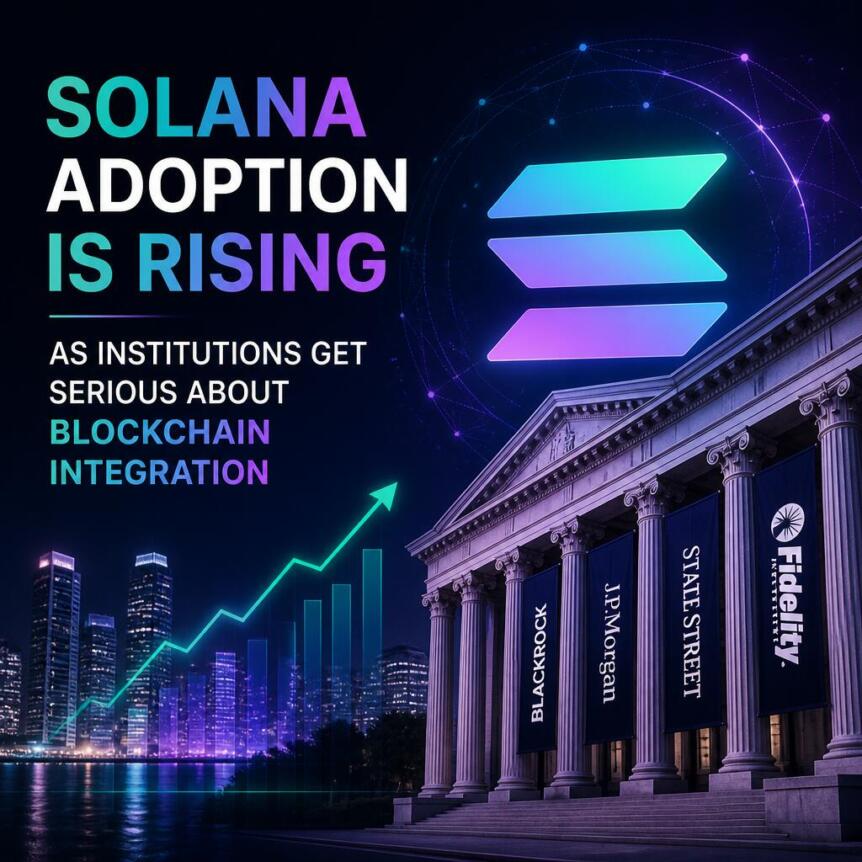
Adoption of Solana increases as institutional investment in blockchain infrastructure goes beyond merely investing in crypto products to actual integration.
The Institutional Engagement Has Gone Beyond Investment Exposure
There has been growing traction of Solana as financial institutions turn their attention toward blockchain technology and infrastructure rather than investing in digital assets. The emergence of credit assessments in relation to blockchain technology, along with interest from established financial entities such as Moody’s, points to a gradual shift in perception about decentralized blockchain technology from traditional financial institutions.
For decades, public blockchains have been associated with speculation and diversifying investments. The focus of traditional financial institutions centered on the risk factors and regulatory issues associated with blockchain technology. This shift indicates that institutions are recognizing the usefulness of blockchain in practice.
Traditionally, credit ratings have been used to assess companies, bonds, and sovereign debts. The increased use of these terms in blockchain contexts demonstrates that institutions are starting to assess decentralized blockchain technology using conventional financial risk management models. It shows more engagement than exposure to crypto-assets alone.
Rather than just asking whether digital assets can be invested in, institutions are now looking at whether blockchain technologies can sustain key operations of financial institutions.
Advantages of Solana in the Blockchain Infrastructure Arena
Among prominent blockchain projects, Solana is one of the top candidates expected to be adopted by financial institutions. Its main advantages include high transaction capacity, low costs, and rapid finality, making it well suited for applications that need scalable infrastructure.
Over the past several years, the Solana network has developed in DeFi, gaming, NFTs, and, finally, in tokenizing real-world assets. These processes have turned Solana from an instrument of investment into a working layer of the digital economy.
Institutional adoption of Solana does not relate to custody services and trading anymore. At the moment, some financial companies are considering integrating blockchain infrastructure into their business processes. This means building a payment network, issuing platform, and settlement infrastructure on the blockchain level. All these processes require careful planning, significant industry knowledge, and compliance with regulations.
Market Dynamics Illustrate Resilience of Networks Over Time
The history of Solana’s performance on the market has been characterized by cycles of rapid growth followed by a decline typical of other players in the cryptocurrency industry. When conditions were bullish, the price of SOL previously soared above $200, while total market capitalization reached dozens of billions of dollars due to an increased influx of funds.
As expected for any other digital asset, Solana’s valuation dropped during the bearish period due to reduced risk appetite and lower liquidity in the industry. Nevertheless, the network continued developing actively despite this period.
During subsequent recovery phases, Solana’s valuations grew rapidly, with market capitalization soaring above previously observed levels to exceed $100 billion. While the latest correction has negatively impacted this momentum, valuations are still much higher than during the bearish period. This illustrates changing investor perception of Solana, shifting from short-term prospects to long-term perspectives.
The Part Solana Will Play in the Future of Blockchain Infrastructure
The increasing use of Solana signals a shift happening across the blockchain industry. As organizations transition from exploration to real incorporation, networks that can provide reliable and efficient infrastructure are becoming more prominent. Regardless of market turbulence, Solana is establishing its position in this new environment.
https://www.cryptobreaking.com/solana-adoption-is-rising-as/?utm_source=blogger%20&utm_medium=social_auto&utm_campaign=Solana%20Adoption%20Is%20Rising%20as%20Institutions%20Get%20Serious%20About%20Blockchain%20Integration%20
Comments
Post a Comment