
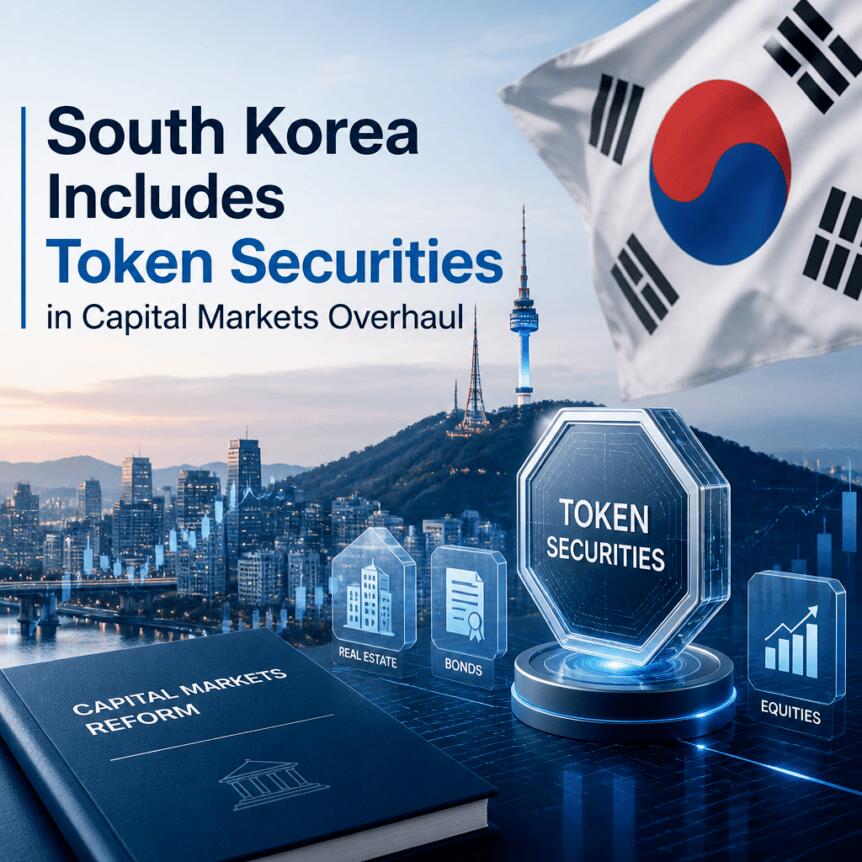
South Korea’s Financial Services Commission (FSC) has moved tokenized securities deeper into a broader national program to modernize capital-market infrastructure. The regulator said it is coordinating reforms across ministries and market operators, positioning token securities not as a standalone initiative, but as part of a wider effort to improve settlement efficiency and market connectivity.
On Tuesday, the FSC launched a capital market infrastructure review meeting to align policy work with operational plans. The regulator indicated that token securities will continue to be developed through a separate public-private council, with those outcomes subsequently integrated into the broader infrastructure roadmap.
Key takeaways
- The FSC is coordinating token securities work alongside a broader capital-market overhaul, including faster settlement and longer trading hours.
- Legislation already approved by South Korea’s National Assembly recognizes blockchain-based distributed ledgers as securities registries, enabling issuance and transfer of token securities.
- The FSC expects key token securities subordinate regulations and guidelines to be released around July, with the framework scheduled to take effect in February 2027.
- Operational infrastructure is planned for completion by end-2026, including a Korea Securities Depository (KSD) system for settling certain over-the-counter transactions in unlisted shares and fractional investment products.
- Firms should monitor how the token securities framework will be implemented alongside existing investor-protection and market-integrity obligations.
Capital-market infrastructure review folds in token securities
The FSC’s decision to incorporate token securities into a wider infrastructure reform effort reflects a policy approach aimed at aligning digital assets with established market plumbing. In practical terms, this matters for compliance and operational readiness because tokenized issuance and transfer typically require integration with securities registries, settlement processes, custody models, and audit trails.
According to the FSC, the initiative includes a roadmap to shorten the securities settlement cycle, targeted for completion by October. It also includes development of a KSD system intended to handle settlement of over-the-counter trades involving unlisted shares and fractional investment products. The FSC’s timetable places that system by end-2026, preceding the start date for the token securities regime.
FSC Vice Chairman Kwon Dae-young framed the effort as part of four policy priorities: trust, shareholder protection, innovation, and market access. That set of objectives suggests regulators will seek guardrails that preserve investor protections while enabling adoption of technology, rather than treating tokenization as purely a technology experiment.
Legislative groundwork and the planned 2027 rollout
South Korea’s token securities program predates the new capital-market infrastructure review. In January, the National Assembly approved amendments that recognize blockchain-based distributed ledgers as valid securities registries. The amendments also permit the issuance and circulation of token securities, establishing the legal basis required for regulators to build implementation rules and supporting infrastructure.
Per the FSC, the token securities framework is scheduled to take effect in February 2027, contingent on completion of subordinate rules and supporting infrastructure. The FSC said it is targeting July for the release of proposed subordinate regulations and guidelines following work at the public-private token securities council.
Cointelegraph previously reported on the broader legislative direction behind South Korea’s tokenized securities laws, including their expected regulatory treatment and timeline. The FSC’s latest updates emphasize that implementation details remain under active development and will be formalized through additional consultation and rulemaking rather than immediately after the statute’s passage.
For regulated firms, the gap between legislative authorization and effective implementation rules is significant. During this period, businesses typically need clarity on operational requirements such as how token securities will be registered, validated, and reconciled with traditional securities records; what disclosure or investor-protection measures will apply; and how compliance controls will be expected to function in a distributed-ledger environment.
KSD integration and platform development for blockchain-based custody
Infrastructure planning is a core component of the FSC’s approach. The regulator has identified settlement capability through the KSD as a milestone ahead of the February 2027 effective date. The KSD system described by the FSC is intended to support settlement for over-the-counter trades in unlisted shares and fractional investment products.
Separately, Samsung SDS said in May that it won a contract to build a token securities management platform. According to reporting cited by the FSC’s broader communications, the platform is designed to connect the KSD’s existing electronic securities account system with blockchain-based data. Samsung SDS said it aims to complete the platform by February 2027, aligning its delivery with the planned launch of the token securities framework.
The FSC also noted that detailed token securities plans will continue to be discussed within the public-private council before being linked to the broader infrastructure review. This sequencing suggests regulators are attempting to coordinate “digital asset” rulemaking with the more general modernization agenda, potentially reducing the risk of parallel standards that could complicate implementation.
From a governance perspective, integrating blockchain-based data with established depository and accounts infrastructure may also shape how auditability, data integrity controls, and reconciliation processes are implemented—elements that are central to compliance monitoring and investor assurance.
Regulatory implications: investor protection, compliance controls, and cross-border considerations
While the FSC is advancing token securities through a structured timetable, several implementation questions remain relevant for compliance and institutional readiness. The amendments enabling blockchain registries and token issuance establish the legal pathway, but firms will still need to understand how regulators intend to operationalize investor protections and “trust” requirements in distributed systems.
Institutional stakeholders should also consider how token securities will interact with existing market rules governing custody, settlement finality, transfer restrictions, disclosure, and governance. Tokenization can introduce new operational risks—such as data integrity and access control—that require controls comparable to those in traditional securities infrastructure.
Cross-border activity may further complicate matters. South Korea’s approach—embedding token securities within domestic market infrastructure—does not automatically resolve differences with other jurisdictions that have distinct regulatory frameworks for tokenized instruments. For firms operating internationally, that means compliance programs may need to map how token securities obligations align (or diverge) across regulatory regimes.
In the European context, for example, MiCA provides a framework for certain crypto-asset activities, but its scope and alignment with tokenized securities rules depends on how a given product is classified. Similarly, in the United States, the regulatory landscape for tokenized securities has historically depended on securities-law analysis and enforcement posture. Even though the FSC’s initiative is a Korean domestic reform, global institutions will likely evaluate it through the lens of their existing compliance and legal risk management practices.
Closing perspective
South Korea’s FSC appears to be moving toward an integrated model in which tokenized securities are introduced alongside settlement modernization and broader market-access reforms. The next critical milestones are the public-private council’s subordinate regulations and guidelines targeting July, followed by the February 2027 effective date. Observers will likely focus on how regulators translate the legal recognition of blockchain-based registries into enforceable operational standards for custody, settlement, investor protection, and auditability.
https://www.cryptobreaking.com/south-korea-includes-token-securities/?utm_source=blogger%20&utm_medium=social_auto&utm_campaign=South%20Korea%20Includes%20Token%20Securities%20in%20Capital%20Markets%20Overhaul%20
Comments
Post a Comment