
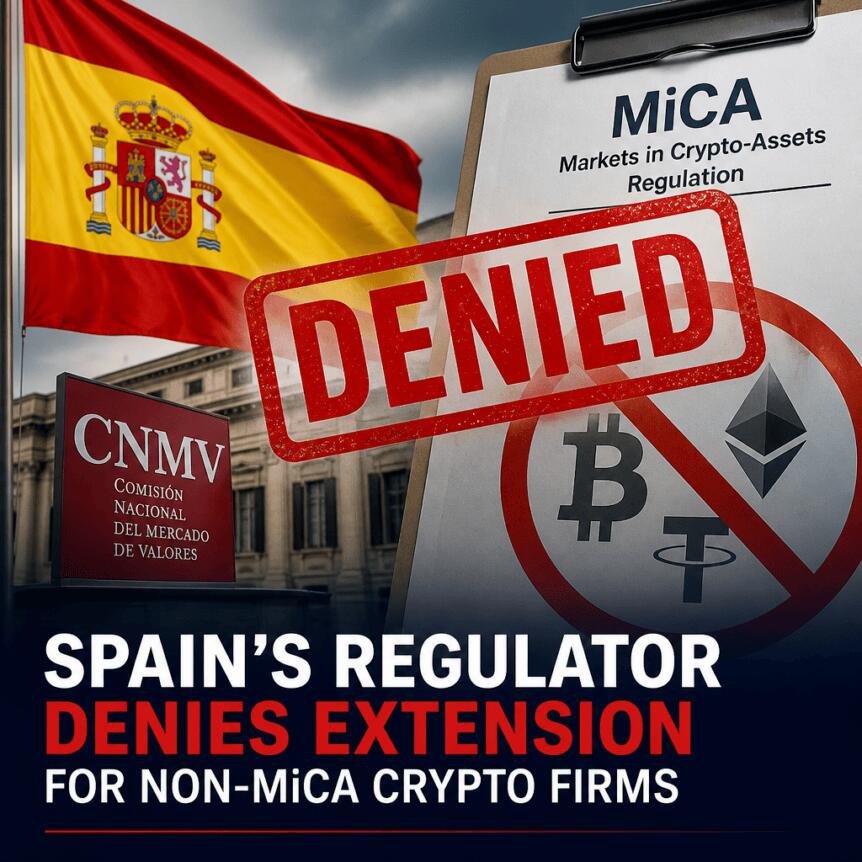
Spain’s securities markets regulator has signaled that crypto trading venues will not receive extensions to comply with the EU’s Markets in Crypto-Assets (MiCA) framework past the July 1 deadline. Speaking to Reuters, CNMV chair Carlos San Basilio said regulators will not grant “exceptions or extensions” for firms that have not obtained EU authorization by that date—an issue highlighted by Binance’s status in the bloc.
The practical compliance impact is immediate for affected platforms and their counterparties. If an exchange is not properly licensed, it may be required to stop onboarding new EU users and adjust product availability for EU-based accounts from July 1, increasing operational uncertainty for both retail and institutional participants.
Key takeaways
- Spain’s CNMV chair Carlos San Basilio said there will be no extensions to the July 1 MiCA deadline for exchanges that are not authorized in time.
- Reuters reported that Binance had withdrawn its Greece MiCA application and had not secured approval from other EU authorities as of the reporting date.
- Where licensing is not obtained, regulators may require exchanges to halt new EU user onboarding and restrict services for EU-based accounts from July 1.
- Last-minute MiCA authorizations by other venues suggest the authorization process is workable, but outcomes can differ across jurisdictions.
Spain’s CNMV positions MiCA compliance as non-negotiable
MiCA sets a harmonized regulatory framework for crypto-asset issuers and service providers across the European Union, including rules governing crypto trading platforms. Under the transitional structure, firms seeking to operate legally within the EU are expected to obtain the relevant approvals by the end of the transition.
In comments reported by Reuters on June 26, CNMV chair Carlos San Basilio emphasized that the regulator is focused on how the transition will end and how firms will adapt to the post-transition environment. His statement that there would be “no exceptions or extensions” underscores a strict enforcement posture for entities that have not achieved authorization by the specified date.
For institutions monitoring market integrity and regulatory risk, the message is operational: the deadline is not merely a target but a point at which authorization status directly affects permitted business conduct. This can influence vendor risk assessments, counterparty onboarding decisions, and compliance controls for EU-facing crypto activities.
Binance’s EU authorization gaps and the risk of service restrictions
Reuters linked Spain’s deadline stance to Binance and other exchanges affected by MiCA. According to the report, Binance withdrew its MiCA application in Greece with the Hellenic Capital Market Commission and, as of the reporting date, had not received authorization from any other EU regulator.
Under the expected implementation of MiCA-related transitional requirements, an exchange that has not obtained approval may be required to halt onboarding of new EU-based users and limit certain services for EU-based accounts after July 1. Cointelegraph previously reported that Binance’s EU service limits would apply if authorizations are not secured in time.
The significance for EU market participants is not only that some user activity could shift to other platforms. Service restrictions can also affect compliance workflows for counterparties that rely on exchange liquidity, custody arrangements, and operational continuity—particularly for institutions that treat authorized service providers as a baseline governance requirement.
While other exchanges have reportedly secured last-minute approvals under MiCA, the authorization status of a platform with a large EU user base would likely be of greater systemic and compliance relevance due to potential changes in where regulated activity concentrates.
Industry dispute highlights the enforcement and governance stakes
Alongside the regulatory deadline, public controversy around Binance’s approach to EU compliance has continued. Cointelegraph reported earlier that Binance’s MiCA process raised questions regarding the role of European central banking stakeholders in licensing discussions.
Separate commentary attributed to OKX founder and CEO Mingxing Xu referenced alleged behavior described in public materials and court filings, including claims relating to money laundering, sanctions violations, and market manipulation. While such statements are part of the broader public debate, the regulatory implication remains the same for compliance teams: MiCA deadlines and licensing outcomes determine whether a firm can legally offer services in the EU, regardless of public messaging.
Cointelegraph said it reached out to Binance for comment but did not receive an immediate response. The absence of a timely position from the firm on its EU licensing pathway can further heighten uncertainty for institutions assessing counterparty risk near a fixed regulatory deadline.
EU users weigh alternatives as authorization timelines remain unclear
As July 1 approaches, some observers are discussing practical steps to manage exposure to potential restrictions. Community reports indicate users are considering other venues that already hold relevant authorizations in EU jurisdictions.
For example, Payward, operating as Kraken, reportedly holds a Crypto Asset Service Provider license through the Central Bank of Ireland. Community discussions suggest some users may be looking to Kraken specifically if they anticipate interruptions to Binance’s EU onboarding or certain service availability after the MiCA transition.
From a compliance monitoring perspective, this type of behavior matters because it affects how quickly counterparties may need to update operational processes—such as approved vendor lists, account access policies, and transaction routing rules—if a major exchange is no longer able to onboard or fully serve EU customers.
Closing perspective: watch licensing decisions and transition enforcement mechanics
The next developments will likely come from national regulators’ licensing decisions and the concrete application of MiCA-related transitional restrictions after July 1. For regulated firms and institutional stakeholders, the key question is not only whether approvals are granted, but how consistently restrictions on onboarding and service scope are implemented across jurisdictions as the EU transitions from transitional arrangements to MiCA-compliant operations.
https://www.cryptobreaking.com/spains-regulator-denies-extension-for/?utm_source=blogger%20&utm_medium=social_auto&utm_campaign=Spain’s%20Regulator%20Denies%20Extension%20for%20Non‑MiCA%20Crypto%20Firms%20
Comments
Post a Comment