
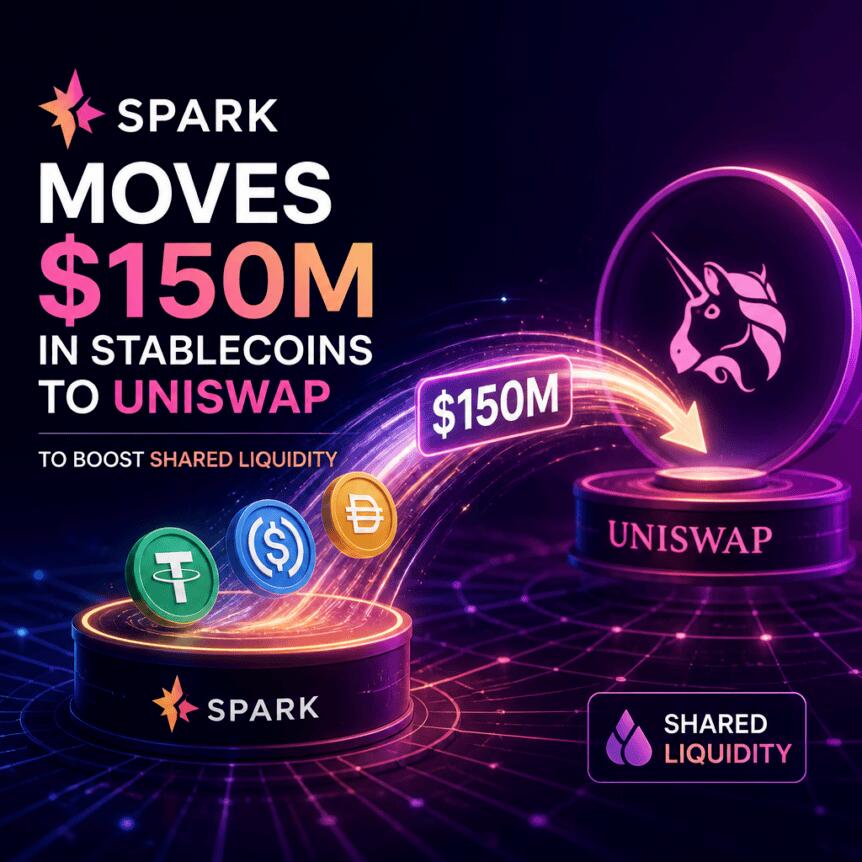
DeFi infrastructure provider Spark has initiated a major stablecoin liquidity deployment on Ethereum, moving roughly $150 million into two Uniswap v4 pools as part of a broader effort to standardize how stablecoin issuers access shared market-making liquidity.
According to a Spark spokesperson speaking to Cointelegraph, the initial liquidity is live in two pools pairing Spark’s USDS with PayPal USD (PYUSD) and USDT, with USDS positioned as the foundation. Spark frames the rollout as one of the largest AMM liquidity migrations in DeFi and describes it as the first phase of what it calls the “Stablecoin FX Layer,” aimed at bootstrapping shared liquidity on Uniswap v4.
Key takeaways
- Spark has deployed about $150 million in stablecoin liquidity across two Uniswap v4 pools on Ethereum, initially using USDS as the anchor asset.
- The rollout is intended to establish shared liquidity for stablecoin markets, reducing the need for each issuer to individually bootstrap separate liquidity networks.
- Spark plans to expand into a more programmable liquidity system later, using Uniswap v4 hooks after additional security review and testing.
- The project also functions as a real-world test of the broader thesis that decentralized venues can capture growing activity tied to tokenized finance.
From isolated pools to shared stablecoin liquidity
The core objective behind Spark’s deployment is coordination: rather than requiring every stablecoin issuer to assemble liquidity and trading inventory across multiple venues, Spark says it is building toward a shared liquidity framework. In the first phase, that approach is implemented through standard Uniswap v4 pools—avoiding the complexity of Spark’s planned programmable layer until later.
Spark’s spokesperson told Cointelegraph that the current deployment specifically focuses on “bootstrapping shared liquidity on Uniswap v4.” In other words, the near-term milestone is less about advanced routing or automation and more about proving that large-scale stablecoin liquidity can migrate into a common structure on Uniswap v4.
For market participants, the difference matters. Liquidity bootstrapping is often a slow and capital-intensive process, particularly when issuers need to align with market makers and manage balances across venues. A shared approach—if it reduces operational burden without sacrificing liquidity quality—could make onboarding new stablecoins faster and improve consistency across trading pairs.
Programmable liquidity and the planned DualPool hook
Spark said its longer-term plan involves introducing a Shared Liquidity Layer and a DualPool hook in subsequent phases, leveraging Uniswap v4’s programmable architecture. Uniswap v4 hooks are designed to allow integrations that can extend how liquidity and strategies are managed within the protocol’s framework.
In Spark’s description, a liquidity hook would enable idle or not immediately required capital to be deployed into governance-approved products, liquidity venues, or yield-generating strategies. That concept—turning capital from a static balance sheet into a programmable set of behaviors—is central to how DeFi seeks to compete with traditional finance infrastructure efficiencies.
Spark also noted that the DualPool hook will undergo a separate security review, along with additional testing and production-readiness steps before it is deployed. The distinction is important for users and developers: building on hooks can introduce new failure modes, and Spark’s statement implies that the initial pools are a “safe start,” with more experimental programmability coming only after a formal review process.
While Spark is working with additional partners across the stablecoin ecosystem, the spokesperson did not provide details on those integrations at this stage.
Why this fits the tokenization narrative
Even though Spark’s rollout focuses on stablecoins rather than tokenized securities, it aligns with a wider market narrative: as tokenization expands, trading venues that can efficiently provide liquidity for new onchain assets may see outsized benefits.
Earlier in the month, Standard Chartered pointed to Uniswap as a potential beneficiary of tokenized assets moving into DeFi. In its outlook, the bank forecast that total assets held in DeFi could reach $2.7 trillion by 2030, with Uniswap potentially positioned as a liquidity venue as tokenized markets grow.
Cointelegraph reports that the Spark deployment offers a more immediate test of that general infrastructure thesis, albeit in a stablecoin context. Stablecoins are not tokenized securities, but they are the rails many onchain financial products depend on—particularly when trading activity, hedging, and market-making require deep, reliable liquidity.
The timing also follows steps toward institutional tokenized-asset trading on Uniswap. On Feb. 12, BlackRock said it would bring its $2.1 billion tokenized Treasury fund, BUIDL, to Uniswap, enabling eligible institutional investors and market makers to trade the security through decentralized infrastructure.
Together, these developments highlight a pattern: as more real-world finance primitives move onchain, decentralized venues increasingly need to prove they can deliver not just execution, but also scalable liquidity and operational efficiency.
What to watch next
Investors and builders should watch whether Spark’s shared-liquidity approach can scale beyond two initial stablecoin pairs and whether the planned DualPool hook clears its security review without disrupting liquidity depth. The next phase—moving from standard pools into Spark’s programmable layer—will likely be the clearer signal of whether this “shared liquidity” thesis can deliver measurable efficiency gains across stablecoin markets.
https://www.cryptobreaking.com/spark-moves-150m-in-stablecoins/?utm_source=blogger%20&utm_medium=social_auto&utm_campaign=Spark%20Moves%20$150M%20in%20Stablecoins%20to%20Uniswap%20to%20Boost%20Shared%20Liquidity%20
Comments
Post a Comment