
New research released by Paybis at Money20/20 Europe suggests that stablecoins are rapidly evolving from a crypto-native tool into a core component of business payment infrastructure, with B2B transactions now accounting for the overwhelming majority of stablecoin payment volume.
According to the company's latest Stablecoin Infrastructure Report, business adoption is accelerating across cross-border settlements, treasury management, supplier payments, and international payouts. The findings challenge the long-standing narrative that retail checkout payments would become the primary use case for stablecoins.
B2B Stablecoin Payments Reach Critical Scale
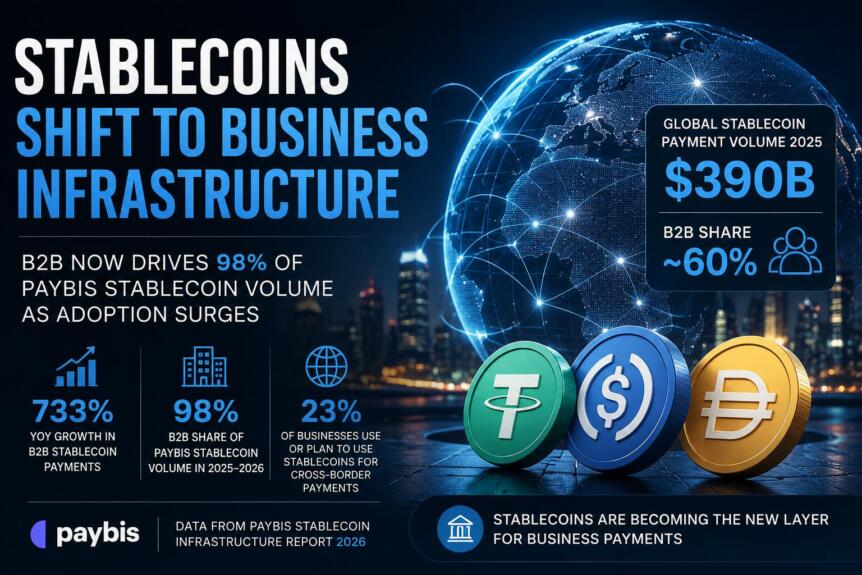
The report cites market research indicating that approximately $390 billion in stablecoin payment volume was processed globally in 2025, with around 60% originating from business-related transactions. B2B stablecoin payments reportedly grew by 733% year-over-year, highlighting increasing demand for faster and more efficient international payment rails.
Paybis' internal transaction data reflects a similar trend. Stablecoins represented just 12% of crypto transaction volume on the platform in 2023. By April 2026, that figure had climbed to nearly 86%, making stablecoins the dominant asset category processed through the company's infrastructure.
Even more notable is the shift in customer composition. B2B transactions accounted for approximately 36% of Paybis stablecoin volume in 2023, increasing to more than 70% in 2024 and reaching nearly 98% throughout 2025 and the first months of 2026.
The company reported a cumulative $2.81 billion in stablecoin transaction volume between 2023 and 2026.
Cross-Border Payments Drive Adoption
The strongest adoption appears in sectors that regularly move funds across borders and require efficient settlement mechanisms.
According to Paybis, the largest B2B stablecoin categories since April 2024 have included:
- Digital Goods
- Virtual Assets Businesses
- Technology Companies
- Retail and E-commerce
- Financial Technology Firms
Together, these sectors represented more than three quarters of the platform's B2B stablecoin activity.
For many businesses operating internationally, traditional payment systems continue to present challenges related to settlement delays, banking fees, liquidity management, and operational complexity. Stablecoins are increasingly being evaluated as an alternative settlement layer capable of reducing friction while improving transaction speed and transparency.
Businesses Still Misunderstand Stablecoin Costs and Settlement Speed
Despite growing adoption, the report highlights a significant knowledge gap among business decision-makers.
In a survey of more than 1,000 respondents, only 53% correctly believed that international stablecoin transfers settle almost instantly. The remaining participants expected settlement times ranging from one hour to an entire day.
Similarly, fee expectations varied considerably. While stablecoin payment costs are generally considered competitive compared with traditional international payment methods, survey participants were almost evenly divided between expecting very low fees and significantly higher costs.
The findings suggest that education and implementation clarity remain major obstacles to broader enterprise adoption.
Stablecoins Becoming Financial Infrastructure
Commenting on the findings, Konstantins Vasilenko, Co-Founder and CBDO of Paybis, said:
"Stablecoins have moved from a crypto niche to business infrastructure. B2B is now the overwhelming majority of volume on our platform, driven by companies that need faster cross-border settlement and treasury movement."
Vasilenko believes the next phase of growth will depend less on awareness and more on integration.
Businesses increasingly want access to stablecoin-based settlement without having to manage complex blockchain infrastructure themselves. As a result, regulated providers offering compliant on-ramp, off-ramp, treasury and payment solutions may play a key role in accelerating adoption.
Looking Ahead
While stablecoins still represent a relatively small portion of global payment activity, current market data suggests they are finding product-market fit in specific business workflows where speed, cost efficiency and cross-border accessibility are critical.
As regulatory frameworks continue to mature and enterprise infrastructure improves, stablecoins may become an increasingly common component of international business payments rather than simply a cryptocurrency use case.
With major industry discussions taking place this week at Money20/20 Europe in Amsterdam, the debate is no longer whether stablecoins can be used for payments, but where they deliver the greatest value. Current data increasingly points toward business adoption rather than consumer checkout experiences.
https://www.cryptobreaking.com/stablecoins-shift-from-consumer-payments/?utm_source=blogger%20&utm_medium=social_auto&utm_campaign=Stablecoins%20Shift%20From%20Consumer%20Payments%20to%20Business%20Infrastructure%20as%20B2B%20Adoption%20Surges%20
Comments
Post a Comment