
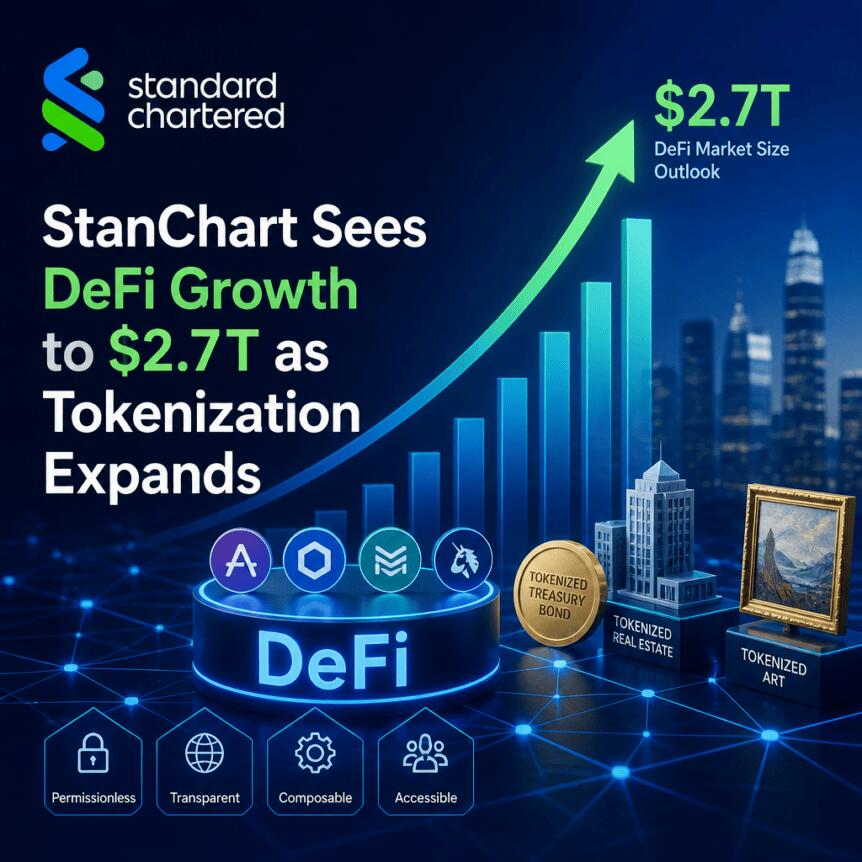
Standard Chartered is forecasting a major acceleration in how decentralized finance (DeFi) can absorb tokenized assets. In a research note released Monday, Geoff Kendrick—head of digital assets research at the bank—projected that assets actively used in DeFi could expand 37-fold to $2.7 trillion by the end of 2030.
The estimate hinges on a shift in where tokenized value goes once it is issued. Kendrick argued that DeFi protocols could become a key distribution channel not only for crypto-native assets, but also for tokenized real-world assets (RWAs) that are increasingly being developed by traditional finance participants.
Key takeaways
- Standard Chartered expects DeFi-active tokenized assets to reach $2.7 trillion by 2030, implying a 37x increase from current levels.
- The forecast depends on both tokenized RWAs and crypto-native assets finding their way into onchain lending, trading, and other DeFi use cases.
- According to Kendrick, only 3% of stablecoins and 10% of tokenized RWAs are currently used in DeFi.
- Standard Chartered projects tokenized asset usage in DeFi rising to about 30% by end-2030, from roughly 3.5% today.
- The bank points to Uniswap as a possible hub for tokenized markets, though other researchers warn tokenization alone doesn’t solve liquidity fragmentation.
Standard Chartered’s 2030 DeFi absorption forecast
Kendrick’s central claim is that DeFi could be the next major engine for “generational wealth” in digital assets. He estimated that the amount of tokenized assets active in DeFi will grow 37x by the end of the decade.
While tokenization is often discussed as a way to bring real-world finance onto public blockchains, the investment question is how that tokenized value translates into real onchain participation. Kendrick’s projections address that by focusing on usage rates—how much of the overall tokenized supply is actually deployed inside DeFi protocols.
Per the research note, only 3% of stablecoins and 10% of tokenized RWAs are currently used in DeFi. Standard Chartered expects those tokenized shares to rise sharply over the next several years, with the portion of tokenized value used in DeFi projected to reach 30% by end-2030, up from about 3.5% today.
The scale of the jump is important: growing the absolute figure to $2.7 trillion would require both (1) rapid growth in total onchain tokenized assets and (2) a near ninefold increase in the share of that tokenized value being put to work in DeFi.
Why tokenized value may not automatically become liquid
The bank’s outlook reinforces the broader institutional argument that tokenization could re-route capital flows toward onchain systems. However, the path from issuance to deep markets is not straightforward.
The research note acknowledges—and the wider debate around tokenization highlights—that tokenization does not inherently guarantee liquidity or a unified market structure. Other researchers have warned that tokenized assets can still trade in ways that remain fragmented across ecosystems.
Earlier coverage from Cointelegraph noted concerns raised by Axis CEO Chris Kim that issuing the same asset across multiple blockchains and formats can create “siloed liquidity,” leading to pricing gaps and higher costs. In practical terms for traders and liquidity providers, that fragmentation can make it harder for market participants to find consistent pricing and for liquidity to pool efficiently—even if total market value grows.
Similarly, Oya Celiktemur of Ondo Finance told Cointelegraph at Paris Blockchain Week in April that tokenizing an illiquid asset does not “magically” make it liquid. The implication is that deeper liquidity depends on market design, distribution, and the incentives that keep trading and settlement efficient once tokenized assets reach users.
From earlier RWA estimates to a DeFi-centered distribution thesis
Standard Chartered has previously linked tokenization growth to large market expansions. The new DeFi-focused forecast builds on an earlier projection that non-stablecoin tokenized RWAs could grow to $2 trillion by the end of 2028, according to Kendrick—where tokenized money-market funds and US equities are expected to represent much of the projected market.
What’s new here is the emphasis on where those tokenized instruments are used rather than just their total outstanding value. The shift matters because DeFi impact is not measured only by token counts or issuance volumes; it’s measured by how much liquidity and trading activity migrates into onchain protocols that support borrowing, trading, and settlement.
By framing DeFi as a destination for tokenized capital, Standard Chartered is effectively proposing that tokenization’s biggest long-term value creation could be tied to protocol-level adoption—rather than confined to isolated token issuances or simple exposure products.
Uniswap as a potential liquidity bridge for tokenized markets
Alongside the usage-rate assumptions, Kendrick singled out Uniswap as a venue that could play a growing role in trading tokenized assets as more of them move onchain. He pointed to the decentralized exchange’s scale, branding, and track record of operating through multiple crypto cycles.
In his view, these characteristics could be especially relevant for traditional financial institutions that are likely to prioritize security and reliability when integrating tokenized RWAs into DeFi. Kendrick also suggested that if Uniswap is able to “commercialise enough” and form meaningful TradFi partnerships that improve scale, it could strengthen its fee-generation relative to its market capitalization—potentially narrowing the gap with major centralized exchanges.
The bank’s bet on Uniswap aligns with the thesis that tokenized-market liquidity will depend on venues capable of onboarding new assets at meaningful volume. Still, it sits in tension with the liquidity-fragmentation warnings raised by other researchers: even if a venue is technically capable of supporting tokenized assets, liquidity can remain dispersed if the same instruments arrive in multiple formats, across multiple chains, or with mismatched trading infrastructure.
Looking ahead, investors and builders should watch whether DeFi protocols can convert rising tokenization volumes into sustained onchain usage—particularly by tracking how stablecoins and tokenized RWAs distribute across different DeFi activities. The key uncertainty is whether liquidity consolidates around major venues like Uniswap or continues to fragment as tokenized assets proliferate across ecosystems.
https://www.cryptobreaking.com/stanchart-sees-defi-growth-to/?utm_source=blogger%20&utm_medium=social_auto&utm_campaign=StanChart%20Sees%20DeFi%20Growth%20to%20$2.7T%20as%20Tokenization%20Expands%20
Comments
Post a Comment