
Sumsub integrates Model Context Protocol to connect AI agents with compliance configuration
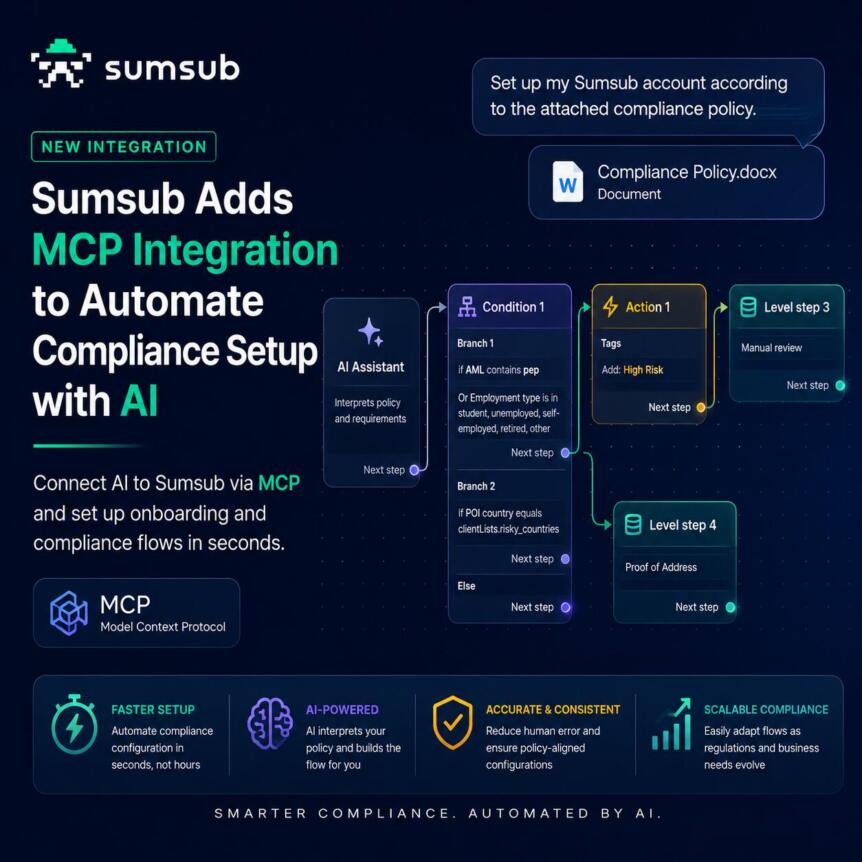
Sumsub, a verification and anti-fraud platform used by companies to support identity checks and compliance workflows, has launched a Model Context Protocol (MCP) integration and new AI agent skills. The announcement centers on a practical shift for regulated onboarding and fraud prevention teams, by allowing AI agents to help translate anti-money laundering (AML) policies and related compliance documents into configuration changes inside Sumsub.
In many compliance stacks, the work does not end at document review. Teams still need to configure verification levels, risk questionnaires, and onboarding or applicant routing workflows for each jurisdiction and product. Sumsub’s stated goal is to move part of that configuration effort from manual interpretation to a more automated “policy-to-setup” process, mediated by AI agents.
What the MCP integration changes
Model Context Protocol is designed to standardize how AI tools connect to external systems. According to Sumsub, its MCP integration is model-agnostic, intended to work with leading AI agents including ChatGPT and Claude. That is notable because compliance use cases often require consistent auditability and controlled access, even when the AI model behind the assistant varies.
From policy documents to live workflow settings
Sumsub says teams can upload AML policies or other compliance requirements and have an AI agent build a corresponding Sumsub environment. The configuration described includes verification levels, risk questionnaires, and onboarding workflows that can reflect jurisdiction-specific risk logic. Sumsub frames the change as reducing configuration timelines from days to minutes, though the company does not provide independent benchmarks in the material shared.
Handling operational tasks through agent skills
The launch also includes agent capabilities intended to support day-to-day compliance work. Sumsub lists use cases such as reviewing applicants, running analytics, generating verification links, and responding to regulatory changes. In practice, this approach positions AI agents not only as assistants for drafting or analysis, but as tools that can execute operational steps inside a compliance platform, subject to permissions.
Why this matters for identity verification and AML operations
Identity verification and AML compliance have become key layers of customer onboarding, especially in digital-first industries such as financial services, crypto platforms, and other regulated online businesses. Even when organizations have policy documents and internal compliance guidance, there is often a gap between text-based requirements and the configuration logic used by verification vendors.
That gap tends to create manual bottlenecks. Solution architects or compliance operations teams may need to interpret policy text, translate requirements into platform settings, and then rebuild or adjust workflows when regulations or internal risk tolerances change. If the “translation” step can be accelerated safely, it could reduce cycle time for onboarding updates and help teams respond faster to evolving compliance requirements.
At the same time, automating compliance configuration introduces governance questions. AML controls are not simply workflow automation, they are risk controls that must be aligned with regulations, internal policy, and operational evidence. Sumsub’s approach, as described in the announcement, emphasizes controlled execution rather than fully autonomous configuration.
Permissioning, sandboxing, and human approval
Sumsub says access to the MCP integration is restricted by separate permissions to allow granular control over what an AI agent can do. The company also states that sensitive actions are performed in isolated sandbox environments, and that configuration changes are reviewed and approved by humans.
This matters because agentic systems can increase throughput but also expand the potential surface area for mistakes. For compliance workflows, oversight and traceability are typically non-negotiable, particularly when configurations affect verification requirements, risk scoring, or customer onboarding outcomes.
Developer availability and integration pathway
Sumsub indicates the MCP integration is supported via an open-source set of agent skills published on GitHub, installable with a single terminal command. Documentation for the MCP server and for building with Sumsub’s AI features is described as publicly available via Sumsub’s developer resources.
Additionally, Sumsub says it is now officially listed on the ChatGPT Apps platform, and that discussions are ongoing with additional large language model providers. The practical implication is that teams building compliance or onboarding workflows may be able to access the integration through AI application ecosystems, rather than implementing everything from scratch.
Industry context: agentic AI meets regulated workflows
The compliance and identity verification market has been experimenting with AI for multiple years, including document analysis, fraud signals, and investigative assistance. However, the latest push in the industry is moving toward “agentic” workflows, where AI systems can take structured actions in software tools, not just generate text or summaries.
Agentic compliance workflows are attractive because they promise to reduce operational friction, particularly for tasks like policy interpretation and workflow setup. But adoption tends to depend on how well vendors manage governance, permissioning, and audit trails, as well as how reliably they can map policy language to operational controls.
Sumsub’s announcement suggests the company is targeting the configuration layer, positioning MCP integration as a way to standardize how AI agents interact with compliance platforms while keeping human review in the loop.
What to watch next
For teams evaluating this type of capability, several practical questions often determine whether it can move from pilots to production: how permissions are scoped across roles, what evidence is stored for configuration approvals, and how quickly organizations can validate that AI-generated setups match their compliance requirements.
Sumsub says the integration is available now, with additional documentation and agent skills provided for developers. The next phase will likely involve how quickly existing compliance operations teams can test policy-to-configuration accuracy and integrate the workflow into their onboarding processes without adding new governance overhead.
https://www.cryptobreaking.com/sumsub-mcp-integration-automate-compliance/?utm_source=blogger%20&utm_medium=social_auto&utm_campaign=Sumsub%20Adds%20MCP%20Integration%20to%20Automate%20Compliance%20Setup%20with%20AI%20
Comments
Post a Comment