
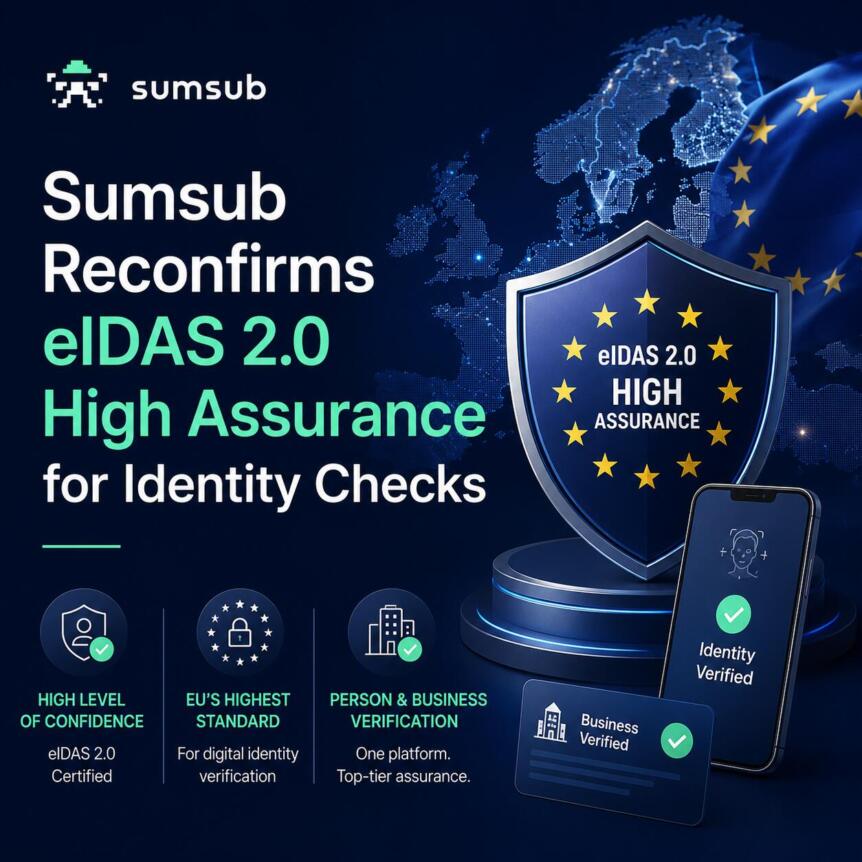
European regulators have raised the bar for digital identity assurance as fraud techniques evolve and identity checks move closer to the moment of onboarding. In that environment, verification providers are increasingly seeking formal certification against the EU’s eIDAS 2.0 framework, which is designed to standardize trust in electronic identification and related processes.
On June 16, verification platform provider Sumsub said it has reconfirmed its certification under eIDAS 2.0 for key identity and business verification modules at the High Level of Confidence. The announcement targets the “highest European confidence level” under eIDAS 2.0, according to the company, for both natural persons (key person verification) and legal entities (business verification).
What Sumsub says is covered under eIDAS 2.0
Sumsub’s certification is reported to have been issued by SRC Zert GmbH & Co. KG. The company states the reconfirmation applies to several modules used for verification workflows, including:
- Auto Identification
- Video Identification
- e-ID Verification
- KYB Verification
The company also says these modules meet relevant eIDAS 2.0 requirements for identifying both natural and legal persons, and in particular reference the ETSI TS 119 461 V2.1.1 (2025-02) standard.
Fully automated eID checks
Beyond standard assisted verification, Sumsub also states it achieved certification for a Fully Automated module. In this approach, the system verifies individuals by reading Electronic Machine-Readable Travel Documents (eMRTDs) without manual agent review, according to the announcement.
Why eIDAS 2.0 certification matters for regulated onboarding
eIDAS 2.0 is intended to extend and update the EU’s framework for trusted electronic identification and trust services. For regulated organizations, the practical challenge is often not simply verifying that a user exists, but demonstrating that verification methods are robust enough to withstand regulatory scrutiny.
Sumsub’s stated objective is to provide what it describes as a reliable pathway to eIDAS and AML-aligned onboarding processes across Europe. The company links its certified verification modules to downstream compliance workflows, including checks associated with anti-money laundering (AML) and fraud prevention.
While companies across the identity verification market compete on speed and user experience, certification and assurance levels are increasingly used as signals for institutions that compliance controls need to be defensible. In sectors such as fintech, trading, gaming, and other services that onboard users subject to regulatory obligations, identity checks are frequently treated as a key risk control rather than a purely operational step.
Implications for compliance stacks in Europe
Sumsub positions the reconfirmation as reinforcement of its broader “platform approach” to compliance. The company says its system combines identity and business verification with additional components such as AML checks, fraud prevention, orchestration, and case management.
For organizations building compliance stacks, the significance is less about any single module and more about how verification capabilities are integrated into onboarding and ongoing monitoring. Institutions generally want consistency, auditability, and predictable outcomes from vendor processes, particularly when regulators assess how firms mitigate identity-related fraud and unlawful activity.
However, it is worth noting that certification announcements do not, by themselves, determine whether a particular customer implementation will meet all regulatory expectations. The operational details, configuration, and how verification results are used in risk decisions typically determine whether controls function as regulators expect. In practice, certified modules can be one building block in a wider compliance framework that also includes policies, monitoring, staff procedures (where relevant), and documented risk assessments.
Market context: rising demand for assurance and automation
Identity verification providers have been under pressure to balance two competing needs: delivering low-friction onboarding and meeting higher assurance requirements. According to Sumsub, fraud tactics and access to increasingly advanced technologies have contributed to regulators pushing standards upward for digital identity verification.
If the industry trend continues, eIDAS-aligned assurance levels are likely to remain important in procurement decisions, especially where firms must demonstrate that identity checks are strong enough to support compliance objectives. For vendors, reconfirmation rather than a one-time certification can also matter, since it suggests that certified processes persist as frameworks and technical standards evolve.
What’s next
Sumsub did not provide additional details in the announcement beyond the scope of certified modules and the stated assurance level. Regulated businesses evaluating verification vendors typically look for documentation, integration guidance, and evidence of how certified processes map to their specific regulatory obligations.
For European operators, the practical question remains how eIDAS 2.0 certified components fit into end-to-end onboarding and compliance workflows, and whether they reduce the friction between regulatory certainty and operational scalability.
https://www.cryptobreaking.com/sumsub-reconfirms-eidas-2-0/?utm_source=blogger%20&utm_medium=social_auto&utm_campaign=Sumsub%20Reconfirms%20eIDAS%202.0%20High%20Assurance%20for%20Identity%20Checks%20
Comments
Post a Comment