
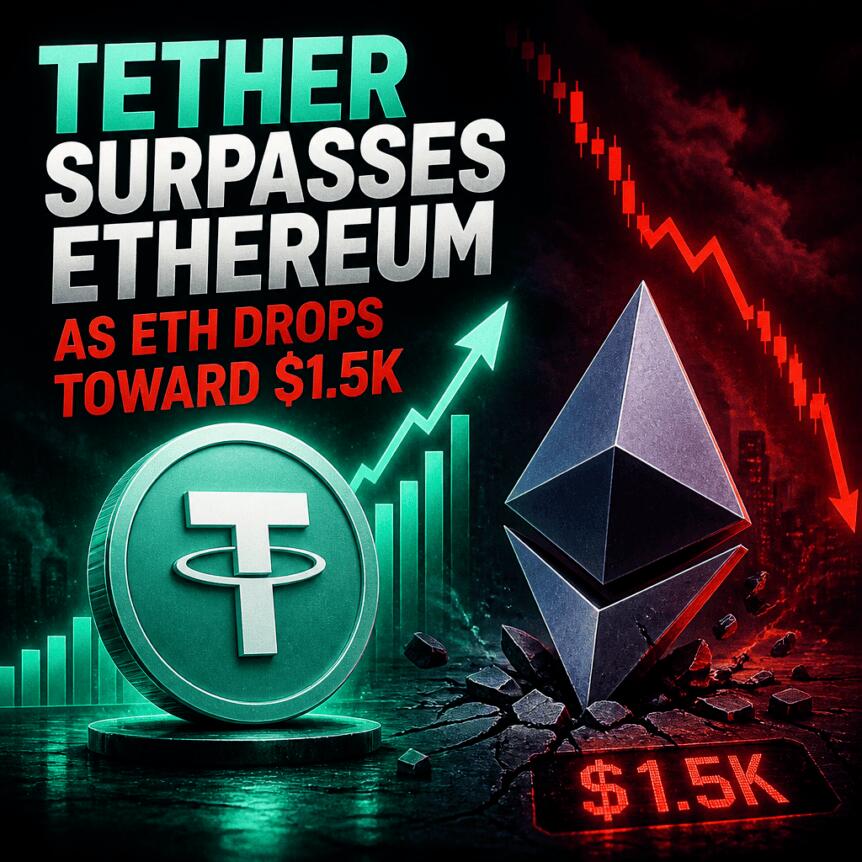
Tether’s USDt has flipped Ether (ETH) into the second spot by market capitalization after a sharp selloff pushed ETH to its lowest level of the year. The rotation underscores a broader theme playing out across crypto: during volatility, traders and institutions increasingly gravitate toward stablecoins for liquidity and risk management.
On Friday, ETH’s market value fell below $185 billion following a 5.2% drop over 24 hours, taking the token down to around $1,510 on Coinbase, according to TradingView. That decline allowed USDt—reported at roughly a $186 billion market cap—to overtake ETH. As Cointelegraph reported, Bitrue Research Institute’s research lead Andri Fauzan Adziima said the stablecoin move “highlights how the market still favors stability over ETH’s volatility right now.”
Key takeaways
- USDt surpassed ETH in market capitalization as Ether slid to about $1,510 on Coinbase after a 5.2% daily drop, per TradingView.
- Analysts interpret the flip as a sign that stablecoins remain preferred during volatility, even when the broader crypto market is shifting.
- Stablecoins represent nearly 15% of total crypto market capitalization, reflecting continued demand for reliable liquidity.
- Ether’s weakness is occurring alongside notable Ethereum Foundation staffing and leadership changes, even as new development initiatives take shape.
Why USDt taking the crown matters
When a stablecoin climbs in market cap during a drawdown, it’s rarely just a one-day anomaly. Stablecoins are often used as the “settlement layer” for trading and transfers—meaning their growth can signal that market participants are prioritizing capital preservation and fast execution over exposure to higher-volatility assets.
Andri Fauzan Adziima of Bitrue Research Institute framed the shift in exactly those terms, suggesting the market’s current preference for stability is outweighing ETH’s relative volatility. That perspective aligns with how market infrastructure typically behaves: deeper stablecoin liquidity can support higher trading activity and lower friction for entering and exiting positions across venues.
Stablecoin momentum and “cycle-independent” demand
The USDt/ETH flip comes amid ongoing stablecoin expansion. Cointelegraph pointed to accelerating stablecoin growth that now accounts for almost 15% of total crypto market capitalization. The article also notes that while stablecoin supply contracted by more than 30% during the last bear market, the latest cycle is different—stablecoin issuance and usage are reaching new highs.
In comments shared on Thursday, 21Shares argued that the current pattern is evidence that stablecoins are becoming one of crypto’s defining use cases and that demand increasingly does not depend on the market cycle. The firm’s statement said: “To us, that is the strongest evidence yet that stablecoins are one of crypto’s defining use cases – demand that no longer depends on the cycle.”
From a practical standpoint, that “cycle-independence” claim matters because it implies stablecoins can remain a structural part of crypto market activity even when risk appetite fades. And as liquidity deepens, more participants can trade with tighter spreads and faster settlement—an environment that can benefit both traders and builders who rely on stablecoin rails for recurring activity.
Ethereum under pressure, with ecosystem shifts underway
Ether’s decline isn’t happening in isolation. The article ties the selloff to a broader stretch of weakness, noting that ETH prices returned to crucial support levels last seen in October 2023 and April 2025. That matters for investors because repeated visits to long-term support can act as a decision point: buyers often step in to defend key ranges, but persistent failures can also accelerate downside.
At the same time, Ethereum’s institutional and organizational landscape has been changing. Cointelegraph cited multiple executive departures as well as a 20% workforce reduction at the Ethereum Foundation. Those internal moves can influence how quickly priorities shift, how quickly research and engineering programs move from roadmap to execution, and—importantly for market participants—how confidence forms around Ethereum’s near-term narrative.
Still, the article highlights a compensating development: a new nonprofit organization called Ethlabs was launched this week by key EF developers and researchers, with backing from ether treasuries Bitmine and Sharplink. The existence of a new entity doesn’t automatically resolve market concerns, but it does signal that ecosystem stakeholders are continuing to organize around Ethereum development rather than stepping away during turbulence.
Not all players are waiting: accumulation and cross-asset rotations
While the USDt flip is a bearish signal for ETH relative performance, the article also points to pockets of support at lower prices. Ether treasury company Sharplink reportedly bought the dip on Thursday, making its first purchase in eight months and acquiring 5,000 ETH. Separately, Bitmine—chaired by Tom Lee—has also been accumulating, adding 76,881 ETH last week, the article notes, referencing its broader bear-market accumulation efforts.
Beyond Ethereum, the stablecoin narrative isn’t unique to USDt. Cointelegraph also reports that Circle’s USDC flipped Ripple’s XRP in market capitalization as XRP retreated toward $1, a level described as its lowest since November 2024. The article gives market caps of $64 billion for XRP versus $73.6 billion for USDC, reinforcing the idea that in periods of weakness for specific assets, stablecoins can keep gaining share.
Circle’s USDC reached a $73.6 billion market capitalization in the comparison cited, while XRP fell back toward $1 and a $64 billion market cap.
For traders, these cross-asset rotations often become a liquidity story as much as a price story: stablecoins can act as a consistent “base” for risk management and positioning, while assets like ETH and XRP can experience sharper drawdowns when sentiment deteriorates.
Looking ahead, the market will likely watch whether ETH can defend its identified support zones and whether stablecoin growth continues to outpace broader crypto assets—especially in the face of ongoing Ethereum ecosystem changes. If USDt’s market cap lead holds during subsequent sessions, it may signal that “stability premium” demand is becoming increasingly persistent rather than reactive.
https://www.cryptobreaking.com/tether-surpasses-ethereum-as-eth/?utm_source=blogger%20&utm_medium=social_auto&utm_campaign=Tether%20Surpasses%20Ethereum%20as%20ETH%20Drops%20Toward%20$1.5K%20
Comments
Post a Comment